
Water parameters
Overview
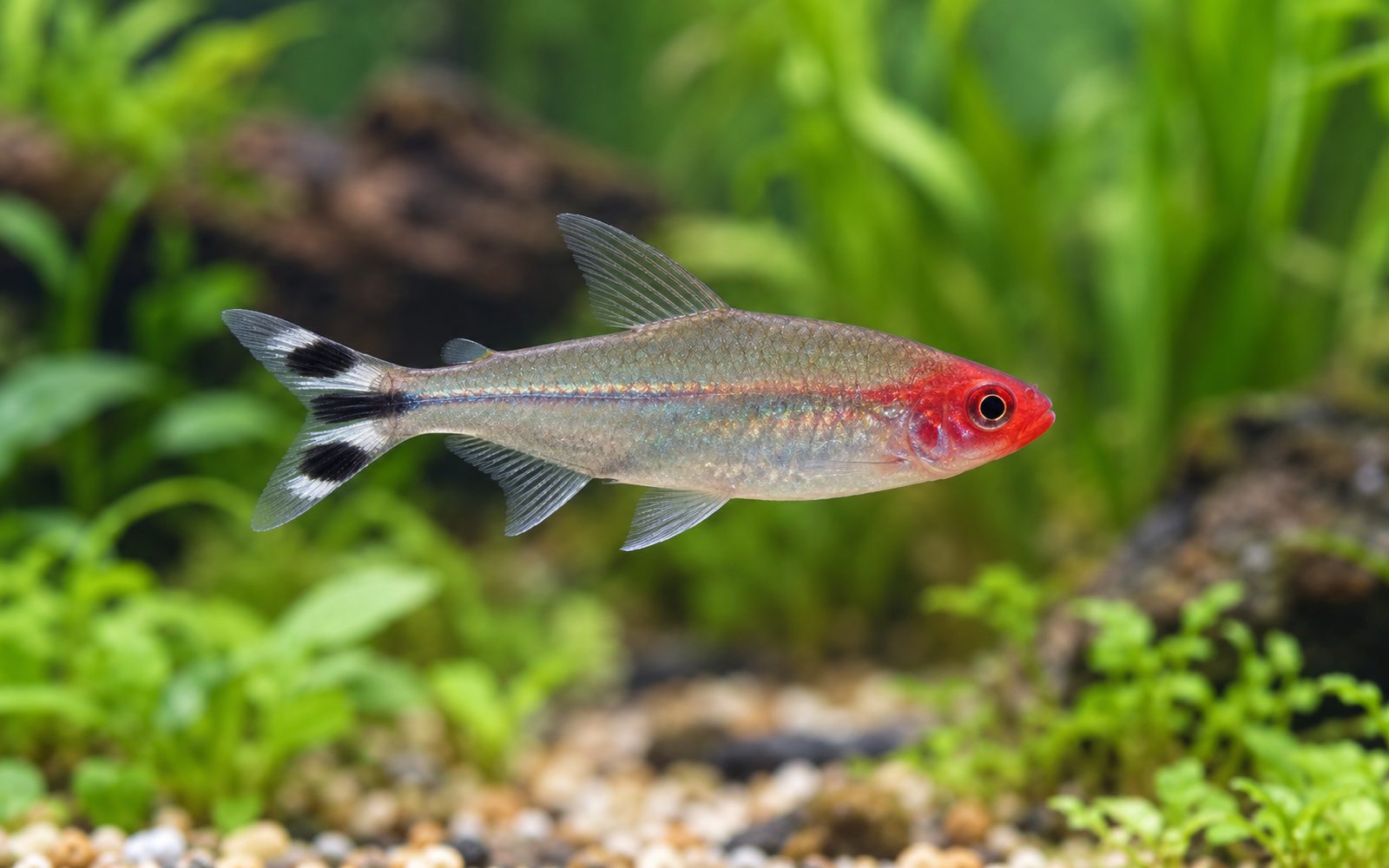
The rummy-nose tetra is instantly recognized by the bright red color on its head, its silvery body and its black-and-white striped tail. There are several closely related species sold under the same name in stores (H. rhodostomus, H. bleheri, Petitella georgiae); their care is the same.
The most interesting feature of this species is that its nose reacts to water quality: when the water is clean and the values are right, the red is bright and broad; when nitrate rises or the fish is stressed, it fades. Many hobbyists see it as the aquarium's "early warning system."
Natural Habitat
It lives in large schools in the soft, acidic and warm tributaries of the Amazon, in slow-flowing waters with dense plants and roots.
Tank Setup
- Volume: at least 80 liters and 80 cm of length for a school of 10–12; it needs a long swimming area.
- Water: 24–27°C, soft and slightly acidic; nitrate should be kept low.
- Setting: dense plants along the edges, open water in the middle; gentle flow encourages the school to swim together.
Diet
Omnivorous. Small granules and flakes, frozen brine shrimp, daphnia and bloodworms. It feeds in the middle water layer and prefers slow-sinking foods.
Behavior and Compatibility
A peaceful species with a very strong schooling bond: the school turns in the same direction and swims at the same speed, which is why it is known as "the best schooler." It is shy and sensitive; active and large fish stress it.
Good companions: discus, angelfish (the risk is low with large specimens but not zero), corydoras, otocinclus, rams, dwarf gouramis.
Avoid: active, nippy species such as tiger barbs, large cichlids, coldwater fish.
Group and Colony Structure
At least 8, ideally 12 or more individuals. The rummy-nose tetra is one of the tetras that shows schooling behavior most clearly; in groups of fewer than 6 it becomes shy and pale. The sex ratio does not matter.
Breeding
It is difficult to breed in the aquarium. It needs very soft, acidic water and a separate breeding tank; the eggs are scattered among fine-leaved plants and the parents eat the eggs. The fry are very small and are fed infusoria.
Health and Common Problems
- Pale nose: not a disease but a warning: check the water values (nitrate, ammonia) and the temperature.
- Losses in a newly set-up tank: it is very sensitive to immature water.
- White spot: with temperature fluctuations.
Sexing
Hard to tell apart from the outside. Mature females look plumper in the belly; males are slightly slimmer.
Tank mates
This list is calculated automatically from the species profile and grows as new species are added to the catalog. Try it in the planner for a definite answer.
Usually compatible
 Flame Tetra
 Blackfin Corydoras
 Polystictus Corydoras
 Emerald Cory
 Porthole Catfish
 Keyhole Cichlid
 Cupid Cichlid
 Geophagus altifrons
 Geophagus surinamensis
 Cryptocoryne Parva
Should not be kept together






Hobbyist notes
Things you won't find in books, learned by trial and error. The most helpful ones are on top.
Change history and contributors
- Page created · October 16, 2026