
Water parameters
Overview
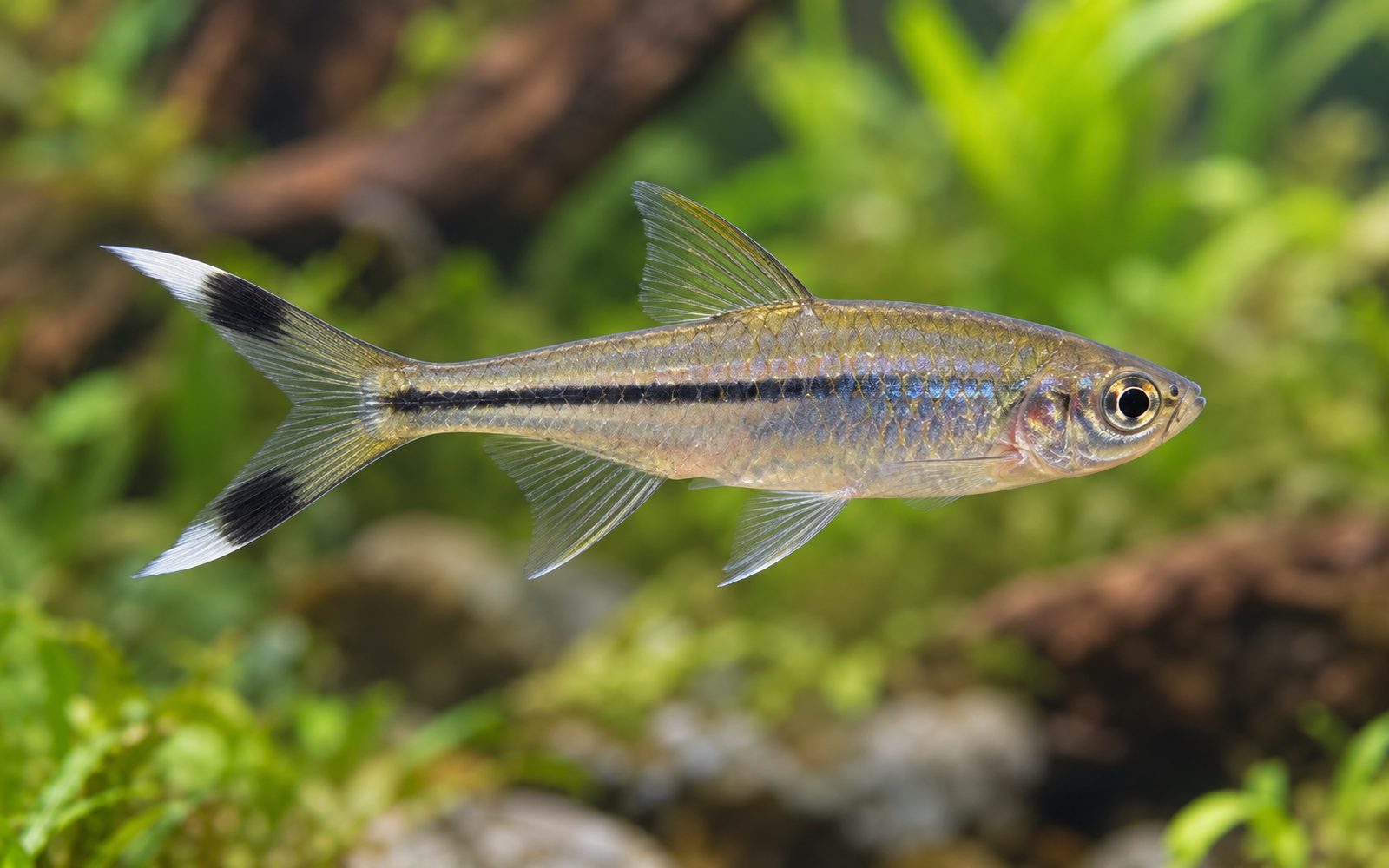
The scissortail rasbora is recognized by the black band and white tips on both lobes of its tail fin. As the fish swims, the lobes open and close rhythmically, resembling the movement of scissors. Its body is silvery and semi-transparent, with a thin dark line running along the rear half.
In the aquarium it usually reaches 7–9 cm, approaching 10 cm under good conditions. It is an active, hardy and peaceful species; in medium-sized community aquariums it is very useful as a school that livens up the open water alongside gouramis and calm cichlids.
Natural Habitat
It is spread over a wide area of Southeast Asia: it lives in the marginal waters of large rivers, in lakes, canals and flooded forest areas. The water is usually soft and slightly acidic, but the species adapts well to changes in water values.
Tank Setup
- Volume: at least 120 liters and 80–100 cm in length for a school of 6–8; long swimming space is essential.
- Water: 23–26°C, pH 6–7.5, soft to moderately hard water.
- Layout: plants at the back and sides, wide open space at the front and in the middle.
- Flow: it enjoys moderate current; it swims in the filter outflow.
- Lid: a good jumper; the aquarium must be covered.
Diet
Omnivorous and a very eager eater. Use quality flakes and granules as the staple; vary the diet with frozen or live brine shrimp, daphnia, mosquito larvae and bloodworms. In the wild it also eats insects that fall onto the water surface.
Behavior and Compatibility
Peaceful and social, but fast. As a school it is constantly on the move in the middle and upper layers of the aquarium. It can outcompete very small, slow and shy species at feeding time, so it is more compatible with tankmates of similar size.
Good companions: other medium-sized rasboras and danios, gourami species, corydoras, loaches, calm barbs, angelfish, rainbowfish.
Avoid: predators large enough to swallow it, very small and shy nano species.
Group and Colony Structure
At least 6, ideally 10 or more individuals. A large school behaves more calmly and confidently; kept in small numbers the fish become skittish and may crash into things in the aquarium during sudden escapes. The male-to-female ratio is not important.
Breeding
It scatters its eggs over fine-leaved plants or moss; there is no parental care and the eggs are eaten quickly. For breeding, a grid or dense moss is placed in a separate aquarium and a few well-fed individuals are added. The adults are removed after spawning. The fry become free-swimming within a few days and are fed infusoria, then newly hatched brine shrimp.
Health and Common Problems
Hardy. It becomes stressed in a cramped, short aquarium; collision injuries and fin damage are linked to this stress. Poor water quality paves the way for white spot and columnaris. Do 25–30% water changes weekly.
Sexing
Females are larger and noticeably fuller in the belly. Males are slimmer and may show a faint yellowish tint on the body during the breeding season.
Tank mates
This list is calculated automatically from the species profile and grows as new species are added to the catalog. Try it in the planner for a definite answer.
Usually compatible
 Flame Tetra
Glass Tetra
Flame Tetra
Glass Tetra
 Blackfin Corydoras
 Polystictus Corydoras
 Emerald Betta
 Emerald Cory
 Emerald Dwarf Rasbora
 Porthole Catfish
 Keyhole Cichlid
 Cupid Cichlid
Should not be kept together






Hobbyist notes
Things you won't find in books, learned by trial and error. The most helpful ones are on top.
Change history and contributors
- Page created · October 16, 2026