
Water parameters
Overview
The Siamese algae eater is one of the most popular fish for algae control in planted tanks. It is one of the few fish that can eat black beard algae and other red algae; young fish in particular are very effective at this. In the hobby it is also known by its old name, Crossocheilus siamensis.
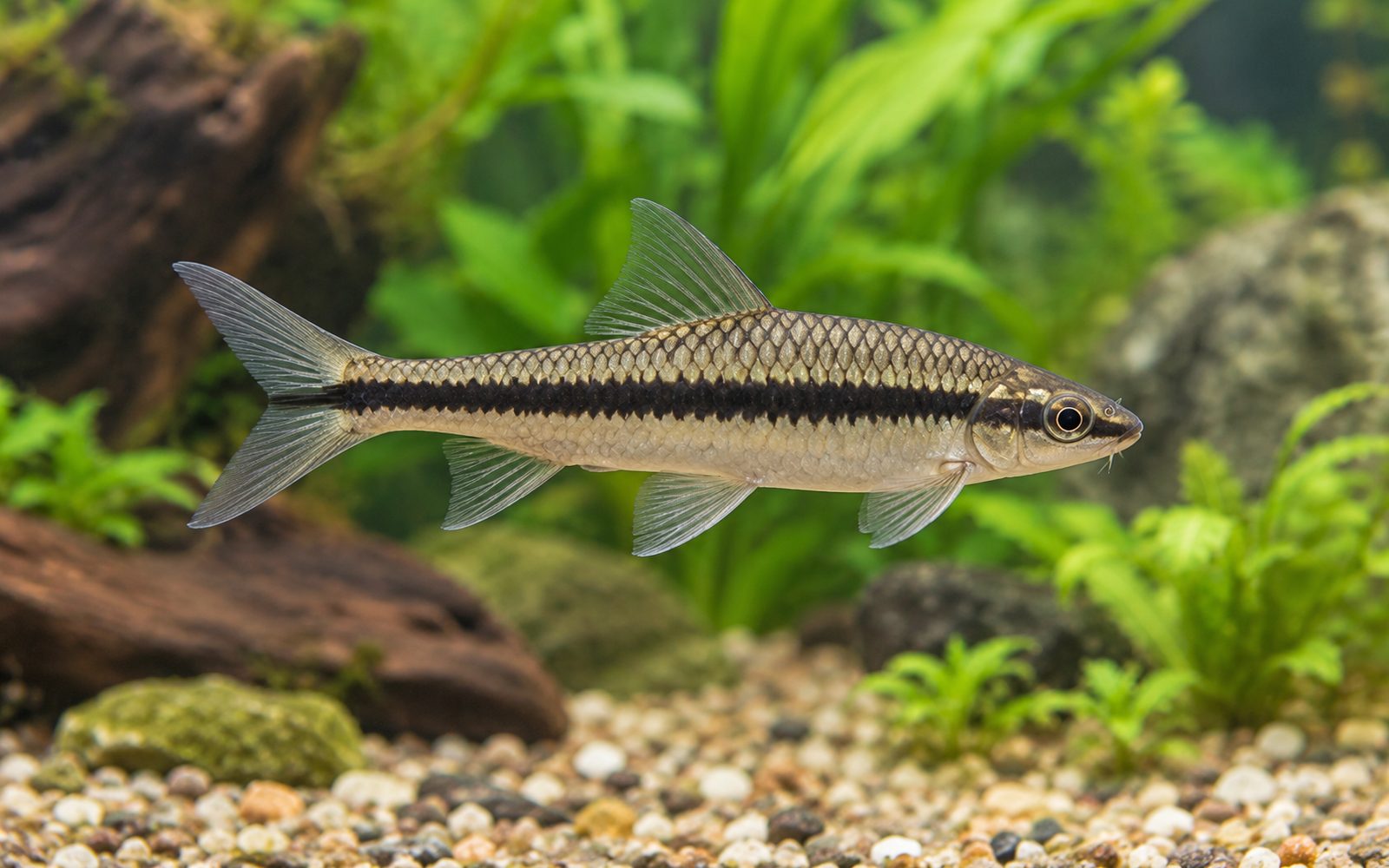
Other similar-looking species (the flying fox and some Garra and Crossocheilus species) may be sold under the same name in the trade. In the true Siamese algae eater, the black band extends into the middle of the tail fin, its upper edge is jagged, and the fins are clear.
Natural Habitat
It lives in fast-flowing rivers and streams of Southeast Asia over rocky and gravelly bottoms. It is known to move into flooded forest areas during the rainy season.
Tank Setup
- Volume: at least 200 liters and 120 cm in length for a group of 3–5. It is very active and reaches 14–15 cm.
- Water: 24–26°C; clean, oxygenated water and gentle to moderate flow.
- Decor: a planted layout with roots and rocks; flat surfaces and broad leaves serve as resting spots.
- Lid: it jumps; a tight lid and closed-off gaps around hoses are needed.
Diet
Omnivorous. It grazes algae and biofilm but cannot live on these alone; provide sinking tablets, granules, spirulina, blanched vegetables and frozen foods. Adults fed plenty of prepared food show less interest in algae; if algae control is the goal, keep feeding moderate.
Behavior and Compatibility
Peaceful and active; it roams the whole tank but spends most of its time on the bottom and grazing surfaces. It has harmless chases with its own kind. It usually leaves adult dwarf shrimp alone; it may eat newly hatched shrimplets.
Good companions: tetras, rasboras, barbs, gouramis, corydoras, otocinclus, Amano shrimp; most planted community tanks.
Avoid: territorial relatives such as the red-tailed black shark and rainbow shark (it gets chased constantly), large and aggressive cichlids.
Group and Colony Structure
It can be kept alone, but in a group of 3–5 it behaves more naturally and plays with its own kind. Two individuals sometimes pick on each other; 3 or more spreads this tension.
Breeding
Breeding in home aquariums is unknown. Commercial production is done on farms with the help of hormones.
Health and Common Problems
Hardy. It struggles in newly set-up tanks that have not finished cycling; such a tank also does not offer it enough algae and biofilm to graze. White spot may occur; quarantine new arrivals for 2–3 weeks.
Sexing
Hard to tell apart externally. Seen from above, mature females have a fuller belly; males look slimmer and longer. Since it does not breed in the aquarium, sexing is not important for its care; randomly chosen fish are fine when forming a group.
Tank mates
This list is calculated automatically from the species profile and grows as new species are added to the catalog. Try it in the planner for a definite answer.
Usually compatible
 Flame Tetra
Glass Tetra
Flame Tetra
Glass Tetra
 Blackfin Corydoras
 Polystictus Corydoras
 Emerald Betta
 Emerald Cory
 Emerald Dwarf Rasbora
 Porthole Catfish
 Keyhole Cichlid
 Cupid Cichlid
Should not be kept together






Hobbyist notes
Things you won't find in books, learned by trial and error. The most helpful ones are on top.
Change history and contributors
- Page created · October 16, 2026