
Water parameters
Overview
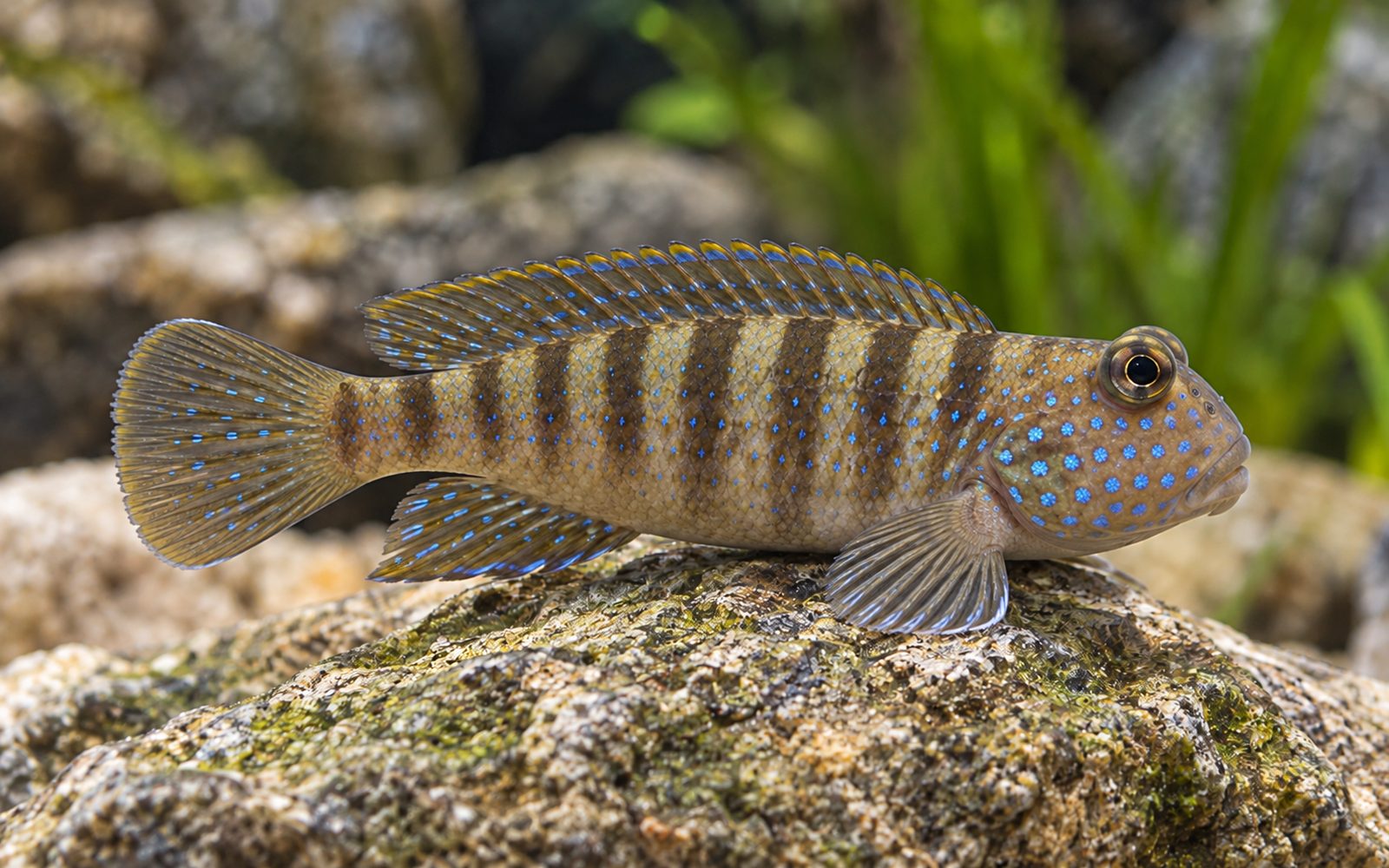
Eretmodus cyanostictus is known in the hobby as the "goby cichlid" because it resembles a goby in both appearance and movement. With its rounded head, large eyes set high and downturned mouth, it lives pressed against the rock surface; instead of swimming, it moves over the rock in short hops. Its olive-beige body is decorated with dark vertical bands and small blue spots concentrated especially on the head (cyanostictus: blue-spotted). It reaches around 8 cm.
It has an interesting way of breeding: the pair is monogamous and the eggs are carried first in the female's mouth, then in the male's. When the right environment is provided, it is a fish with character and a long lifespan.
Natural Habitat
It lives on the shallow shoreline rocks of the lake, 0–2 m deep, where waves constantly break. Here the water is always moving and very rich in oxygen. Because its swim bladder is reduced, it can stay on the rock surface without being swept away by the current; it feeds by scraping the algae layer off the rocks.
Tank Setup
- Volume: 100 liters and 80–100 cm length for a pair; a much larger footprint for more than one pair.
- Flow and oxygen: a strong filter outlet plus extra aeration or a circulation pump are essential.
- Decor: flat stones, pebbles and rock groups; the substrate is fine sand or small gravel.
- Water: pH 8–9, hard and stable; a 30% water change every week. Sensitive to nitrate buildup.
- Lighting: strong light encourages algae growth on the rocks.
Diet
Herbivorous; in the wild it feeds on algae on the rock surface and the small organisms living in it. Spirulina-based sinking granules or tablets should be the staple; frozen cyclops and brine shrimp can be given occasionally. High-protein foods lead to bloat.
Behavior and Compatibility
Quite territorial toward its own species and similarly shaped bottom dwellers; generally indifferent to other species. The pair defends its own rock group together.
Good companions: Cyprichromis, Paracyprichromis, Julidochromis species, Tropheus (in a large aquarium).
Avoid: other goby cichlids (in a small aquarium), aggressive Neolamprologus species that want the same bottom area, large carnivorous cichlids.
Group and Colony Structure
- Kept as a pair; the pair bond is strong and long-lasting.
- The safest way to form a pair is to grow up 5–6 juveniles together; the pair that forms stays.
- More than one pair can be kept only in an aquarium with a large footprint, giving each its own rock group.
- A single individual or individuals of the same sex constantly attack each other.
Breeding
The pair spawns on a stone; the female immediately takes the eggs into her mouth. After about 10 days the fry are transferred to the male's mouth and the male completes the incubation; the total time is around 3 weeks. The fry are released small but well developed; they are fed finely crushed spirulina food and newly hatched brine shrimp.
Health and Common Problems
- Lack of oxygen: shows as rapid breathing and inactivity; flow and aeration should be increased.
- Bloat: seen with protein-rich food and overfeeding.
- Nitrate buildup: leads to faded colors and loss of appetite.
Sexing
Very difficult from the outside. Males are sometimes slightly larger with a more pointed head. The most reliable way is to wait for a pair to form naturally from a group raised together.
Tank mates
This list is calculated automatically from the species profile and grows as new species are added to the catalog. Try it in the planner for a definite answer.
Usually compatible
 Yellow Regal Peacock
 Egyptian Mouthbrooder
 Yellow Tail Acei
Amazon Molly
Yellow Tail Acei
Amazon Molly
 Butterfly Goodeid
Anatolian Killifish
Eastern Happy
Red Shoulder Peacock
Butterfly Goodeid
Anatolian Killifish
Eastern Happy
Red Shoulder Peacock
 Fairy Cichlid
Blue Orchid Peacock
Fairy Cichlid
Blue Orchid Peacock
Should not be kept together



Hobbyist notes
Things you won't find in books, learned by trial and error. The most helpful ones are on top.
Change history and contributors
- Page created · October 16, 2026