
Water parameters
Overview
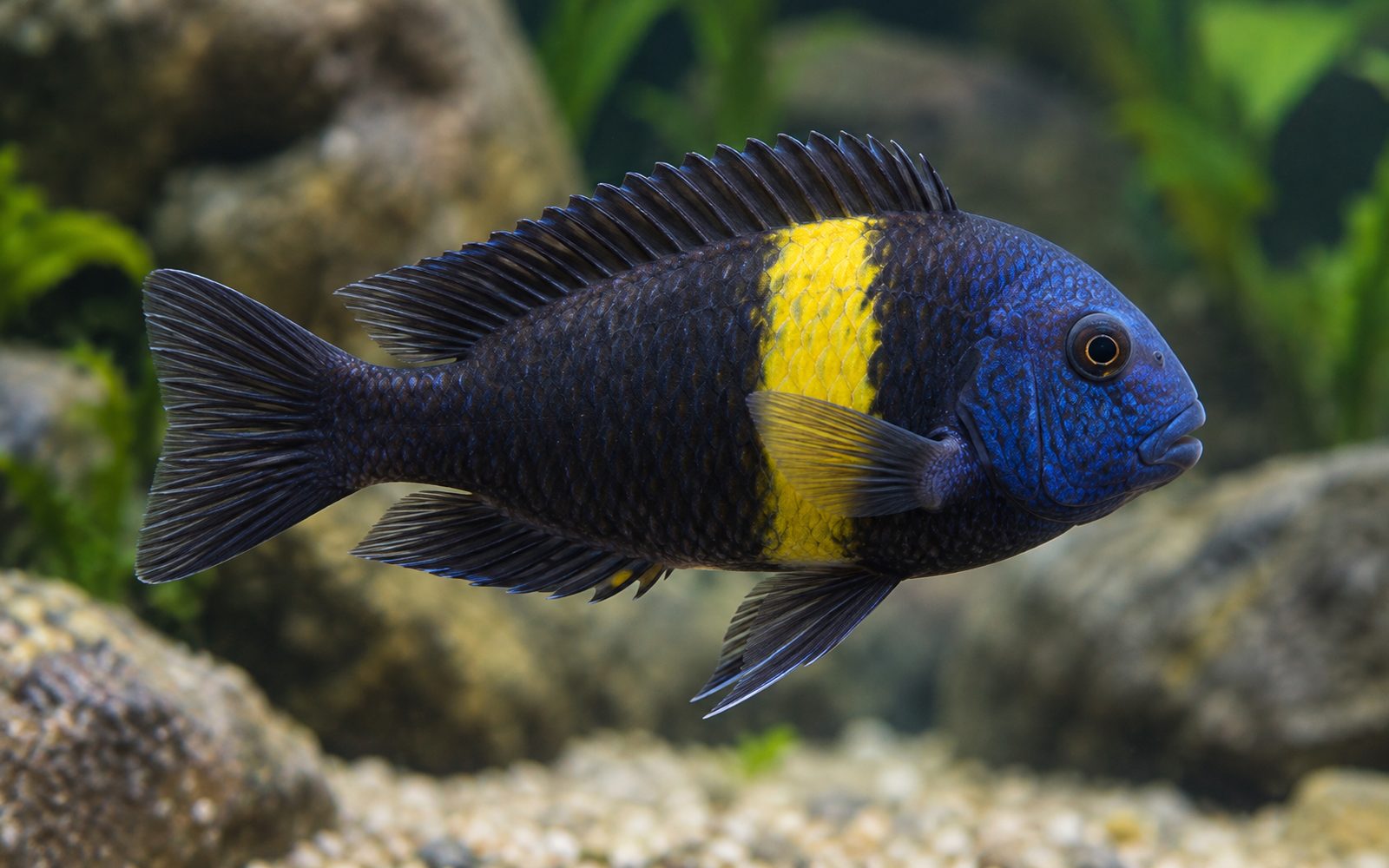
Tropheus duboisi is the most easily recognized member of the genus. Juveniles are covered with white and bluish spots on a coal-black background; this pattern disappears as the fish grows. In adults the head turns blue tones, and a single, distinct vertical band ranging from white to yellow forms in the middle of the black body. The width and color of the band vary with the local form.
It is slightly less aggressive than other Tropheus and can be managed in groups of 8–12; for this reason it is often recommended to those who want to start with Tropheus. The feeding rules, however, are just as strict.
Color and Fin Varieties
- Maswa: the best-known local form, with a broad, bright yellow band. In other forms the band is usually narrower and lighter.
Natural Habitat
In the north of the lake it lives deeper than other Tropheus species, mostly in rocky areas between 3 and 15 m. It feeds by scraping the algae layer on the rock surface and the small organisms within it. The water is hard, alkaline and rich in oxygen; the temperature is stable all year round.
Tank Setup
- Volume: at least 250 liters and a length of 120–150 cm for a group of 8–12.
- Rockwork: plenty of rock piles and dividers that break lines of sight; an open swimming area at the front.
- Water: pH 8–9, hard and stable; a 30% water change every week, low nitrate.
- Oxygen: a strong filter and surface agitation.
- Lighting: moderate light encourages algae growth on the rocks.
Diet
Herbivorous. A low-protein flake or granule based on spirulina and vegetables should be the staple; give small amounts 2–3 times a day. Do not feed bloodworms, tubifex or mammalian meat. A fasting day once a week is beneficial. Very small amounts of frozen mysis or brine shrimp can be given occasionally.
Behavior and Compatibility
There is a hierarchy and frequent jostling within the group, but it is milder than the moorii forms. Juveniles are quite tolerant of each other; with maturity, the males begin to set up territories.
Good companions: Cyprichromis, Paracyprichromis, Synodontis catfish; large Julidochromis species in a large aquarium.
Avoid: other Tropheus species and forms (they hybridize), Petrochromis, Malawi mbuna, carnivorous species, shrimp and soft-leaved plants.
Group and Colony Structure
- At least 8–10, ideally 12 individuals are kept together.
- The easiest start is to grow up 10–12 juveniles together; as the spots fade and the band appears, the males come to the fore.
- In an adult group, aim for 1 male : 3–4 females; extra males are removed.
- A single individual is not added to an established group; if needed, several individuals are added together and the rockwork is rearranged.
Breeding
The female is a mouthbrooder. A small number of large eggs are laid; incubation lasts about 4 weeks and the female does not eat during this period. The fry leave the mouth white-spotted and fully developed, and can grow up in the main aquarium by hiding among the rocks. They are fed crushed spirulina food and newly hatched brine shrimp.
Health and Common Problems
- Bloat: loss of appetite, white stringy feces and a swollen belly. It is triggered by protein-rich food, overfeeding and stress; early treatment is essential.
- Low oxygen and high nitrate: shows as rapid breathing and faded colors.
- Stress in newly arrived fish: refusing food in the first days is normal; they should not be force-fed.
Sexing
Difficult from the outside. Males are usually slightly larger with a broader head and are the dominant individuals in the group. A definite distinction is made with the genital papilla; a brooding female can be spotted by her swollen throat.
Tank mates
This list is calculated automatically from the species profile and grows as new species are added to the catalog. Try it in the planner for a definite answer.
Usually compatible
 Demasoni Cichlid
 Pundamilia nyererei
 Pundamilia pundamilia
 Zebra Obliquidens
Burton's Mouthbrooder
Zebra Obliquidens
Burton's Mouthbrooder
 Auratus Cichlid
 Bumblebee Cichlid
 Horned Nerite Snail
Ice Blue Zebra
Horned Nerite Snail
Ice Blue Zebra
 Afra Cichlid
Should not be kept together








Hobbyist notes
Things you won't find in books, learned by trial and error. The most helpful ones are on top.
Change history and contributors
- Page created · October 16, 2026