
Water parameters
Overview
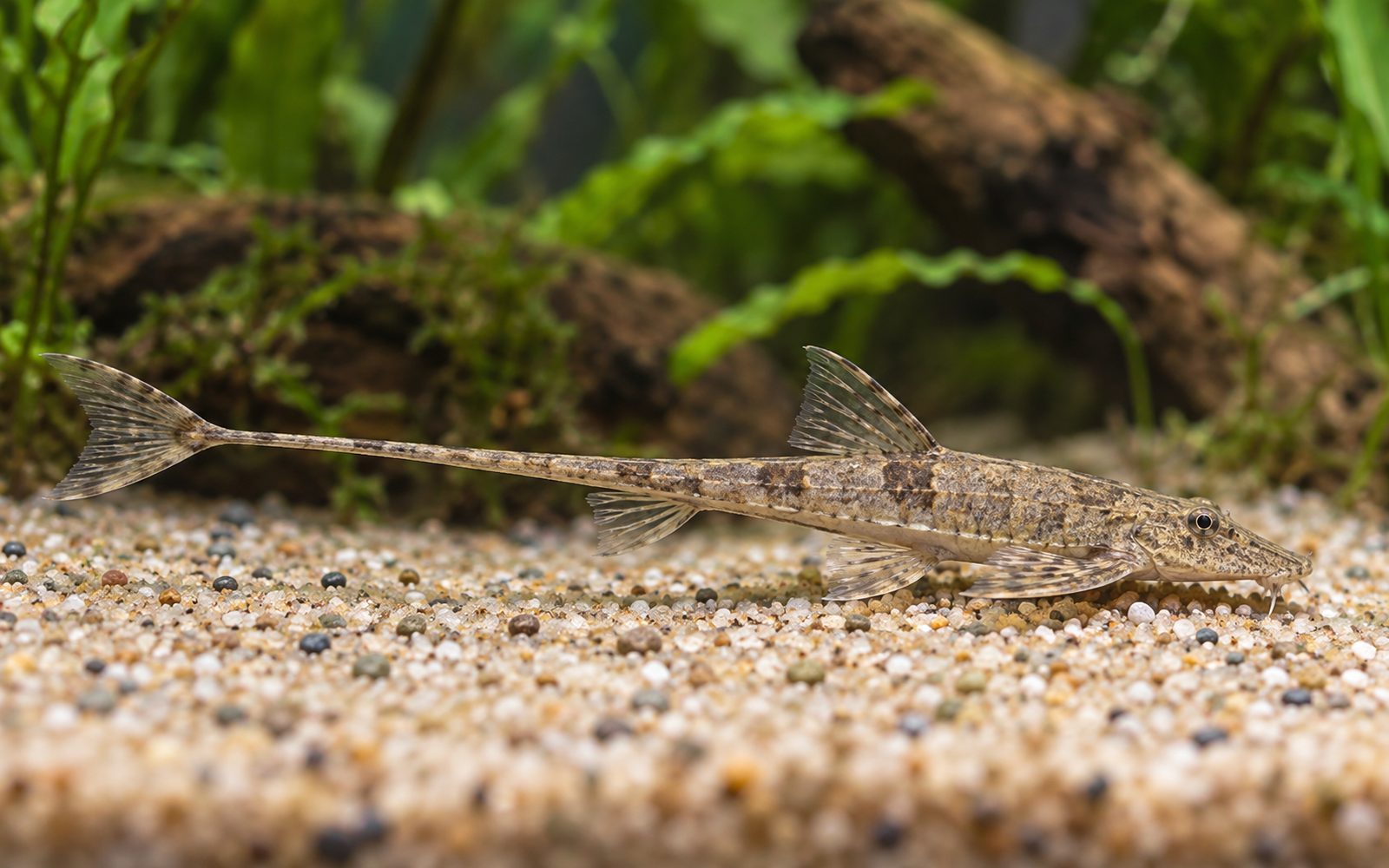
The whiptail catfish is a small suckermouth catfish that resembles a lizard, with a flat, slender body, a long caudal peduncle and a color that almost disappears against sand. It is one of the members of the genus Rineloricaria most often found in aquariums; in older sources it also appears in the genus Hemiloricaria.
It is easy to care for and breeds readily in the aquarium. The only important point to watch is temperature: this species comes from cooler, subtropical waters and becomes ill if kept above 26°C for long periods. It should not be kept with warm-water fish such as discus.
Natural Habitat
It lives in slow- to moderately flowing rivers and streams with sandy or fine gravel bottoms in the Paraguay River basin. It camouflages itself among leaf and twig debris on the bottom.
Tank Setup
- Volume: 60 liters and 60 cm in length for a small group.
- Substrate: Soft sand or fine gravel; an open bottom area.
- Hiding: Roots, leaf litter and tubes 2–3 cm in diameter for breeding.
- Water: 21–24°C is ideal; clean, oxygenated water; gentle flow.
Diet
Omnivorous. Sinking wafers and granules, frozen bloodworms, brine shrimp and daphnia, and blanched vegetables can be given. Since it feeds on the bottom, make sure the food reaches the bottom; it may fall behind fast corydoras schools in the competition for food.
Behavior and Compatibility
Calm and peaceful. It can stay motionless in the same spot for hours. It leaves other fish and shrimp alone and does not damage plants. It is often seen during the day as well, which makes it easier to observe than nocturnal plecos.
Good companions: Calm fish that like cool to warm water: small tetras, rasboras, danios, corydoras (aeneus, paleatus), otocinclus, shrimp.
Avoid: Discus and species that need warm water, cichlids that claim the bottom, fin-nippers.
Group and Colony Structure
It can be kept singly, but a group of a few individuals is more natural. Males push each other over tubes during the breeding season but do no harm. For breeding, 1 male and 1–2 females are enough.
Breeding
It breeds easily in the aquarium. The male claims a tube or a narrow cave; the female sticks her eggs there and the male guards them, fanning them for about a week to ten days. The fry are raised on fine powdered food, microworms and crushed wafers.
Health and Common Problems
Hardy. High temperatures, low oxygen and sharp gravel cause problems. It is sensitive to copper. A sunken belly line in newly arrived individuals is a sign of starvation; give food just before the lights go off, in a form that sinks to the bottom.
Sexing
Mature males develop short, brush-like odontodes on the sides of the head and on the pectoral fin rays; their heads are also slightly wider. Females are plumper when viewed from above.
Tank mates
This list is calculated automatically from the species profile and grows as new species are added to the catalog. Try it in the planner for a definite answer.
Usually compatible
 Flame Tetra
Glass Tetra
Flame Tetra
Glass Tetra
 Blackfin Corydoras
 Polystictus Corydoras
 Emerald Cory
 Emerald Dwarf Rasbora
 Porthole Catfish
 Keyhole Cichlid
 Cryptocoryne Parva
 Egyptian Mouthbrooder
Should not be kept together






Hobbyist notes
Things you won't find in books, learned by trial and error. The most helpful ones are on top.
Change history and contributors
- Page created · October 16, 2026