
Water parameters
Overview
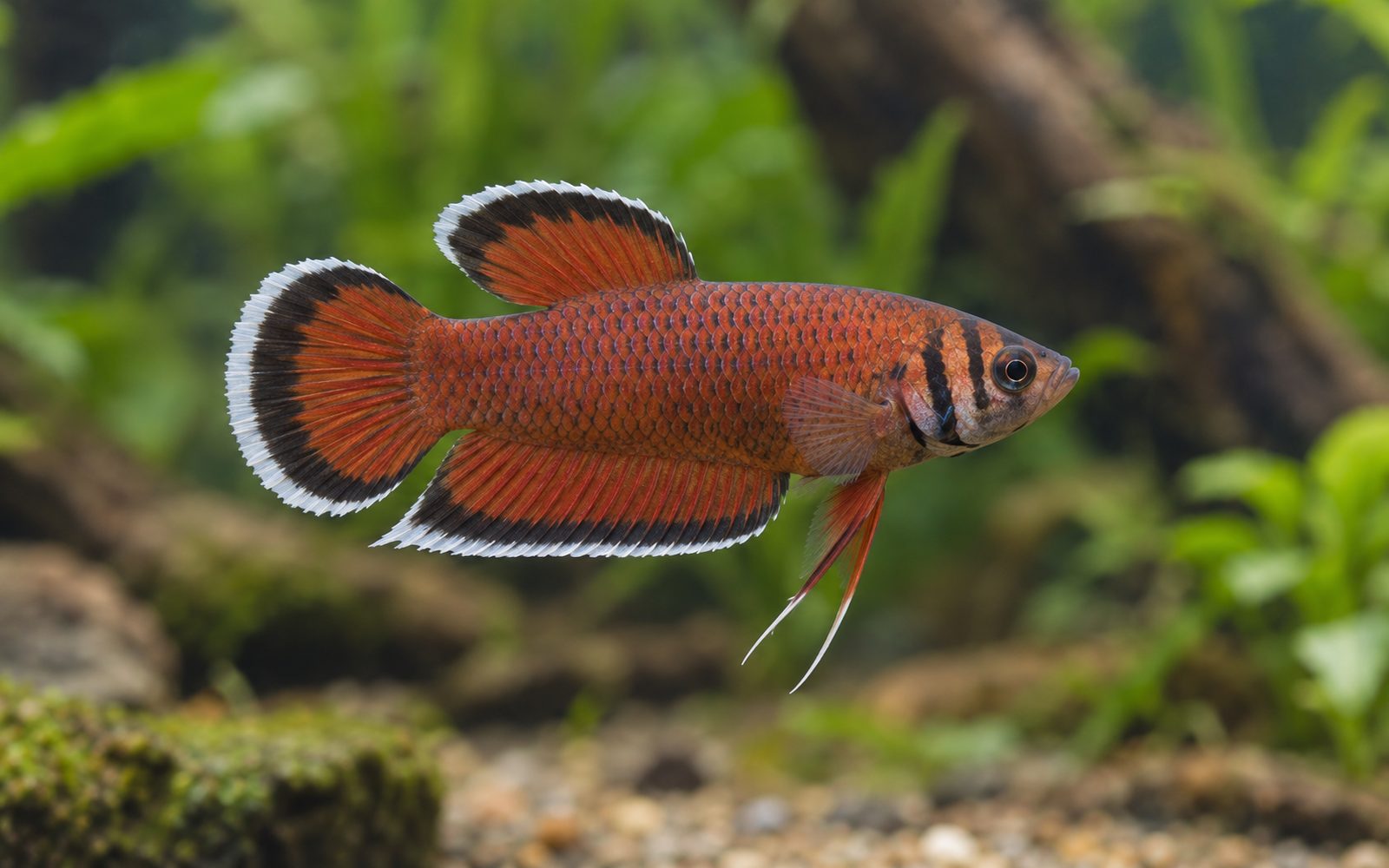
The whiteseam fighter is a small, stocky wild betta that reaches only 4 cm. The males' orange-red body and fins are framed by a black band around the edges of the dorsal, anal and tail fins and a bright white line outside it; its Latin name also means "white-edged".
Unlike the Siamese fighting fish, it does not build a bubble nest: the male carries the fertilized eggs in his mouth. With its calm nature, small size and hardiness, it is a suitable species for getting started with mouthbrooding bettas. It is often confused in the trade with its very similar relative Betta channoides.
Natural Habitat
It lives in small forest streams and shallow pools in Kalimantan, in northeastern Borneo. These waters are shaded, cool, full of leaf litter, soft and slightly acidic. The current drops to very little in the still pockets along the edges.
Tank Setup
- Volume: at least 30 liters for a pair; 45 liters is more comfortable.
- Water: 23–25°C is ideal; this species prefers cool water to warm. pH 5.5–7, soft water.
- Setting: Dried leaves, roots, small caves and dense plants; dim light.
- Flow: Weak; a sponge filter is enough.
- Lid: It can escape through small gaps; a tight lid is essential.
Diet
Carnivorous. Live or frozen brine shrimp, daphnia, cyclops, microworms and chopped bloodworms should be the staple; some individuals accept small granules. Feed small amounts 1–2 times a day. The male does not eat while brooding.
Behavior and Compatibility
Calm and peaceful; pairs are bonded to each other and move around together. Males display to each other but usually do not fight seriously. It may eat shrimp fry.
Good companions: pencilfish, Boraras species, harlequin rasboras, kuhli loaches, otocinclus, dwarf corydoras; or only its own species.
Avoid: fast and greedy fish, large gouramis, fin nippers, cichlids, species that need very warm water.
Group and Colony Structure
The most suitable setup is a pair. The pair forms a strong bond. In densely planted aquariums of 60 liters or more, several pairs can be kept together; males display, but peace is maintained if there is enough space.
Breeding
The female also plays an active role in courtship. Spawning takes place on the bottom with embraces; as in most mouthbrooding bettas, the eggs end up being gathered in the male's mouth. The male carries the eggs in his mouth for about 10–14 days and does not eat during this time. The released fry are relatively large and can eat brine shrimp nauplii right away. Disturbing the male during brooding may cause him to swallow the eggs.
Health and Common Problems
A hardy species. Bacterial infections and velvet can appear in warm, hard or dirty water. It should not be kept above 27°C for long periods. Make water changes small and regular.
Sexing
Males have an orange-red body and fins framed in black and white; there are dark lines on their heads. Females are brownish, with two dark horizontal stripes on the body and mostly colorless fins; traces of the frame are only faintly visible.
Tank mates
This list is calculated automatically from the species profile and grows as new species are added to the catalog. Try it in the planner for a definite answer.
Usually compatible
 Flame Tetra
 Blackfin Corydoras
 Polystictus Corydoras
 Emerald Cory
 Porthole Catfish
 Keyhole Cichlid
 Geophagus surinamensis
 Cryptocoryne Parva
 Gold Spot Pleco (L001)
 Adolfo's Cory
Should not be kept together







Hobbyist notes
Things you won't find in books, learned by trial and error. The most helpful ones are on top.
Change history and contributors
- Page created · October 16, 2026