
Water parameters
Overview
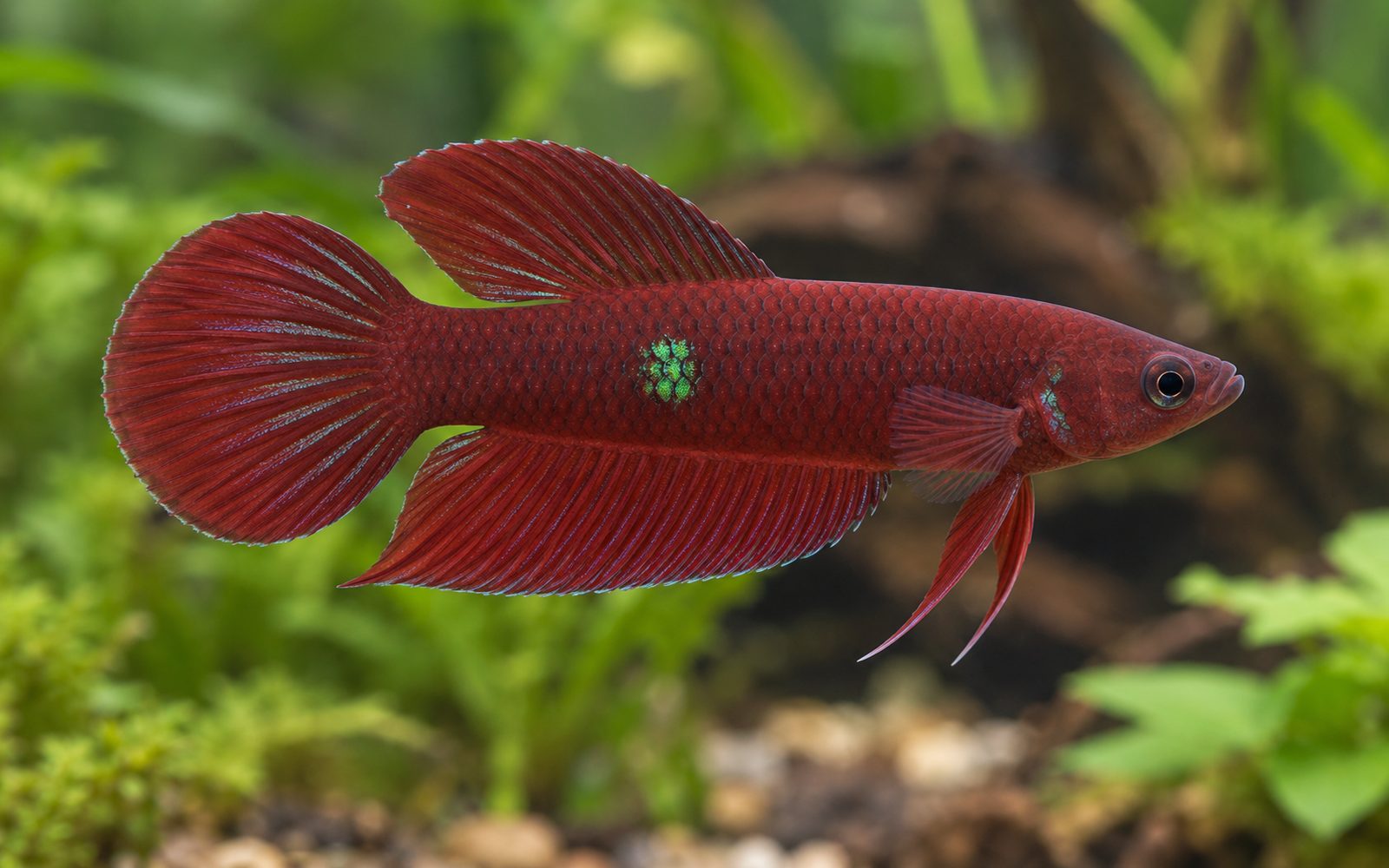
The wine red betta is a small, slender species that looks very different from the Siamese fighting fish. In the middle of its dark wine-red body is an emerald green spot that shines as it catches the light. It grows to about 5 cm, and its fins are short and rounded.
The "coccina group" named after it includes several similar-looking small red betta species; these are often confused with one another in the trade. All of them depend on the very soft, acidic water of peat swamps. As these swamps are converted to farmland, its habitat is shrinking rapidly, so it is important to choose captive-bred fish of known origin.
Natural Habitat
It lives in the shallow, shaded waters of peat swamp forests in Johor (Malaysia) and Jambi (Sumatra). The water is stained a dark tea color by tannins, the pH is often below 5 and the hardness is close to zero. The bottom is covered with a thick layer of leaf litter.
Tank Setup
- Volume: at least 30 liters for a pair; prefer a large footprint.
- Water: 25–27°C, pH 4.5–6.5, GH 1–5. Use reverse osmosis water or rainwater.
- Setup: a thick layer of leaves, roots, floating plants and dim light. Add small tubes and caves where the pair can hide.
- Flow: almost none; a sponge filter is enough.
- Lid: it can escape through even small gaps; a tight lid and warm air above the surface are needed.
Diet
Carnivorous with a small mouth. Live or frozen brine shrimp nauplii, cyclops, daphnia, microworms and finely chopped bloodworms should be the staple. Some fish accept micro granules. Feed small amounts 1–2 times a day; remove leftover food, because soft, acidic water spoils quickly.
Behavior and Compatibility
Calm and timid; it spends most of its day among plants and leaves. Males display to each other; two males should not be kept in a small aquarium. The choice of tankmates is limited by the water parameters.
Good companions: Boraras species, pencilfish, sparkling gourami, very small and calm peat-water species; or only its own species.
Avoid: fast, greedy schooling fish, large gouramis, fin nippers, species that need hard water, other bettas from the coccina group (they can hybridize).
Group and Colony Structure
It is best kept as a pair in a species tank. In a large aquarium with dense leaf cover, a small group of a few pairs can also be tried; each pair chooses its own corner. Keep the number of males in the group limited.
Breeding
The male usually builds his bubble nest inside a tube or cave or under a leaf; the nest is small. A small number of eggs are released during the embraces; the male carries them to the nest and guards them. He is usually tolerant of the female, but she needs to be able to retreat to a separate area. The fry are very small; they start on infusoria and paramecium, then eat brine shrimp nauplii. The key to successful breeding is very soft, acidic, clean water.
Health and Common Problems
In hard, neutral or dirty water its immunity drops quickly; bacterial infections and velvet are the most common problems. Make water changes small and with matching values, and avoid sudden rises in pH. Observe new fish in a separate tank for 2–3 weeks.
Sexing
Males are a darker, brighter red, with distinct green spots and slightly longer fins. Females are brownish red, often show two dark horizontal stripes on the body, and have weak or no green spots.
Tank mates
This list is calculated automatically from the species profile and grows as new species are added to the catalog. Try it in the planner for a definite answer.
Usually compatible
 Flame Tetra
 Blackfin Corydoras
 Polystictus Corydoras
 Emerald Cory
 Porthole Catfish
 Keyhole Cichlid
 Cupid Cichlid
 Geophagus altifrons
 Geophagus surinamensis
 Cryptocoryne Parva
Should not be kept together






Hobbyist notes
Things you won't find in books, learned by trial and error. The most helpful ones are on top.
Change history and contributors
- Page created · October 16, 2026