
Water parameters
Overview
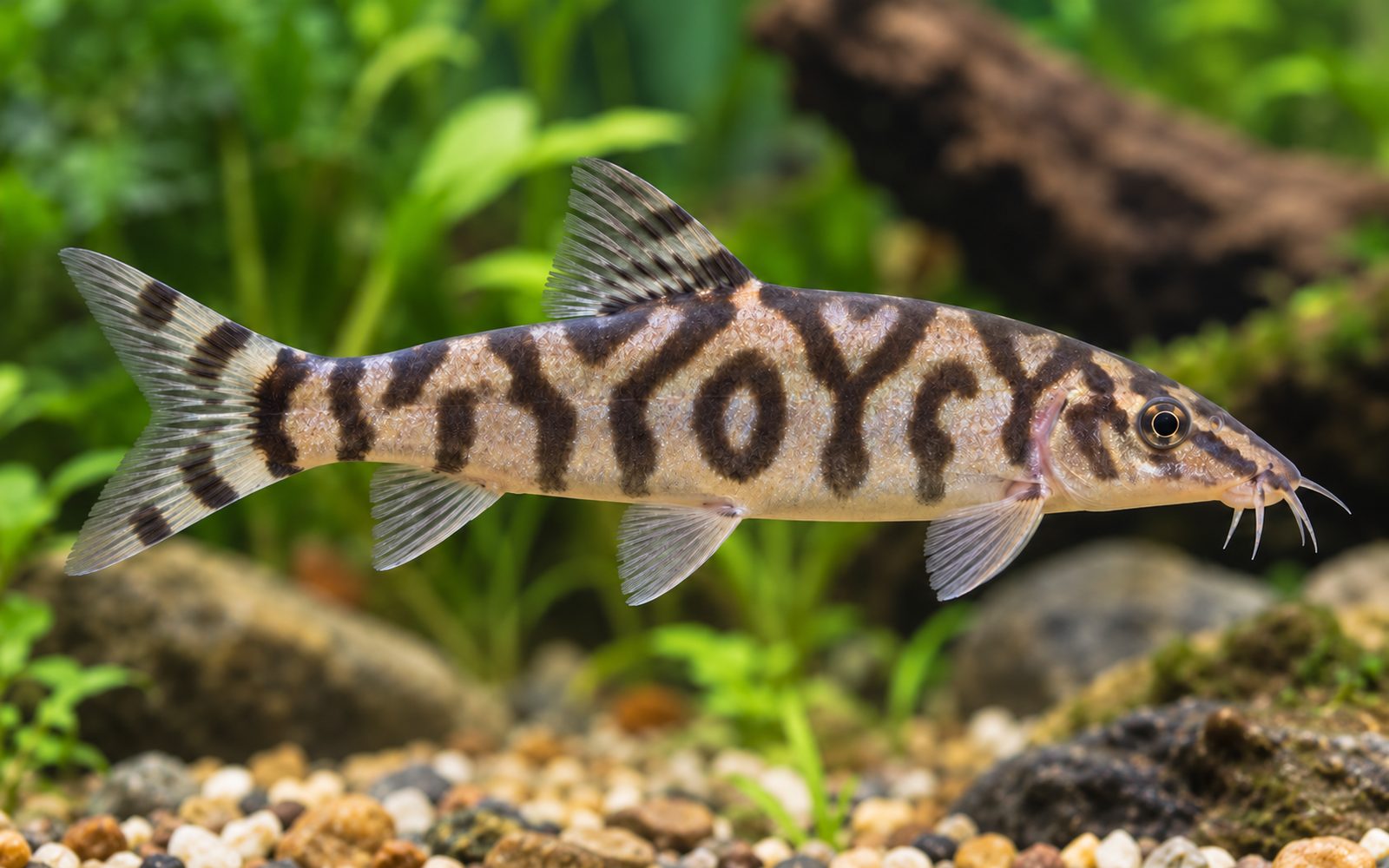
The yoyo loach is recognized by the dark brown markings on its silvery gray body, which resemble the letters "Y" and "O" in juveniles. With age this pattern breaks up, yellowish blotches and a more complex net-like look appear, and the bands on the fins increase. Adults reach 13–15 cm.
Naming in the trade is confused: some of the fish sold as "yoyo loach" are the closely related reticulated loach (Botia lohachata), as yet undescribed Botia species or hybrids. Since their care is practically the same, this causes no problem for the hobbyist.
Natural Habitat
It lives in flowing rivers and streams with sand and gravel bottoms in the Ganges basin of northern India. The water is clear and well oxygenated; the fish hide among stones and roots.
Tank Setup
- Volume: at least 200 liters and 120 cm of length for a group of 5–6.
- Water: 22–27°C, pH 6–7.5. Clean and stable water matters more than exact values; a 30% water change every week.
- Flow: Moderate flow and good aeration.
- Decor: Caves, pipes, roots and gaps between stones. Botias rest squeezed into tight spots.
- Substrate: Fine sand or rounded gravel; sharp gravel wears down its barbels.
- Lid: A tight lid is essential.
Diet
An omnivore leaning toward meaty foods, with a hearty appetite. Alongside sinking granules and tablets, offer frozen bloodworms, brine shrimp, tubifex and blanched vegetables. It eagerly eats snails; it is often chosen to reduce snail numbers, but it is not a solution on its own.
Behavior and Compatibility
Peaceful, but its active, bold nature can wear out small, calm fish. It is very quick at feeding time; slow-eating bottom dwellers (such as corydoras) may not get their share. It is more active at night and at dusk.
Good companions: barbs, danios, rasboras, large tetras, gouramis, other botias.
Avoid: snails, shrimp, slow long-finned fish, timid nano species.
Group and Colony Structure
The yoyo loach must live in a group: at least 5–6, ideally 8 or more individuals. When kept in small numbers it either withdraws or pesters other fish. Chasing and "jostling" within the group are part of the hierarchy; they are harmless if there are enough hiding places.
Breeding
Breeding in the aquarium is not known. Fish entering the trade are either collected from the wild or bred on farms with hormones.
Health and Common Problems
- White spot: Common in botias; new fish should be quarantined.
- Medication sensitivity: It has small scales; start medication at half the dose.
- Bacterial infection: Dirty water and sharp substrate lead to barbel erosion; clean water and a soft substrate are the best protection.
Sexing
Mature females are plumper with a rounder belly. Males are more slender; there is no reliable external difference.
Tank mates
This list is calculated automatically from the species profile and grows as new species are added to the catalog. Try it in the planner for a definite answer.
Usually compatible
 Flame Tetra
Glass Tetra
Flame Tetra
Glass Tetra
 Blackfin Corydoras
 Polystictus Corydoras
 Emerald Betta
 Emerald Cory
 Emerald Dwarf Rasbora
 Porthole Catfish
 Keyhole Cichlid
 Firemouth Cichlid
Should not be kept together






Hobbyist notes
Things you won't find in books, learned by trial and error. The most helpful ones are on top.
Change history and contributors
- Page created · October 16, 2026