
Water parameters
Overview
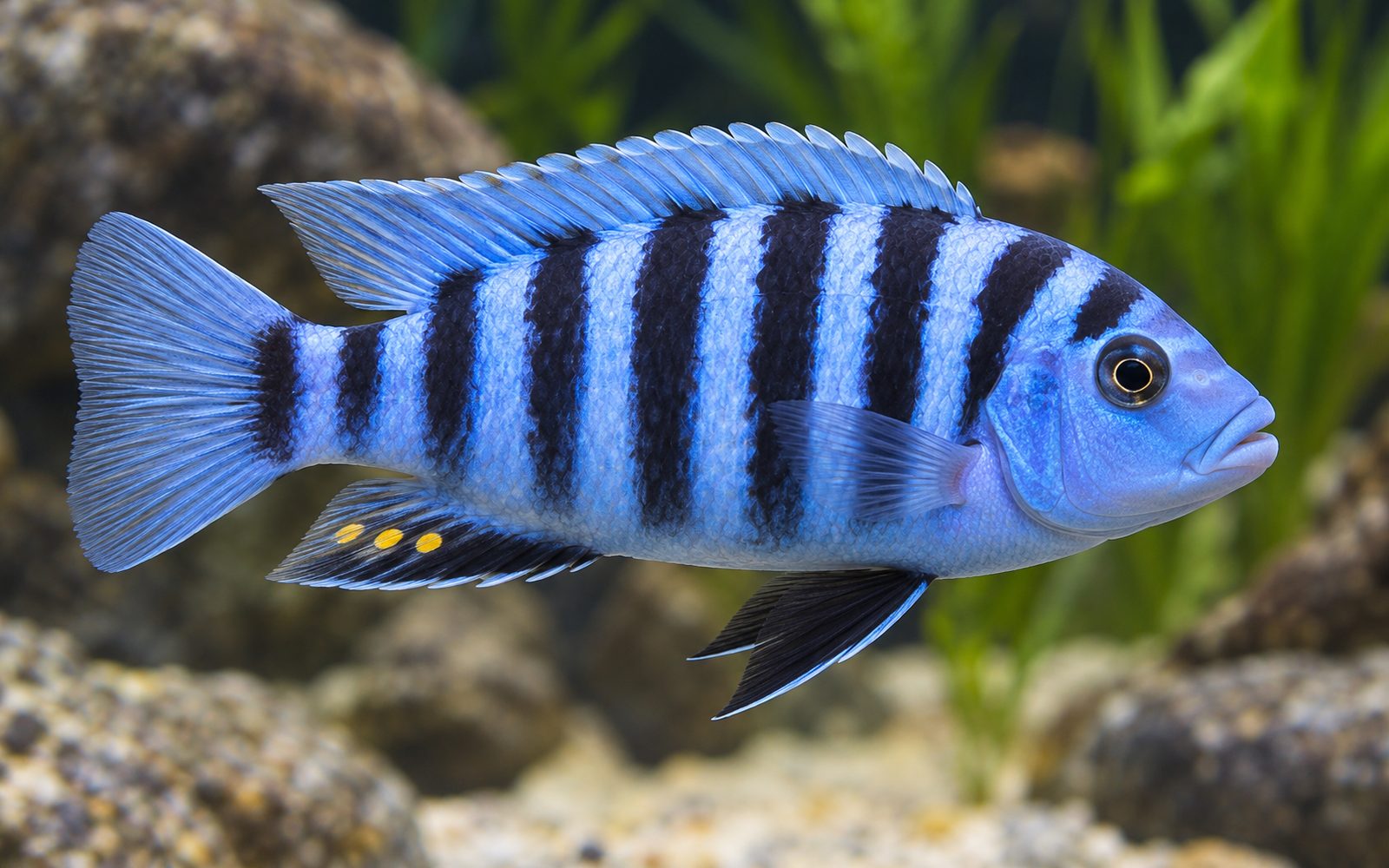
The zebra mbuna is one of the best-known and most widely distributed rock cichlids of Lake Malawi; the "zebra group" also takes its name from this species. The thick black vertical bars on the males' light blue body and the black pelvic fins are its identifying marks. In different parts of the lake there are numerous local forms that differ from one another in color and pattern.
Because it is easy to care for and hardy, it has been kept in aquariums for decades. But "easy" applies only to water and food: its males are territorial and aggressive, and they also pressure the females through constant courtship.
Color and Fin Varieties
These names describe color forms; they are not separate species.
- BB (blue-black): light blue with black bars; the most classic look.
- B (blue): fish with very faint bars, close to plain blue.
- OB (orange blotched): irregular black blotches on an orange background; mostly in females.
Natural Habitat
It lives on the rocky shores of the lake, usually in shallow areas where the upper surfaces of the rocks are covered with algae. It both scrapes the algae layer (aufwuchs) off the rocks and picks up small plankton drifting in the water above the rocks. The water is hard, alkaline and clear.
Tank Setup
- Volume: at least 300 liters and 120–150 cm in length; for an mbuna of this size, floor area and the number of rocks are decisive.
- Rockwork: Rock piles with many caves, rising from back to front. The rocks are set on the bottom glass and sand is filled in between them.
- Water: Hard and alkaline (pH 7.8–8.5). Aragonite substrate and Malawi salt balance soft water.
- Filter and maintenance: Strong filtration, weekly 30–50% water changes.
Diet
Mainly herbivorous. A spirulina-based mbuna food and vegetables should be the staple; a small amount of brine shrimp or mysis can be given once a week. Bloodworms and foods containing mammalian meat can lead to Malawi bloat.
Behavior and Compatibility
The male declares a cluster of rocks its territory and is very pugnacious toward blue-black barred fish. Females are calmer. When kept with similarly patterned species (demasoni, saulosi males, elongatus), fights increase and a risk of hybridization arises.
Good companions: yellow, orange or plain-colored mbuna (yellow lab, red zebra, auratus females), rusty cichlid, Synodontis catfish suited to hard water.
Avoid: other Maylandia species, blue-black barred mbuna, Aulonocara and haps, community fish, shrimp and snails.
Group and Colony Structure
- Harem: 1 male and 3–4 females; more females spread out the pressure better.
- Single-species aquarium: In a large aquarium, a crowded group made up only of zebra mbuna can also be set up; in that case each male needs its own cluster of rocks.
- Hybridization: Zebra-group species hybridize easily with each other; keeping local forms and species mixed ruins pure lines.
Breeding
A mouthbrooder. The male courts in front of a rock or a small pit in the sand; the female picks up the eggs in her mouth and they are fertilized via the egg spots on the male's anal fin. The female carries 15–40 eggs for about 3 weeks and does not eat during this time. The fry grow quickly on finely crushed food.
Health and Common Problems
- Malawi bloat: protein-rich food and stress are the main causes.
- Fight wounds: seen in females, especially when there are few females.
- Nitrate buildup: in a crowded mbuna aquarium it shows up as fading colors and loss of appetite.
Sexing
Males are larger and a brighter blue; their bars and black pelvic fins are distinct, and they carry large yellow egg spots on the anal fin. Females are mostly duller, in colors ranging from gray-brown to pale blue; in some populations orange (O) or orange with black blotches (OB) females occur.
Tank mates
This list is calculated automatically from the species profile and grows as new species are added to the catalog. Try it in the planner for a definite answer.
Usually compatible
 Flowerhorn
 Banded Jewel Cichlid
 Spotted Tilapia
 Demasoni Cichlid
 Jack Dempsey
 Johanni Cichlid
 Redhead Cichlid
 Red Devil Cichlid
 Red Terror Cichlid
 Convict Cichlid
Should not be kept together








Hobbyist notes
Things you won't find in books, learned by trial and error. The most helpful ones are on top.
Change history and contributors
- Page created · October 16, 2026