
Water parameters
Overview
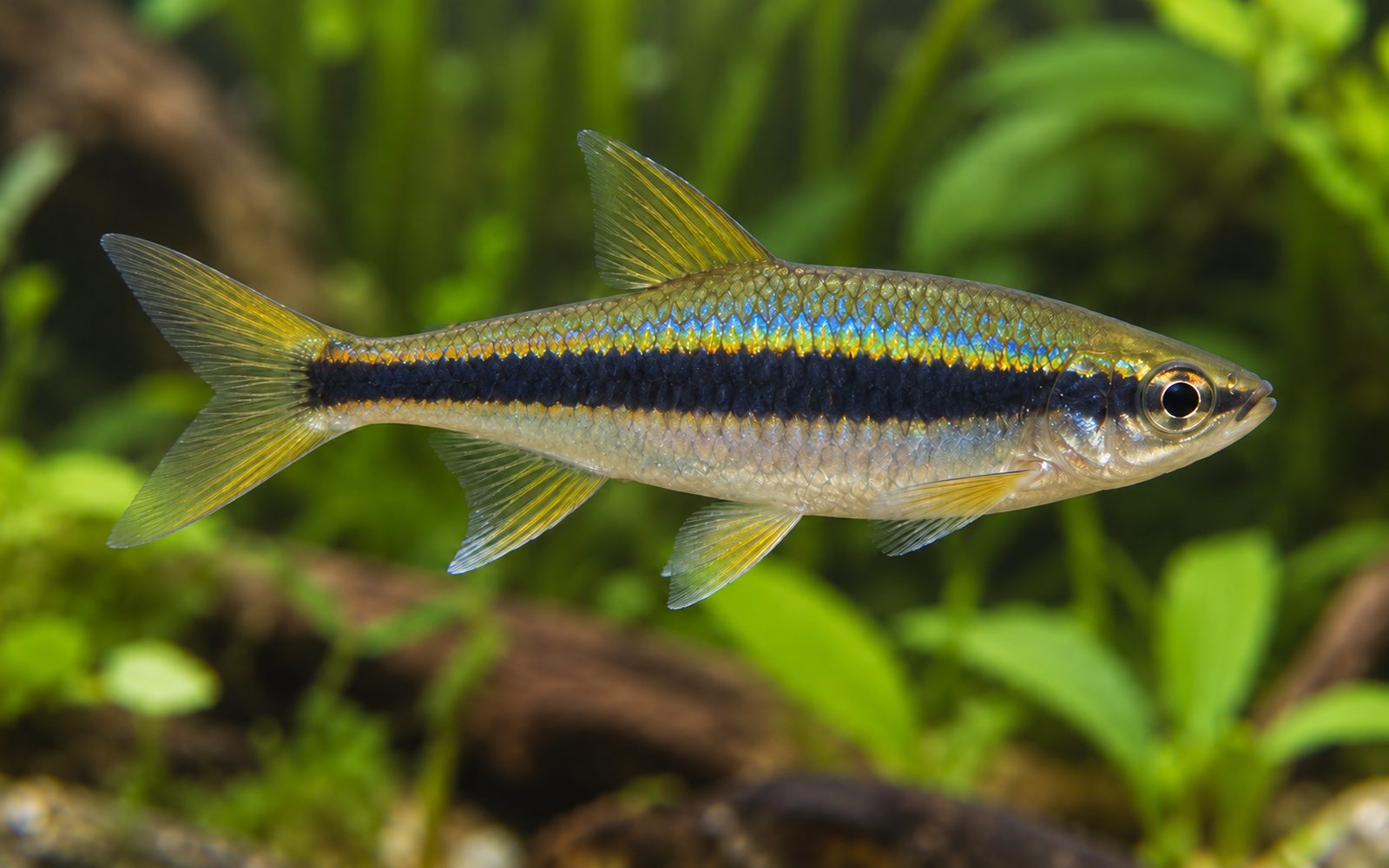
The brilliant rasbora is recognized by a broad, dark stripe running from the snout to the caudal peduncle along its slender, elongated body. The upper edge of the stripe shines between blue and gold as it catches the light; the rest of the body is olive silver. Its fins are clear or slightly yellowish.
It grows to about 8 cm. Its colors are elegant rather than showy and come out best against a dark substrate, roots and dim light. It is a peaceful species that is easy to feed; a good schooling fish for blackwater biotopes and calm community aquariums.
Natural Habitat
It lives in swamps, blackwater streams and flooded areas in the lowland forests of the Malay Peninsula, Sumatra and Borneo. The water is dark from tannins, soft and acidic; the bottom is covered with leaves and branches.
Tank Setup
- Volume: at least 100 liters and 80 cm in length for a school of 8–10.
- Water: 24–27°C, pH 5.5–7, soft water. Slightly tannin-stained water with dried leaves and roots brings out its colors.
- Layout: dark substrate, roots, plants along the sides and open swimming space in the middle.
- Light: dim, or diffused by floating plants.
- Lid: it may jump; use a lid.
Diet
Omnivorous; in the wild it feeds mainly on small insects and their larvae. In the aquarium it accepts flakes and granules; vary the diet with frozen brine shrimp, mosquito larvae, bloodworms and daphnia.
Behavior and Compatibility
Peaceful and social. It swims as a school in the middle layer and occasionally rises to the surface. When startled it quickly retreats into the plants. Chasing among themselves is harmless.
Good companions: other rasboras, tetras, dwarf gouramis, corydoras, kuhli loaches, loaches, otocinclus.
Avoid: large predators, aggressive cichlids; nano species so small and shy that they would lose out at feeding time.
Group and Colony Structure
At least 8, ideally 10 or more individuals. In a large school the fish become bolder and show their colors better. Kept in small numbers they remain shy. The male-to-female ratio is not important.
Breeding
It scatters its eggs among fine-leaved plants and moss; there is no parental care and the eggs are eaten. A well-fed pair or small group may spawn in a separate aquarium with moss, filled with soft, acidic water. The adults are removed after spawning; the fry are fed infusoria, then newly hatched brine shrimp.
Health and Common Problems
- Hard water: after long periods in hard, alkaline water the colors fade and susceptibility to disease increases.
- Water quality: a 25% weekly water change and stable values are sufficient.
- Quarantine: wild-caught fish may carry parasites; a short quarantine is recommended.
Sexing
Males are slimmer and the sheen above the stripe is more pronounced. Females are larger and have a fuller belly.
Tank mates
This list is calculated automatically from the species profile and grows as new species are added to the catalog. Try it in the planner for a definite answer.
Usually compatible
 Flame Tetra
 Blackfin Corydoras
 Polystictus Corydoras
 Emerald Betta
 Emerald Cory
 Porthole Catfish
 Keyhole Cichlid
 Cupid Cichlid
 Geophagus altifrons
 Geophagus surinamensis
Should not be kept together






Hobbyist notes
Things you won't find in books, learned by trial and error. The most helpful ones are on top.
Change history and contributors
- Page created · October 16, 2026