
Water parameters
Overview
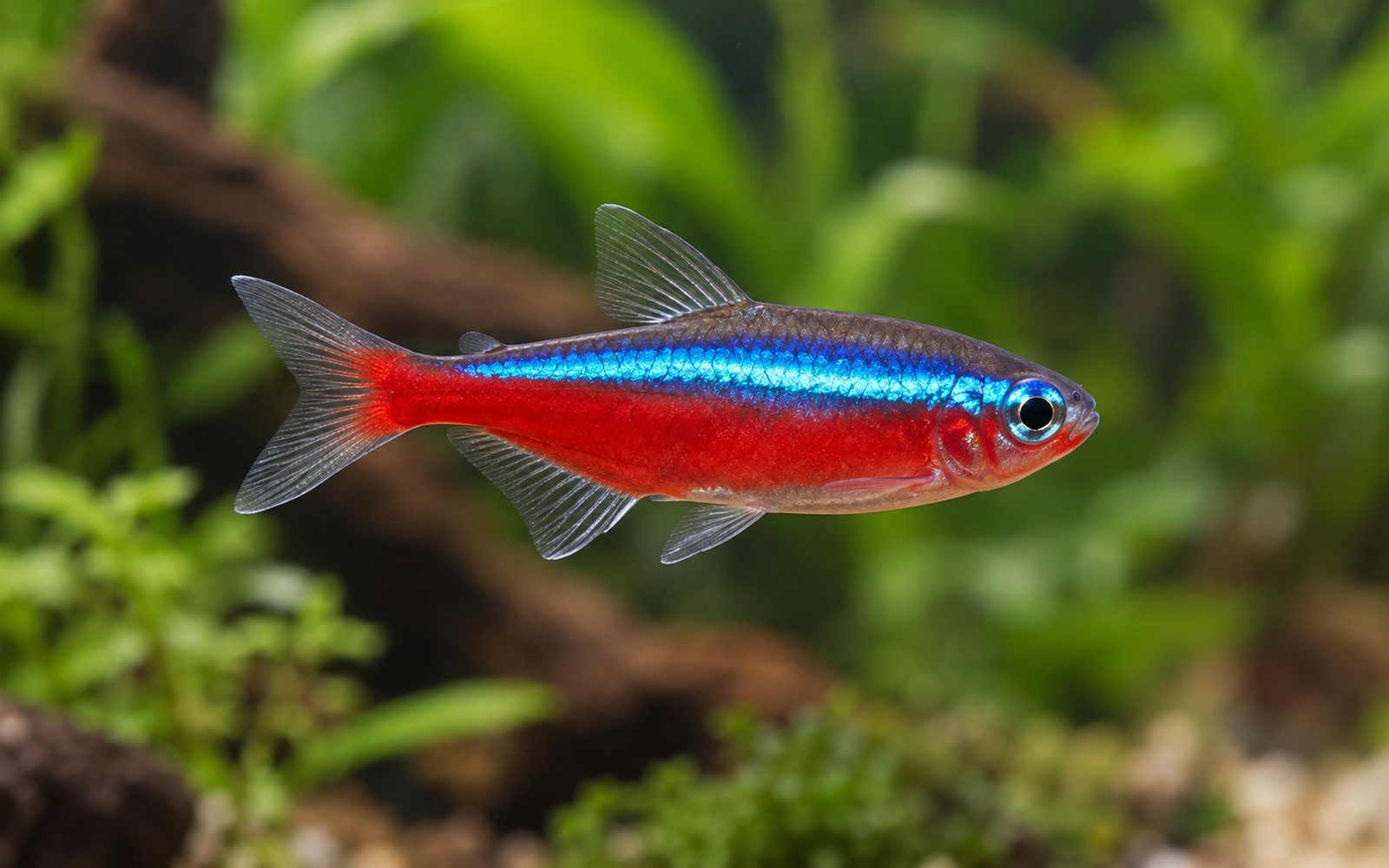
At first glance the cardinal tetra looks very much like the neon tetra; the difference is that the red runs along the entire belly, from below the snout to the tail. In the neon, the red is only on the rear half of the body. The cardinal is slightly larger and its colors are more intense.
A large share of the cardinals sold are still wild-caught; they are an important source of income for local fishing communities on the Rio Negro. Wild-caught fish are used to soft, acidic water and need careful care in the first weeks.
Natural Habitat
It lives in large schools among roots and leaf litter in the Amazon's "blackwater" tributaries, in water that is tea-colored from tannins, very soft (conductivity often below 30 µS/cm) and acidic (pH 4–6). The water is warm: 25–29°C.
Tank Setup
- Volume: 60 liters or more for a school of 10–15; a length of 60 cm or more.
- Water: 25–28°C, soft and slightly acidic. Unlike the neon, it does not like cool water; it can share the same temperature as discus and rams.
- Setting: dark substrate, roots, dried leaves and floating plants. Dim light brings out its colors.
- Maturity: it should not be added to a newly set-up tank; it is sensitive to ammonia and nitrite swings.
Diet
Omnivorous. Make small granules and flakes the staple and vary it with frozen or live brine shrimp, daphnia, cyclops and small bloodworms. Its mouth is small, so keep the food fine. Feed 1–2 times a day, only as much as is eaten within a few minutes.
Behavior and Compatibility
Very peaceful and feels safe in a large school. The school circles together in the middle layer of the aquarium.
Good companions: discus, rams, Apistogramma, corydoras (especially the warm-water-loving C. sterbai), otocinclus, small rasboras.
Avoid: angelfish (adults may hunt cardinals), large fish whose mouths it fits into, coldwater species (goldfish), active fin nippers.
Group and Colony Structure
The cardinal tetra is a schooling fish: at least 8, ideally 15 or more individuals. Large schools clearly bring out natural behavior and color. The sex ratio does not matter. Buying the school from the same source and at the same time makes it easier for newcomers to settle in.
Breeding
It is difficult to breed in the aquarium. It needs very soft (GH < 2), acidic (pH 5–5.5) water, dim light and a separate breeding tank. The female scatters her eggs among fine-leaved plants; the eggs and fry are very sensitive to light. Commercial breeding has increased in recent years but is still limited.
Health and Common Problems
- Losses among new arrivals: wild-caught cardinals are fragile in the first weeks because of transport stress and differences in water. Slow acclimation and quarantine are important.
- White spot and velvet: common at low temperatures.
- It is known to be more resistant to neon tetra disease than the neon, but it is not completely immune.
Sexing
Females are plumper with a rounder belly; viewed from above they are noticeably wider. Males are slimmer and straighter.
Tank mates
This list is calculated automatically from the species profile and grows as new species are added to the catalog. Try it in the planner for a definite answer.
Usually compatible
 Flame Tetra
 Blackfin Corydoras
 Polystictus Corydoras
 Emerald Cory
 Porthole Catfish
 Keyhole Cichlid
 Cupid Cichlid
 Geophagus altifrons
 Geophagus surinamensis
 Cryptocoryne Parva
Should not be kept together







Hobbyist notes
Things you won't find in books, learned by trial and error. The most helpful ones are on top.
Change history and contributors
- Page created · October 16, 2026