
Water parameters
Overview
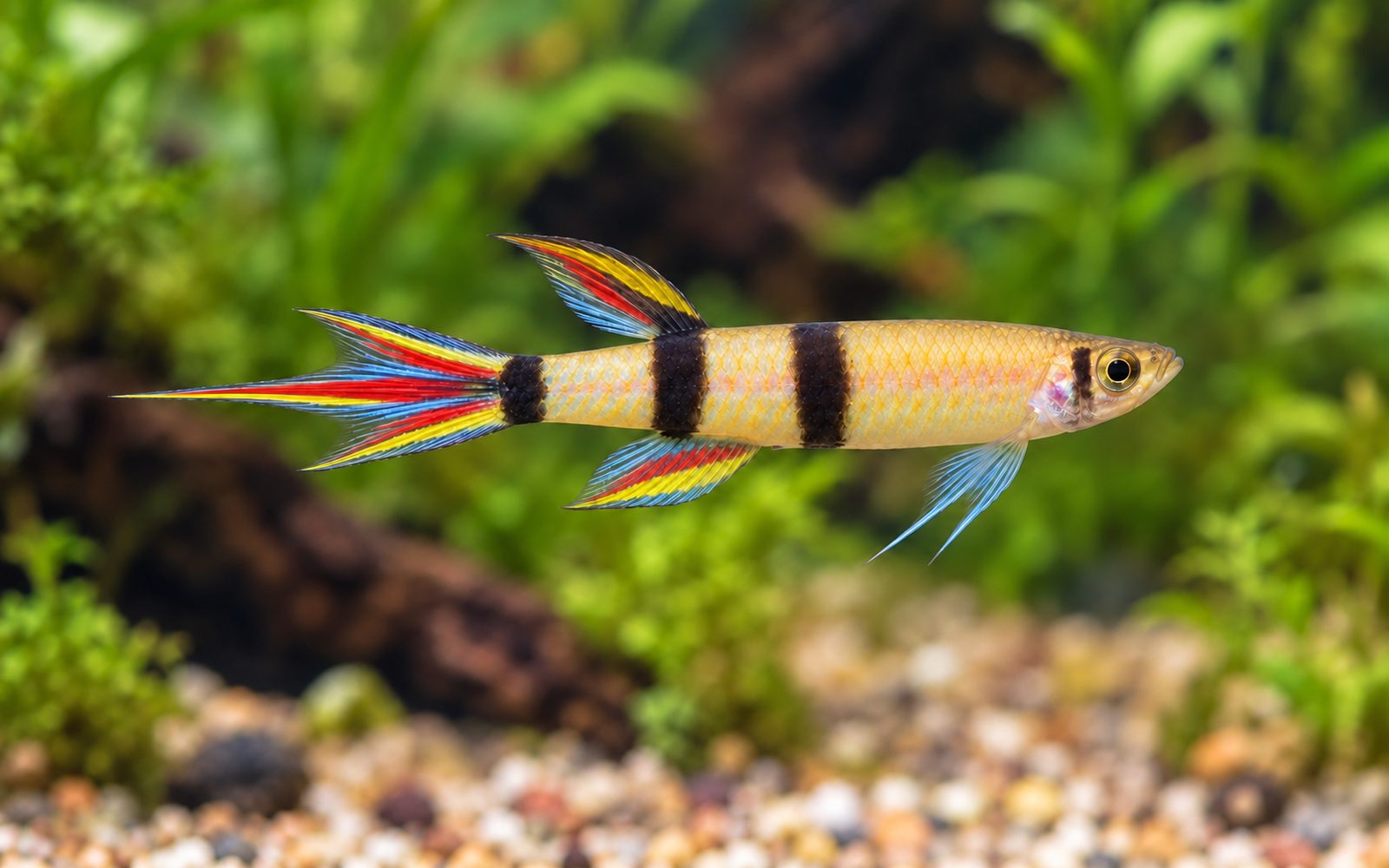
The clown killifish is one of the smallest and most charming killifish species. Its cream-yellow body is divided by four thick black vertical bands; this pattern gives it its name. In males, the center of the tail fin extends into a rocket shape and is colored with red, blue and yellow stripes.
Some sources place it in a separate genus under the name Pseudepiplatys annulatus. It spends almost its entire life just below the water surface. Its peaceful nature makes it very well suited to shrimp tanks and planted nano aquariums, but it needs soft water and a calm environment.
Natural Habitat
It lives in shallow, still or very slow-flowing forest streams and swamps on the low-lying coastal plains of West Africa. The water is very soft, acidic and usually shaded; the surface is covered with plants and grasses overhanging from the banks.
Tank Setup
- Volume: 20 liters or more for a small group; surface area is important.
- Surface: Floating plants (Salvinia, Phyllanthus, Limnobium) are essential; part of the surface should stay open.
- Water: 23–26°C, soft and acidic. There should be almost no flow; an air-driven sponge filter is ideal.
- Lid: A tight lid is essential; despite its small size, it jumps.
- Maintenance: 20% water change weekly; the new water should have the same temperature and hardness.
Diet
Carnivorous, with a small mouth. It prefers small foods offered at or near the surface: newly hatched and frozen brine shrimp, cyclops, daphnia, microworms, flightless fruit flies. Some individuals also eat fine flakes and micro granules. Food that sinks to the bottom is mostly lost.
Behavior and Compatibility
Calm and peaceful; it hangs among the plants just below the surface. Males display to each other with flared fins but do not harm each other. Fast, active fish keep it from reaching food.
Good companions: red cherry and other dwarf shrimp (it leaves adults alone), otocinclus, dwarf corydoras, small and calm rasboras, nerite snails.
Avoid: fast fish that share the surface (hatchetfish, danios), large and aggressive species, strong flow.
Group and Colony Structure
It should be kept in a small group: two females per male, or two to three males with four to six females in a larger aquarium. As the group grows, the males display more and tension is spread out.
Breeding
It lays a few eggs every day on floating plant roots near the surface, on moss or on a wool spawning mop. At 24–25°C the eggs hatch in about 8–12 days. The fry are very small; in the first days they are fed infusoria or paramecium, then microworms and newly hatched brine shrimp. The parents pay little attention to the fry; in a mature aquarium with a plant-covered surface, some of the fry can grow up on their own.
Health and Common Problems
- Sensitive to water: It becomes stressed in hard, unstable water and with sudden water changes.
- Hunger: It may not get enough food when kept with large, fast tankmates.
- Velvet (Oodinium): a common problem in killifish.
Sexing
Males have a rocket-shaped tail with long central rays, colored red, blue and yellow; their pelvic fins are bluish. Females have the same body pattern, but their tails are short, rounded and colorless.
Tank mates
This list is calculated automatically from the species profile and grows as new species are added to the catalog. Try it in the planner for a definite answer.
Usually compatible
 Flame Tetra
 Blackfin Corydoras
 Polystictus Corydoras
 Emerald Cory
 Porthole Catfish
 Keyhole Cichlid
 Cupid Cichlid
 Geophagus surinamensis
 Cryptocoryne Parva
 Gold Spot Pleco (L001)
Should not be kept together







Hobbyist notes
Things you won't find in books, learned by trial and error. The most helpful ones are on top.
Change history and contributors
- Page created · October 16, 2026