
Water parameters
Overview
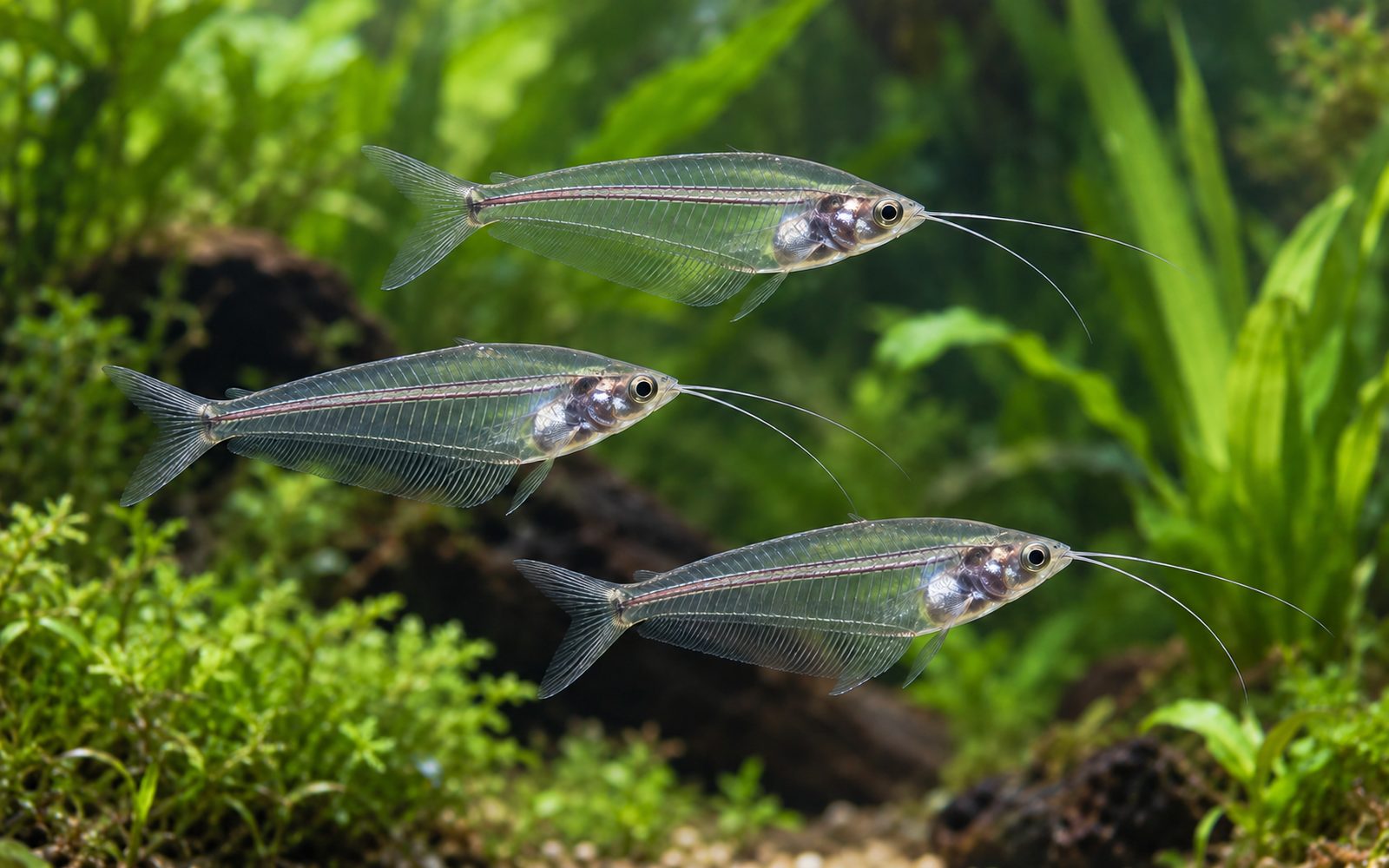
With its unpigmented, transparent body, the glass catfish is one of the most unusual species in the hobby: its spine, bones and internal organs can be seen from outside, and when light hits it, the body shimmers like a rainbow. For many years it was sold as K. bicirrhis; almost all of the fish in aquariums are K. vitreolus.
Unlike other catfish, it swims not on the bottom but in midwater as a school, with its head facing into the current.
Natural Habitat
It lives in forest streams of the Malay Peninsula, in gently flowing, planted and shaded waters.
Tank Setup
- Volume: at least 80 liters for a group of 6–8.
- Flow: it likes gentle to moderate flow and lines up facing the filter outlet.
- Environment: a planted, dim, calm aquarium. Busy and boisterous tankmates stress it.
- Water: 23–26°C; clean and stable. It is sensitive to sudden changes.
Diet
Carnivorous; it hunts small creatures in midwater. Frozen and live brine shrimp, daphnia, cyclops and small bloodworms; small granules it can catch in midwater before they sink. New fish are slow to accept dry food.
Behavior and Compatibility
Very peaceful and timid. Kept alone or in small numbers, it hides, refuses food and wastes away.
Good companions: calm tetras and rasboras, dwarf gouramis, corydoras, otocinclus.
Avoid: busy and large fish, aggressive cichlids, fin nippers.
Group and Colony Structure
The glass catfish lives in schools: at least 6, ideally 8 or more individuals. The group hangs together in midwater and changes direction at the same moment. The sex ratio does not matter.
Breeding
It very rarely breeds in the aquarium; commercial breeding is done on farms.
Health and Common Problems
- Clouding: the transparent body turning milky white is a sign of serious stress or disease.
- Starvation: common in new arrivals; start them on live and frozen food.
- It is sensitive to medications.
Sexing
Difficult to tell apart externally; mature females may be slightly plumper.
Tank mates
This list is calculated automatically from the species profile and grows as new species are added to the catalog. Try it in the planner for a definite answer.
Usually compatible
 Flame Tetra
 Blackfin Corydoras
 Polystictus Corydoras
 Emerald Betta
 Emerald Cory
 Emerald Dwarf Rasbora
 Porthole Catfish
 Keyhole Cichlid
 Geophagus surinamensis
 Cryptocoryne Parva
Should not be kept together






Hobbyist notes
Things you won't find in books, learned by trial and error. The most helpful ones are on top.
Change history and contributors
- Page created · October 16, 2026