
Water parameters
Overview
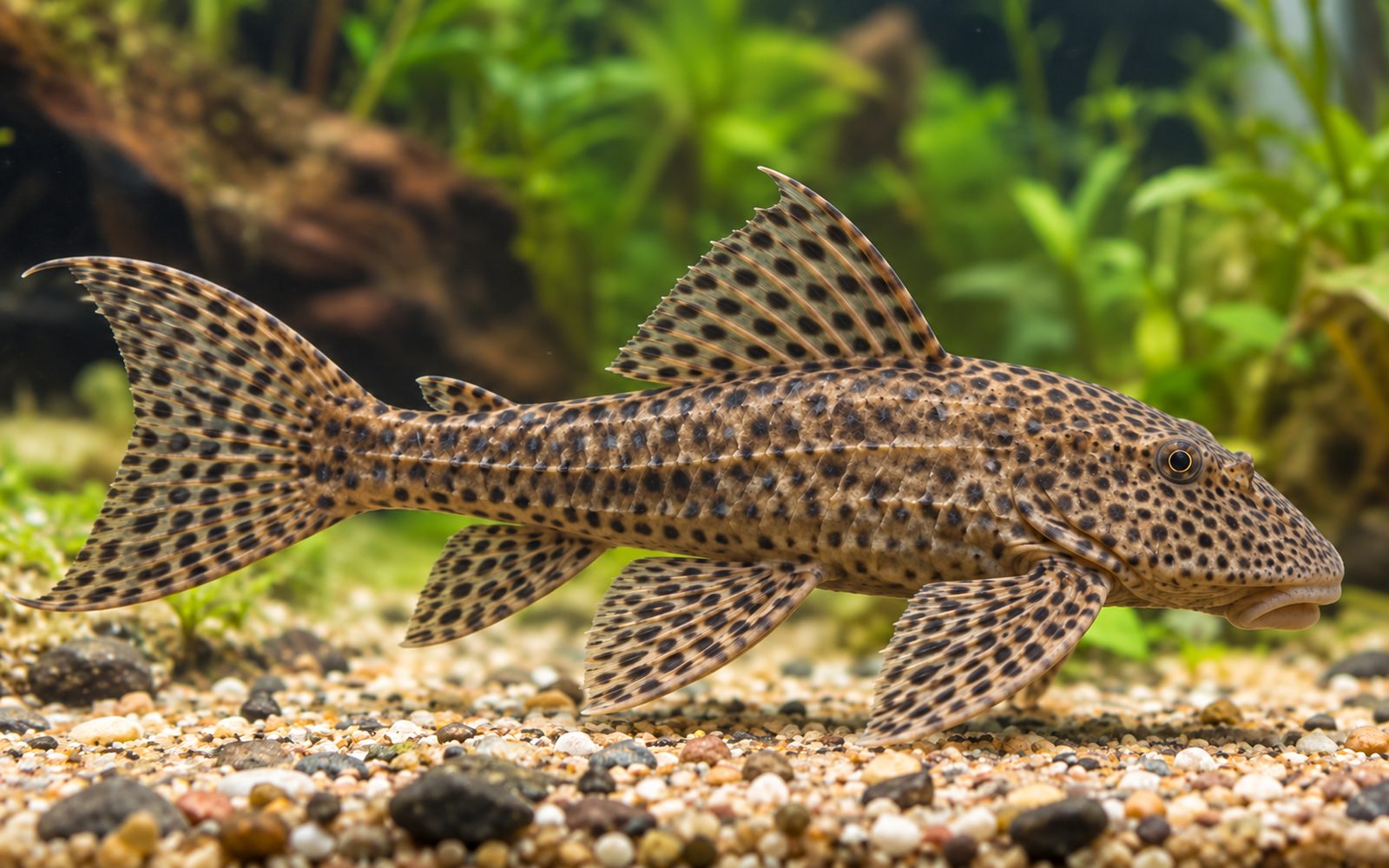
The word "pleco" comes from the scientific name of this species. Hypostomus plecostomus is one of the first suckermouth catfish described by science, and for many years all large, spotted suckermouth catfish were sold under this name. Today, however, most of the fish sold in shops as "plecos" or "algae eaters" are actually Pterygoplichthys species (common pleco, vermiculated sailfin pleco), and those reach 40–50 cm.
The easiest way to tell the real H. plecostomus apart is the dorsal fin: in Hypostomus the fin has around 7 rays, while Pterygoplichthys has more than 10 rays and a tall, sail-like fin. This species usually reaches 25–30 cm; it is still not suitable for small aquariums.
Natural Habitat
It lives in the coastal rivers of Guyana, Suriname and French Guiana, in the tidally influenced lower reaches, in still waters with muddy bottoms and in swamps.
Tank Setup
- Volume: At least 400 liters and 150 cm in length for one adult.
- Filter: A powerful canister filter; it produces a lot of waste.
- Decor: Large roots and spacious caves; it rasps on or uproots plants.
- Water: 24–27°C; it adapts to a wide range of hardness and pH.
- Hiding: A wide cave or root hollow that its body can fit into; it spends the day there.
Diet
An omnivore with a mainly herbivorous diet. Wafers containing algae and vegetables, blanched zucchini, cucumber, spinach and peas should be the staple; bloodworms or shrimp can be given occasionally. It rasps on roots. The algae in the aquarium is not enough for it.
Behavior and Compatibility
It is peaceful toward other species; as it grows it becomes territorial toward its own kind and other large bottom dwellers. It is nocturnal.
Good companions: Medium to large, active fish: large tetras, silver dollars, large barbs, medium to large cichlids.
Avoid: Small aquariums, slow, flat-bodied fish such as discus and angelfish, other large plecos (in a confined space), delicate planted layouts.
Group and Colony Structure
In a home aquarium a single individual is kept. Adding a second large suckermouth catfish to the same aquarium, especially in a confined space, leads to constant territorial fighting.
Breeding
In the wild it breeds in hollows and tunnels along the banks, and the male guards the eggs. Breeding in the aquarium is not known.
Health and Common Problems
Hardy. The real problems are insufficient space, dirty water and too few vegetables. When buying, make sure the fish really is a Hypostomus; otherwise you may end up with a much larger fish than expected. Because of the heavy waste load nitrate rises quickly; a 30–40% water change every week should become a habit.
Sexing
Difficult to tell apart externally; mature males may have thicker pectoral fin spines.
Tank mates
This list is calculated automatically from the species profile and grows as new species are added to the catalog. Try it in the planner for a definite answer.
Usually compatible
 Flame Tetra
Glass Tetra
Flame Tetra
Glass Tetra
 Blackfin Corydoras
 Polystictus Corydoras
 Emerald Betta
 Emerald Cory
 Emerald Dwarf Rasbora
 Porthole Catfish
 Keyhole Cichlid
 Firemouth Cichlid
Should not be kept together




Hobbyist notes
Things you won't find in books, learned by trial and error. The most helpful ones are on top.
Change history and contributors
- Page created · October 16, 2026