
Water parameters
Overview
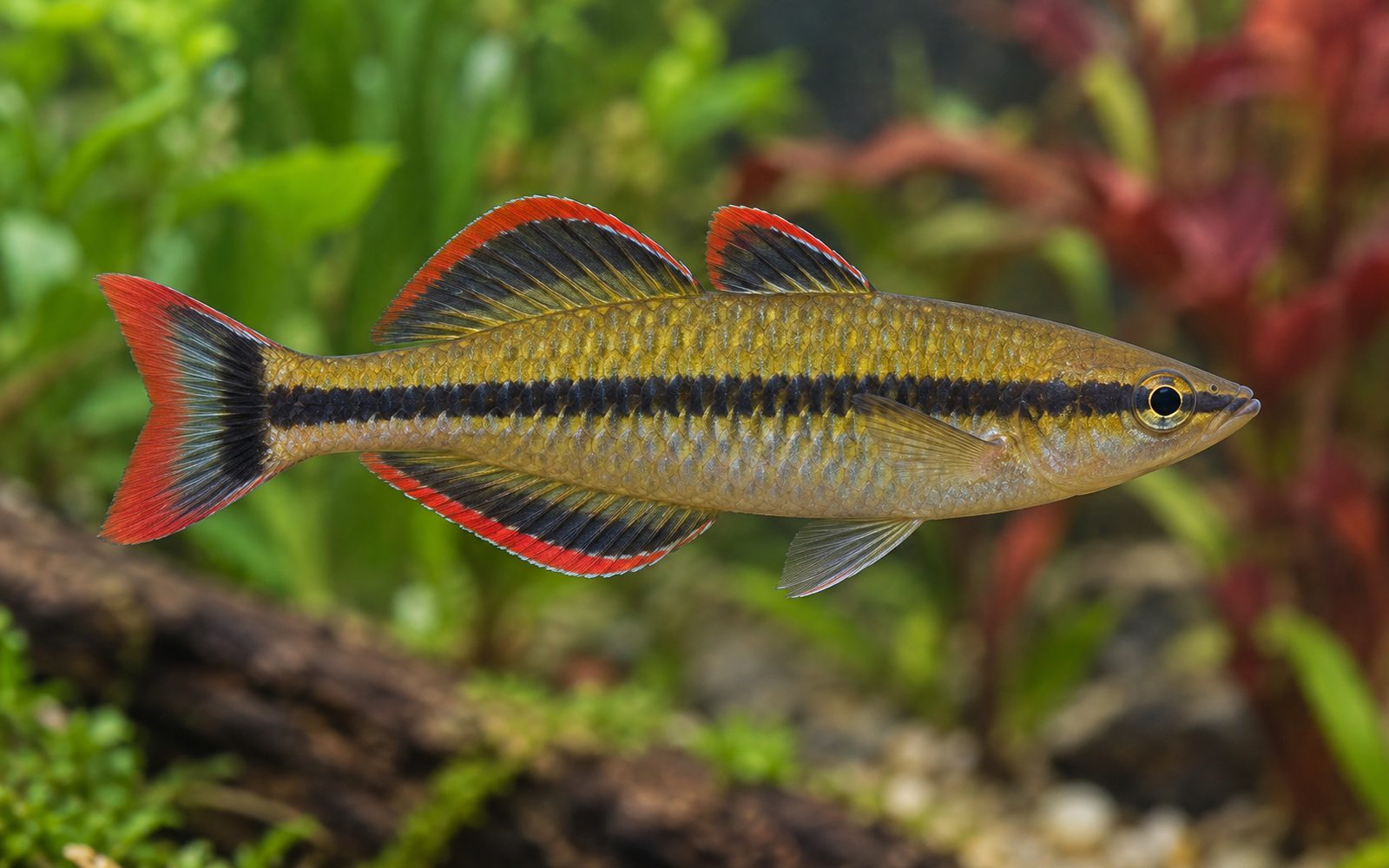
The Madagascar rainbowfish is the best-known species in the hobby of the family Bedotiidae, which is endemic to Madagascar. The dark stripe running along the middle of its golden-olive body and the males' dorsal, anal and tail fins edged in black and red are its typical look. It grows to 8–10 cm.
Its natural habitat is under serious pressure from deforestation and non-native fish species; individuals in the hobby come from lines that have long been bred in aquariums. In the hobby its name is often confused with that of its close relative Bedotia geayi; pay attention to the scientific name and the source when buying.
Natural Habitat
It lives on the east coast of Madagascar, in clear, relatively cool rivers flowing down from the rainforest. The water is soft to moderately hard and around neutral; the fish move in groups in stretches where the current slows down and there are bank plants and roots.
Tank Setup
- Volume: at least 150 liters and 100 cm in length for a school of 6–10.
- Water: 22–24°C is ideal; do not keep it at high temperatures for long periods. Around neutral, soft to moderately hard water.
- Decor: Plants and roots along the edges, plenty of swimming space in the middle.
- Flow: It likes gentle to moderate flow and good oxygenation.
- Lid: It jumps; the lid must fit tightly.
Diet
Omnivorous. It is fed quality flakes and granules, frozen brine shrimp, mysis, bloodworms and daphnia. Because in the wild it largely eats insects that fall into the water, it likes taking food from the surface. Feed small amounts 2–3 times a day.
Behavior and Compatibility
A peaceful, active schooling fish. Males display to each other by spreading their fins; during this the black and red edges on the fins become more distinct. It may eat shrimplets and very small fish fry.
Good companions: Corydoras, bristlenose plecos, medium-sized tetras and rasboras, peaceful barbs, rainbowfish suited to cooler water, botias.
Avoid: aggressive cichlids, fin-nipping barbs, species that need very warm water (e.g. discus).
Group and Colony Structure
At least 6, ideally 10 or more individuals. A female-heavy group (2 females per male) is balanced. Having more than one male increases display behavior; when kept in small numbers the fish become skittish.
Breeding
A continuous-spawning egg scatterer. For days on end, pairs lay a small number of eggs every day on fine-leaved plants or a wool spawning mop; the eggs attach with sticky threads. Because the parents may eat the eggs, move the mop to a separate container. Depending on temperature, the fry hatch in about 1–2 weeks; start with infusoria and liquid fry food, then move on to newly hatched brine shrimp.
Hybridization: It can hybridize with related Bedotia species. Because name confusion is common in the hobby, do not cross Bedotia of unknown origin with your own line, and pass on fry under the correct scientific name.
Health and Common Problems
- Heat stress: being kept above 26°C for long periods shortens lifespan and lowers condition.
- White spot: can appear after sudden temperature changes.
- Water quality: sensitive to low-oxygen and dirty water.
- In suitable conditions it is a hardy species.
Sexing
Males are larger and more colorful; the dorsal and anal fins have black and red edges, and the tail fin has a black band and a red edge. Females are smaller and plainer; they carry the same dark body stripe, but their fins are mostly colorless or slightly yellowish.
Tank mates
This list is calculated automatically from the species profile and grows as new species are added to the catalog. Try it in the planner for a definite answer.
Usually compatible
 Flame Tetra
 Blackfin Corydoras
 Polystictus Corydoras
 Emerald Cory
 Emerald Dwarf Rasbora
 Porthole Catfish
 Keyhole Cichlid
 Cryptocoryne Parva
 Guppy
Guppy
 Egyptian Mouthbrooder
Should not be kept together






Hobbyist notes
Things you won't find in books, learned by trial and error. The most helpful ones are on top.
Change history and contributors
- Page created · October 16, 2026