
Water parameters
Overview
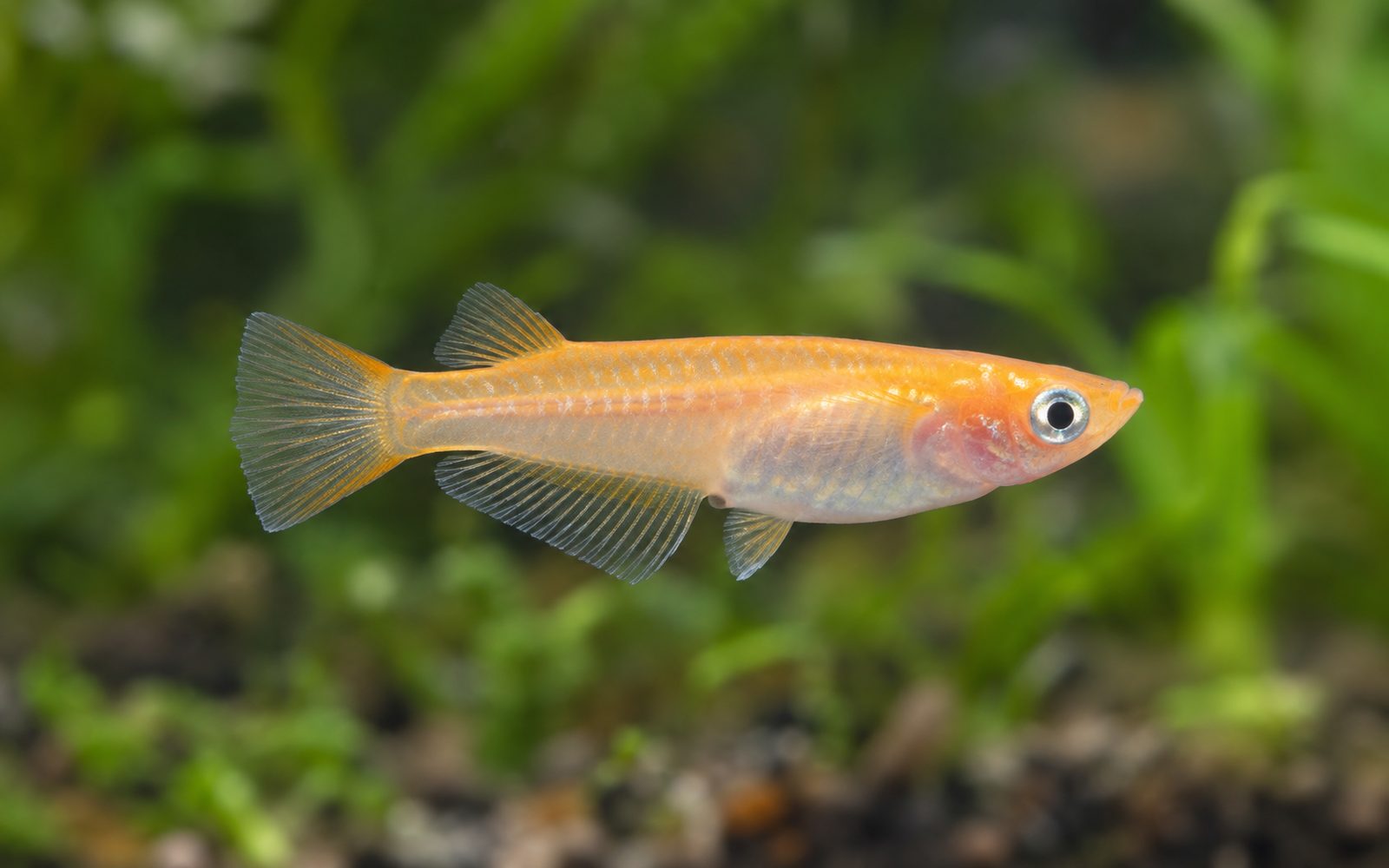
The medaka is a small rice fish that has been kept as an ornamental fish in Japan for centuries. It is not a true killifish, but because it lives at the surface and has similar care and spawning habits, it is grouped with killifish in the hobby. The wild type is gray-olive; the form most often seen in stores is the orange-yellow himedaka.
It is one of the long-established model organisms of genetics and developmental biology research, and it is also known as one of the first vertebrates to mate and produce young in space. For the hobby, its biggest advantage is its wide temperature range: it lives comfortably in an unheated room aquarium and, in summer, in containers on a balcony or in the garden.
Color and Fin Varieties
- Himedaka: orange-yellow; the most common form.
- Shiro (white): a white to cream form.
- Yokihi: a deep orange-red form with intense color.
- Miyuki: a form with a metallic, shiny silver-blue stripe along the back.
- Hikari: a body form whose dorsal fin resembles the anal fin, with a diamond-shaped tail.
Natural Habitat
In Japan and Korea it lives in rice paddies, irrigation canals, ditches, ponds and slow-flowing streams. It is adapted to shallow waters that are warm in summer and cold in winter; it spends the winter on the bottom in a slowed-down state.
Tank Setup
- Volume: 30 liters or more for a group of 6–10; surface area is important.
- Water: 20–25°C is ideal; it adapts to a wide range. No heater is needed.
- Layout: Floating plants and fine-leaved plants (for spawning); an open swimming area.
- Outdoors: It thrives in large, shaded containers in summer. It can also spend the winter outside as long as the container does not freeze; reduce feeding in the cold.
- Lid: It may jump when startled; a lid is recommended in the aquarium.
Diet
Omnivorous and easy to feed. Because its mouth is small and upturned, floating fine flakes and micro granules are ideal. Small live and frozen foods such as brine shrimp, daphnia and cyclops support color and breeding. Outdoors it also eats mosquito larvae and the small creatures living on algae.
Behavior and Compatibility
Peaceful, calm and social. It roams just below the surface in a loose group. Males have brief chases among themselves but do not harm each other.
Good companions: red cherry and other dwarf shrimp, otocinclus, dwarf corydoras, galaxy rasboras, zebra danios, endlers, nerite snails; on its own outdoors.
Avoid: large and aggressive fish, fin nippers, species that need very warm water (such as discus).
Group and Colony Structure
At least 6, ideally 10 or more individuals. An equal or female-heavy group is the most balanced. In a large group it is bolder and uses the surface more.
Breeding
It breeds very easily; 13 or more hours of light a day and water above 22°C trigger spawning. The female spawns in the morning and carries the egg cluster under her belly for a few hours before brushing it off onto plants. At 24–25°C the eggs hatch in about 10 days. The parents eat the eggs and fry; the plant with eggs or the wool spawning mop should be moved to a separate container. The fry are fed infusoria or powdered food in the first days, then newly hatched brine shrimp; they mature in 2–3 months.
Health and Common Problems
- It is very hardy; most problems come from sudden temperature changes and dirty water.
- White spot (ich): can appear especially when moving fish from a cold outdoor container to a warm aquarium.
- Outdoors, part of the container should be shaded to protect against birds and overheating.
Sexing
Males have a distinct notch near the rear edge of the dorsal fin; their anal fin is broad and parallelogram-shaped. Females have a short dorsal fin without a notch, a narrower anal fin and a fuller belly. Females carrying eggs are easy to recognize.
Tank mates
This list is calculated automatically from the species profile and grows as new species are added to the catalog. Try it in the planner for a definite answer.
Usually compatible
 Flame Tetra
 Blackfin Corydoras
 Polystictus Corydoras
 Emerald Cory
 Emerald Dwarf Rasbora
 Porthole Catfish
 Keyhole Cichlid
 Geophagus surinamensis
 Cryptocoryne Parva
 Gold Spot Pleco (L001)
Should not be kept together







Hobbyist notes
Things you won't find in books, learned by trial and error. The most helpful ones are on top.
Change history and contributors
- Page created · October 16, 2026