
Water parameters
Overview
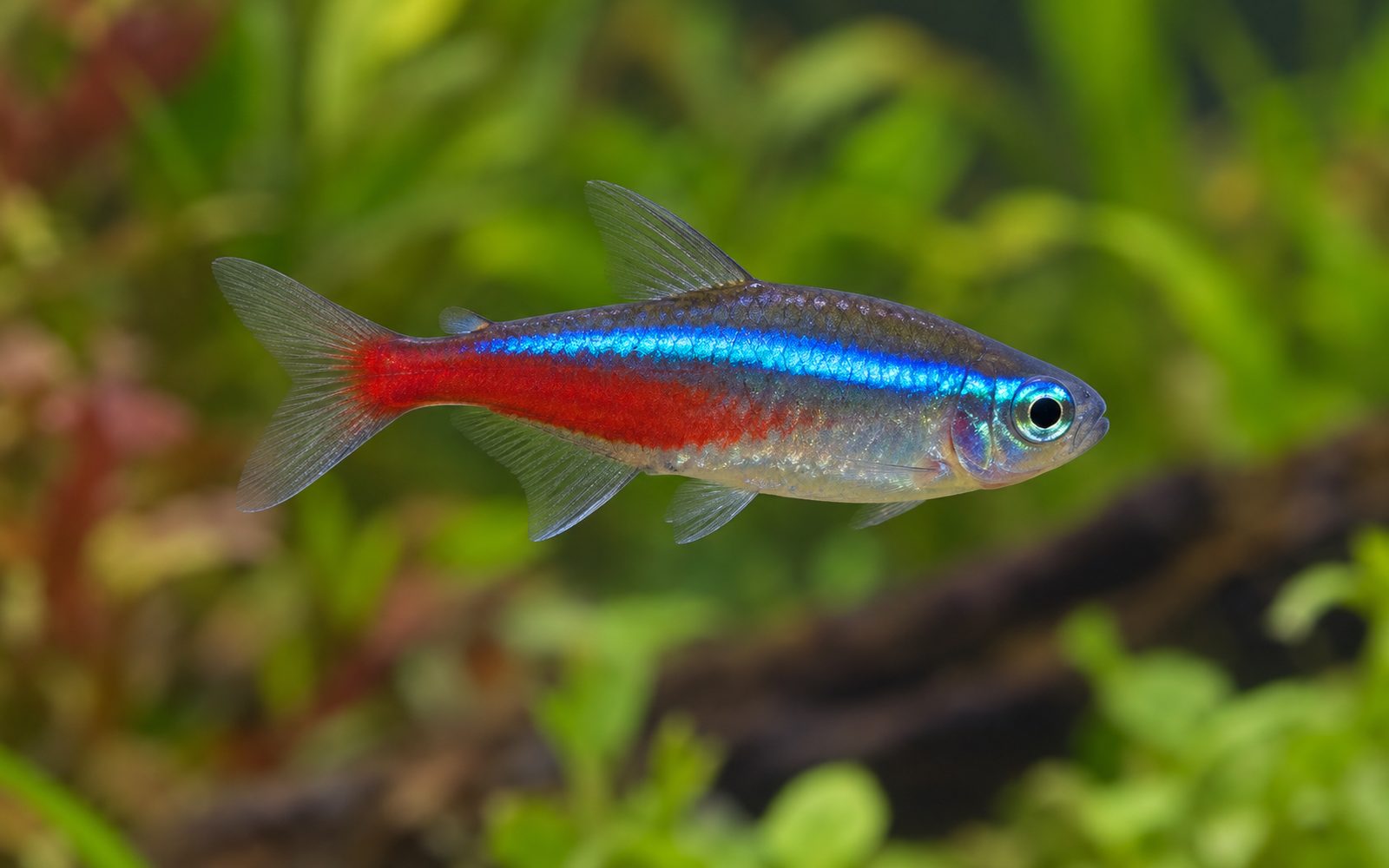
The neon tetra is recognized by the iridescent blue stripe running along its body and the red lower half towards the tail. It has been one of the best-selling aquarium fish since it entered the hobby in the 1930s. Most neons sold today are bred on farms in Southeast Asia and Europe; these fish are more used to harder water than their wild relatives.
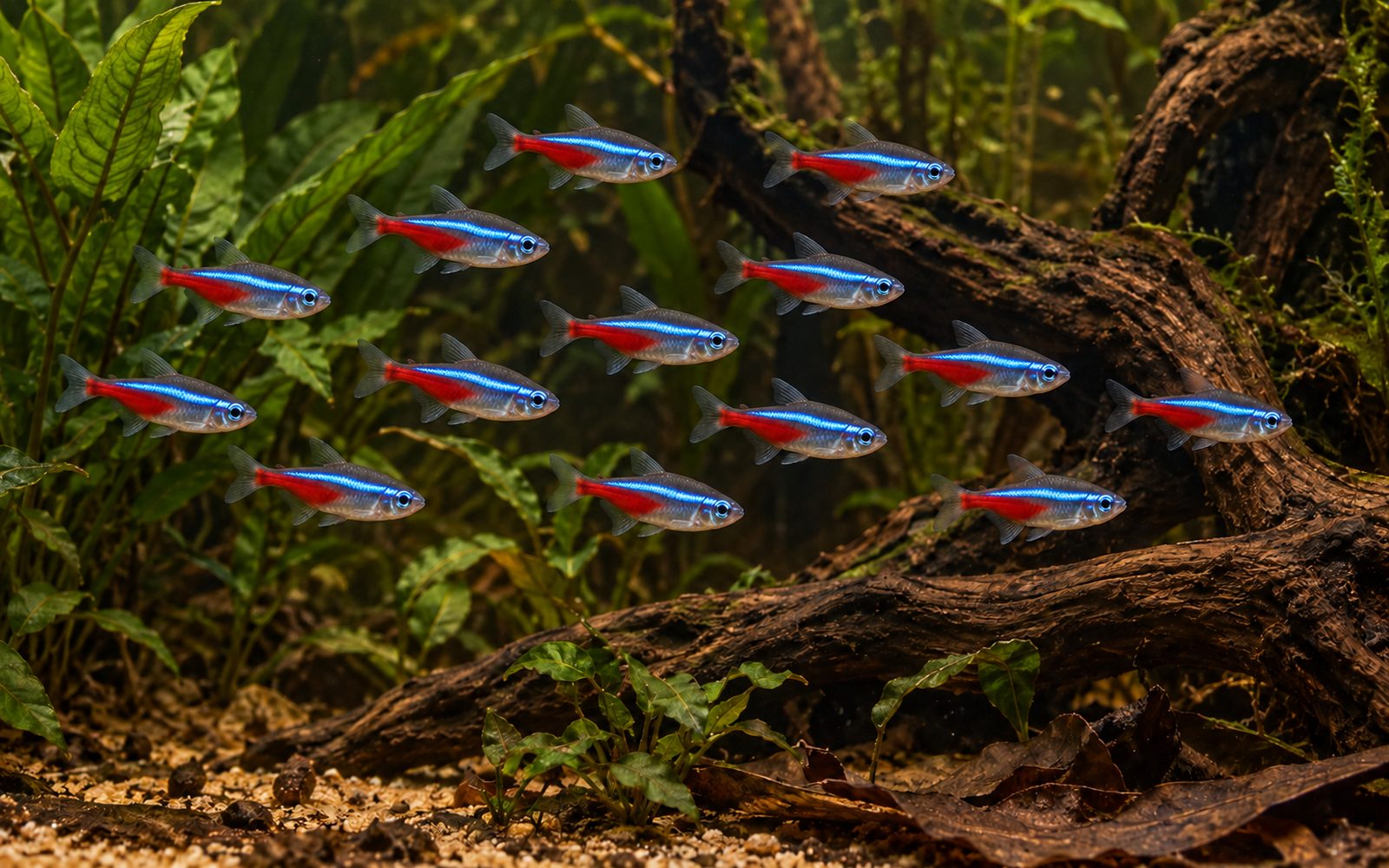
On its own it is a small, inconspicuous fish; kept as a school of at least 8–10, swimming together in front of a dark substrate and green plants, neons create one of the liveliest sights an aquarium can offer.
Natural Habitat
In the wild it lives in slow-flowing, leaf- and root-filled tributaries of the Amazon. These waters are tea-colored from tannins, very soft and acidic (pH 4–6). The forest canopy above filters the light; the neon's bright stripe helps the school keep sight of each other in this dim environment.
To recreate this in the aquarium you can use dark sand, roots and dried catappa (Indian almond) leaves. It is not essential for farm-bred neons, but it noticeably brightens their colors.
Tank Setup
- Volume: at least 54–60 liters for a school of 10 neons. Schooling fish swim lengthwise; a tank length of 60 cm or more matters more than volume.
- Water: 22–25°C is ideal. pH 6–7, soft to moderately hard water. Stable values matter more than hitting an exact number.
- Mature aquarium: Neons are sensitive to ammonia and nitrite swings. They should not be the first fish added to a newly set-up tank that has not finished cycling.
- Decor: Densely planted edges with open swimming space in the middle. Floating plants soften the light.
- Filter: Gentle flow is enough; strong outlets tire the fish.
Diet
Omnivorous and not fussy. Its mouth is small, so food must be fine:
- Small granules or finely crushed flakes as the staple
- Frozen or live brine shrimp, daphnia or small bloodworms 2–3 times a week
- Feed 1–2 times a day, only as much as is eaten within 2–3 minutes
The red color becomes more vivid with carotenoid-rich foods (brine shrimp, spirulina food).
Behavior and Compatibility
Extremely peaceful; it gets along well with larger but peaceful species. It feels safe in a large school and hides and loses color when kept in small numbers.
Good companions: corydoras, otocinclus, small rasboras, dwarf gouramis, shrimp (it leaves adult shrimp alone but may eat newborn shrimplets).
Avoid: fish with mouths big enough to swallow a neon. Angelfish look compatible while young but hunt neons once grown. Busy, nippy species such as tiger barbs stress neons. Goldfish are unsuitable because of both their temperature needs and their mouth size.
Group and Colony Structure
The neon tetra is a schooling fish and finds safety in numbers: at least 8, ideally 15 or more individuals. The sex ratio does not matter; a mixed group behaves naturally.
As the school grows, the fish swim more confidently, their colors brighten and they move together through the middle of the tank. Neons kept in small numbers retreat to the corners, fade and become more prone to disease. Completing the school in one or two batches helps newcomers join the group. When kept with the similar-looking cardinal tetra, the two species usually form separate schools.
Breeding
Breeding it in the aquarium is difficult but not impossible. It needs a separate breeding tank with very soft (GH < 4), acidic (pH 5–6) water and dim light. The female scatters her eggs over fine-leaved plants or a spawning mop; the parents eat the eggs, so they are removed after spawning. The eggs are light-sensitive; they hatch within 24 hours, the fry become free-swimming after 3–4 days and are fed infusoria.
Health and Common Problems
- Neon tetra disease (Pleistophora): patchy loss of color, white spots on the body, a curved spine and swimming apart from the school. There is no cure; the sick fish must be removed immediately. Quarantining new fish for 2 weeks is the best protection.
- White spot (ich): common after sudden temperature changes. Raising the temperature slowly to 28°C and using a suitable medication is effective.
- Sudden deaths: usually caused by an immature aquarium or an abrupt water change. Match the temperature of the new water and do not change more than 30% at once.
Sexing
Females are plumper with a rounder belly, which makes the blue stripe look slightly bent in females. Males are slimmer and straighter, and the stripe runs perfectly straight. The difference is easiest to see from above.
Tank mates
This list is calculated automatically from the species profile and grows as new species are added to the catalog. Try it in the planner for a definite answer.
Usually compatible
 Flame Tetra
 Blackfin Corydoras
 Polystictus Corydoras
 Emerald Cory
 Emerald Dwarf Rasbora
 Porthole Catfish
 Keyhole Cichlid
 Geophagus surinamensis
 Cryptocoryne Parva
 Gold Spot Pleco (L001)
Should not be kept together







Hobbyist notes
Things you won't find in books, learned by trial and error. The most helpful ones are on top.
Change history and contributors
- Page created · October 16, 2026