
Water parameters
Overview
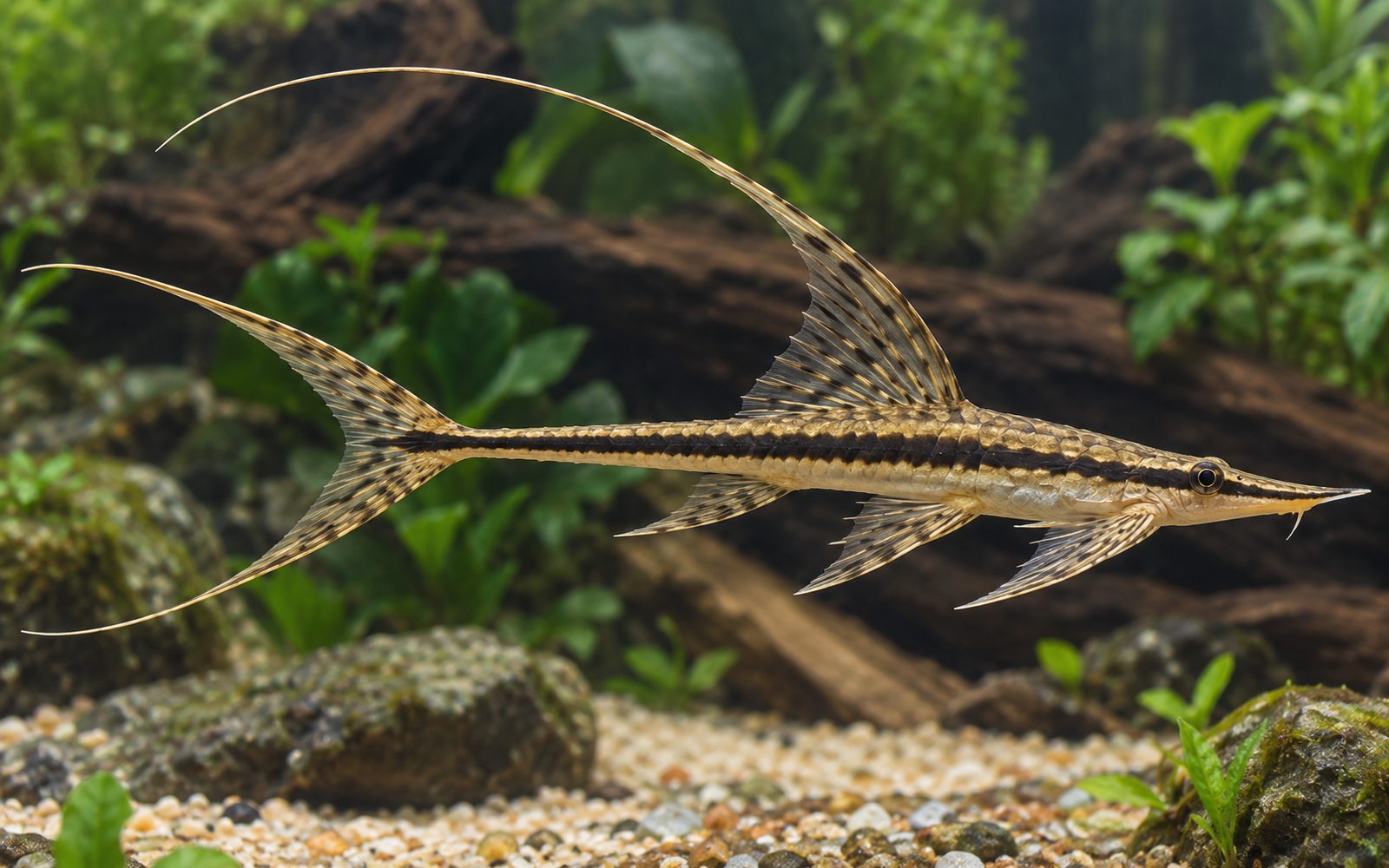
The royal whiptail is one of the most elegant suckermouth catfish, with its long, slender body, pointed snout and long fin extensions. In the hobby it was long known as Sturisoma panamense, and was later moved, together with species from west of the Andes, to the genus Sturisomatichthys. In shops it is sometimes also mistakenly sold as "royal farlowella."
Adults reach 20–25 cm, but because the body is very slender it does not produce as much waste as large plecos of the same length. It does not damage plants and grazes algae on the glass and leaves; however, it is sensitive to the need for clean, oxygenated water.
Natural Habitat
It lives on rocks, gravel and fallen branches in flowing rivers of Panama, Colombia and Ecuador. The water is clean, oxygen-rich and moderately hard. The fish cling to stones and branches where the current is strong and graze algae on the surfaces.
Tank Setup
- Volume: At least 200 liters and 120 cm in length for a pair.
- Flow and oxygen: A powerful filter, noticeable flow and aeration are essential.
- Decor: Roots, flat stones, plants; the area of glass in the current is used as a spawning surface.
- Water: 24–26°C, a 30% water change every week, low nitrate.
Diet
Mainly herbivorous. Spirulina and vegetable wafers, blanched zucchini, cucumber, spinach and peas should be the staple; brine shrimp, daphnia or small bloodworms can be added a few times a week. Since it feeds slowly, make sure fast bottom dwellers do not steal its food.
Behavior and Compatibility
Extremely peaceful; it can stay motionless all day clinging to a root, the glass or a plant leaf. It does no harm to other fish, shrimp or plants.
Good companions: Tetras, rasboras, rainbowfish, corydoras, calm gouramis, shrimp.
Avoid: Fin-nippers (they target the long fin extensions), aggressive cichlids that claim the bottom, large, greedy plecos.
Group and Colony Structure
Keeping it as a pair is ideal. In a large aquarium several individuals can also live together; males only have brief disputes over spawning surfaces.
Breeding
It breeds in the aquarium. The female sticks her eggs on the flat surface of the glass, a root or a large leaf in an area with flow. The male stays over the eggs, guarding and cleaning them. Once the yolk sac is used up, the fry are fed fine vegetable powder, biofilm and micro foods.
Health and Common Problems
It is sensitive to water quality; nitrate buildup and low oxygen lead to loss of appetite and fin problems. Starvation is common in new individuals. It is sensitive to copper.
Sexing
Mature males develop short, dense odontodes (like whiskers) on the sides of the head and on the cheeks. Females have a smooth head and a plumper belly when viewed from above.
Tank mates
This list is calculated automatically from the species profile and grows as new species are added to the catalog. Try it in the planner for a definite answer.
Usually compatible
 Flame Tetra
Glass Tetra
Flame Tetra
Glass Tetra
 Blackfin Corydoras
 Polystictus Corydoras
 Emerald Betta
 Emerald Cory
 Porthole Catfish
 Keyhole Cichlid
 Firemouth Cichlid
 Cupid Cichlid
Should not be kept together


Hobbyist notes
Things you won't find in books, learned by trial and error. The most helpful ones are on top.
Change history and contributors
- Page created · October 16, 2026