
Water parameters
Overview
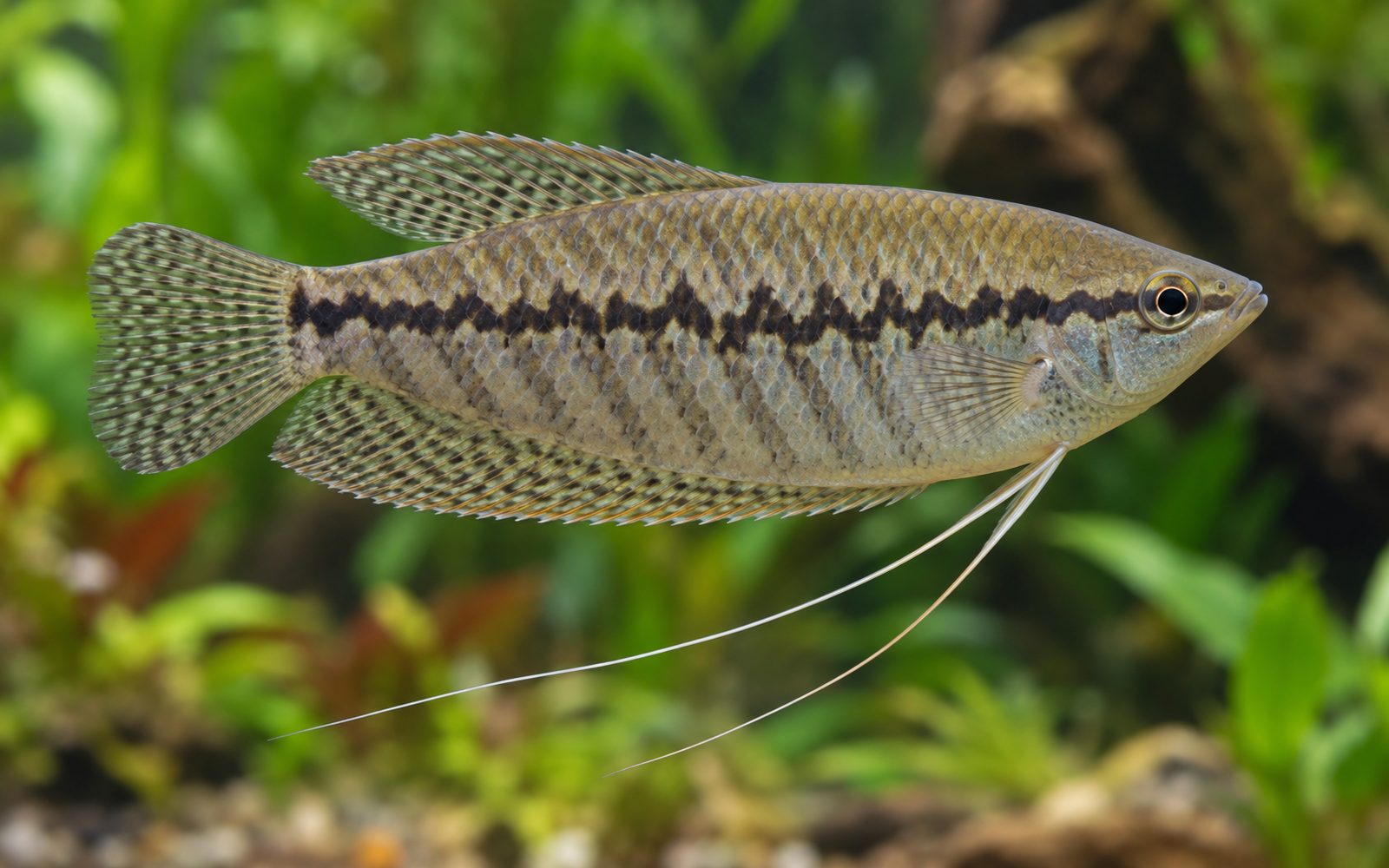
The snakeskin gourami is one of the largest species of the genus Trichopodus; it can exceed 20 cm in the wild and usually grows to 15–20 cm in the aquarium. On its olive-gray body, a broken, zigzag dark stripe running from the eye to the tail and the pale slanted bands crossing it form a pattern resembling snakeskin. It is an important food fish in Thailand and the surrounding region, where it is eaten dried.
Despite its size, it is noticeably calmer than its relative the blue gourami. With its slow movements and docile nature, it is a suitable labyrinth fish for large community aquariums.
Natural Habitat
It lives in swamps, lakes, canals and rice paddies of the Mekong and Chao Phraya basins, in densely vegetated, shallow and still water. It is well adapted to low-oxygen, warm water thanks to its labyrinth organ. It is widely farmed in rice paddies.
Tank Setup
- Volume: at least 250 liters for a single fish or a small group, with a length of 120 cm or more.
- Water: 24–28°C is ideal; it adapts to pH 6–8 and a wide range of hardness.
- Decor: floating plants, roots and a large open swimming area.
- Flow: gentle; use strong pumps with a soft outlet.
- Filter: because of its large size and appetite, a powerful canister filter and weekly water changes of 25–30% are needed.
Diet
Omnivorous but feeds mainly on plant matter. Spirulina flakes and granules should be the staple; add blanched spinach, zucchini and peas along with frozen bloodworms, brine shrimp and daphnia. Feed in moderation 1–2 times a day; because it has a big appetite, it easily gets fat.
Behavior and Compatibility
Calm, slow and peaceful; it rarely causes trouble with other fish. In the breeding season males defend the area around the nest. It may eat very small fish and shrimplets that fit in its mouth.
Good companions: medium to large calm tetras and barbs, pearl gourami, moonlight gourami, kissing gourami, bristlenose pleco, large corydoras species, clown loach.
Avoid: fin nippers, large aggressive cichlids, fish small enough to fit in its mouth (Boraras, galaxy rasbora).
Group and Colony Structure
It can be kept alone, as a pair or as a mixed group of a few fish. Rivalry between males is milder than in other large gouramis; a group of 3–4 lives comfortably in 300 liters or more. Not keeping more males than females in the group reduces chasing in the breeding season.
Breeding
The male builds a bubble nest among floating plants at the surface. Many eggs are released during the embraces; the male places them in the nest and guards them. The female should be removed after spawning. The fry are small and need infusoria in the first days, then newly hatched brine shrimp. Because of its size, breeding in the aquarium requires a large, shallow tank.
Health and Common Problems
Very hardy. Overfeeding and poor water quality are the most common problems; fin rot and bacterial infections occur under these conditions. Cold water changes can trigger ich.
Sexing
The male's dorsal fin is long and pointed and can reach the caudal fin; the female's is short and rounded. Males are generally slimmer, with a more contrasting pattern. Mature females have a noticeably full belly.
Tank mates
This list is calculated automatically from the species profile and grows as new species are added to the catalog. Try it in the planner for a definite answer.
Usually compatible
 Flame Tetra
 Yellow Regal Peacock
Glass Tetra
Yellow Regal Peacock
Glass Tetra
 Blackfin Corydoras
 Polystictus Corydoras
 Emerald Betta
 Emerald Cory
 Emerald Dwarf Rasbora
 Porthole Catfish
 Altum Angelfish
Should not be kept together




Hobbyist notes
Things you won't find in books, learned by trial and error. The most helpful ones are on top.
Change history and contributors
- Page created · October 16, 2026