
Water parameters
Overview
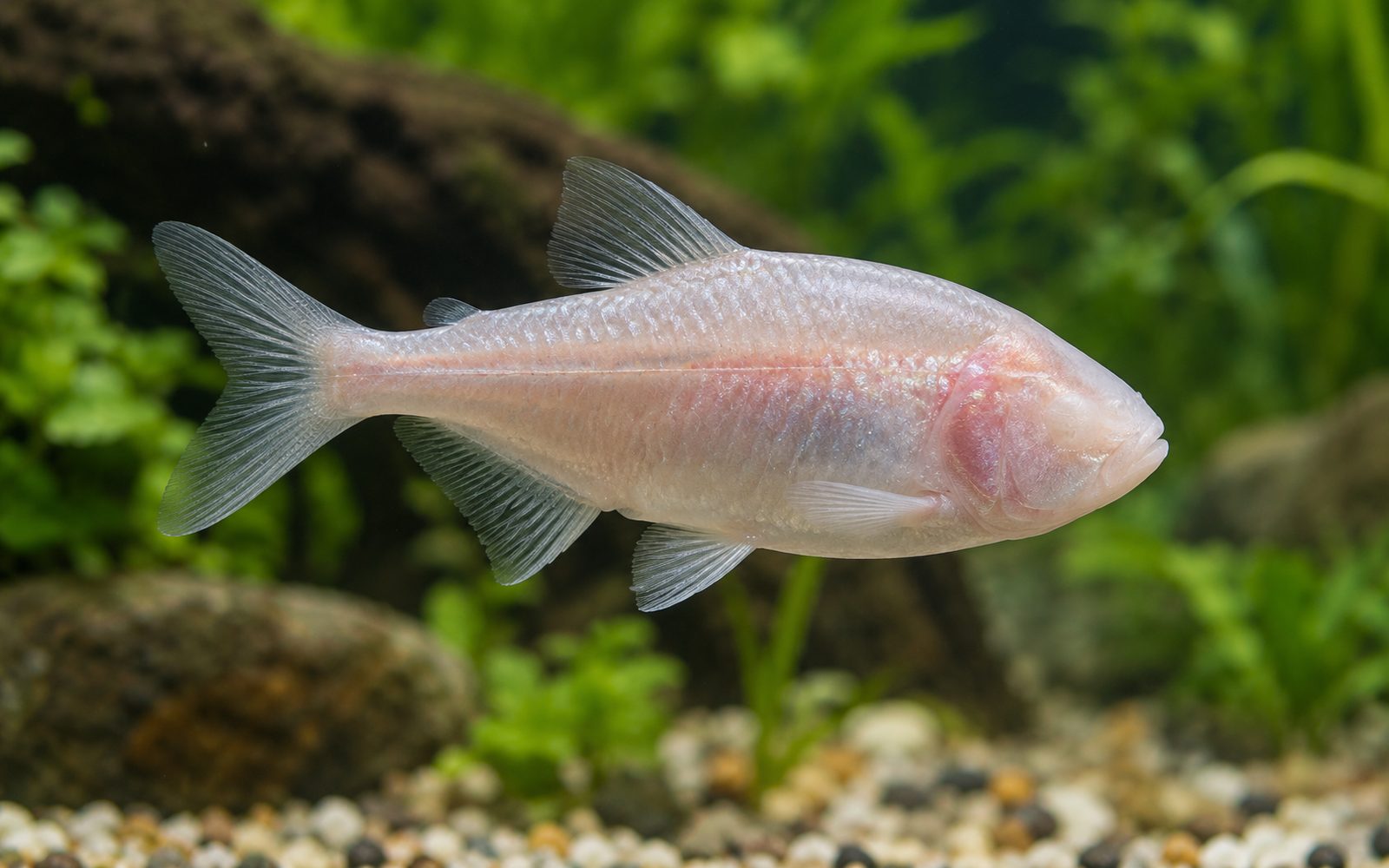
The blind cave tetra is the form of the Mexican tetra that lives in underground caves. As a result of living in total darkness for a long time, its eyes do not develop and become covered with skin; it has also lost its pigment, so its body is pinkish-white. It finds its way with its lateral line organ, which senses vibrations and pressure differences in the water, and it detects food through taste and smell.
The sighted, silvery surface form of the same species is also known among aquarists as the "Mexican tetra." The blind form is a model organism widely used in evolutionary and developmental biology research. It is hardy, has a big appetite and is easy to care for.
Natural Habitat
The surface form of the species lives in rivers and streams stretching from Texas to eastern Mexico. The blind populations are found in limestone caves in northeastern Mexico, in pools that are completely dark and keep a constant temperature all year round. These waters are usually hard and slightly alkaline.
Tank Setup
- Volume: at least 120 liters for a group of 5–8; 80–100 cm of length.
- Water: 20–25°C; pH 6.5–8, medium to hard water. A heater is not essential in most room conditions.
- Decor: because it has no eyes, avoid stones with sharp edges. Sand or rounded gravel, smooth stones and roots are suitable; light intensity does not matter.
- Plants: it usually does not harm plants, but it may uproot newly planted ones while stirring up the substrate.
Diet
Omnivorous with a very big appetite. Sinking granules and tablets, flakes, frozen bloodworms, brine shrimp and mysis shrimp are suitable. Because it finds food by smell and taste, sinking foods work better. Avoid overfeeding.
Behavior and Compatibility
Relatively peaceful but active and greedy. It has minor scuffles with its own kind; it may bite the fins of slow, long-finned fish. It eats small fish and shrimp that fit in its mouth.
Good companions: robust species of similar size: barbs, danios, large corydoras, Ancistrus, peaceful medium-sized cichlids, large tetras.
Avoid: neons and similar small tetras, dwarf shrimp, long-finned fish such as bettas and fancy guppies, overly skittish species.
Group and Colony Structure
It lives in a loose group: at least 5, ideally 8 individuals. A mild pecking order forms within the group, but serious fights are rare. Fish kept alone may bother other species more. The sex ratio does not matter.
Breeding
It is an egg scatterer and breeds easily in the aquarium. In a separate tank it lays a large number of eggs on fine-leaved plants or a spawning grid; the parents must be removed because they eat the eggs. The fry hatch in 1–2 days. As an interesting detail, eye buds begin to form in the embryos but regress in later stages of development and remain under the skin.
Health and Common Problems
- Injury: because it has no eyes, it may bump into sharp decor; choose decor with smooth contours.
- Obesity: because it has a very big appetite, it easily becomes fat; feed in moderation and with a balanced diet.
- General: it is resistant to disease.
Sexing
Females are larger with a noticeably plumper belly. Males are more slender; the difference becomes clearer especially in mature fish.
Tank mates
This list is calculated automatically from the species profile and grows as new species are added to the catalog. Try it in the planner for a definite answer.
Usually compatible
 Yellow Regal Peacock
Glass Tetra
Yellow Regal Peacock
Glass Tetra
 Emerald Betta
 Porthole Catfish
 Keyhole Cichlid
 Firemouth Cichlid
 Buffalohead Cichlid
 Geophagus surinamensis
 Rainbow Cichlid
 Gymnogeophagus balzanii
Should not be kept together






Hobbyist notes
Things you won't find in books, learned by trial and error. The most helpful ones are on top.
Change history and contributors
- Page created · October 16, 2026