
Water parameters
Overview
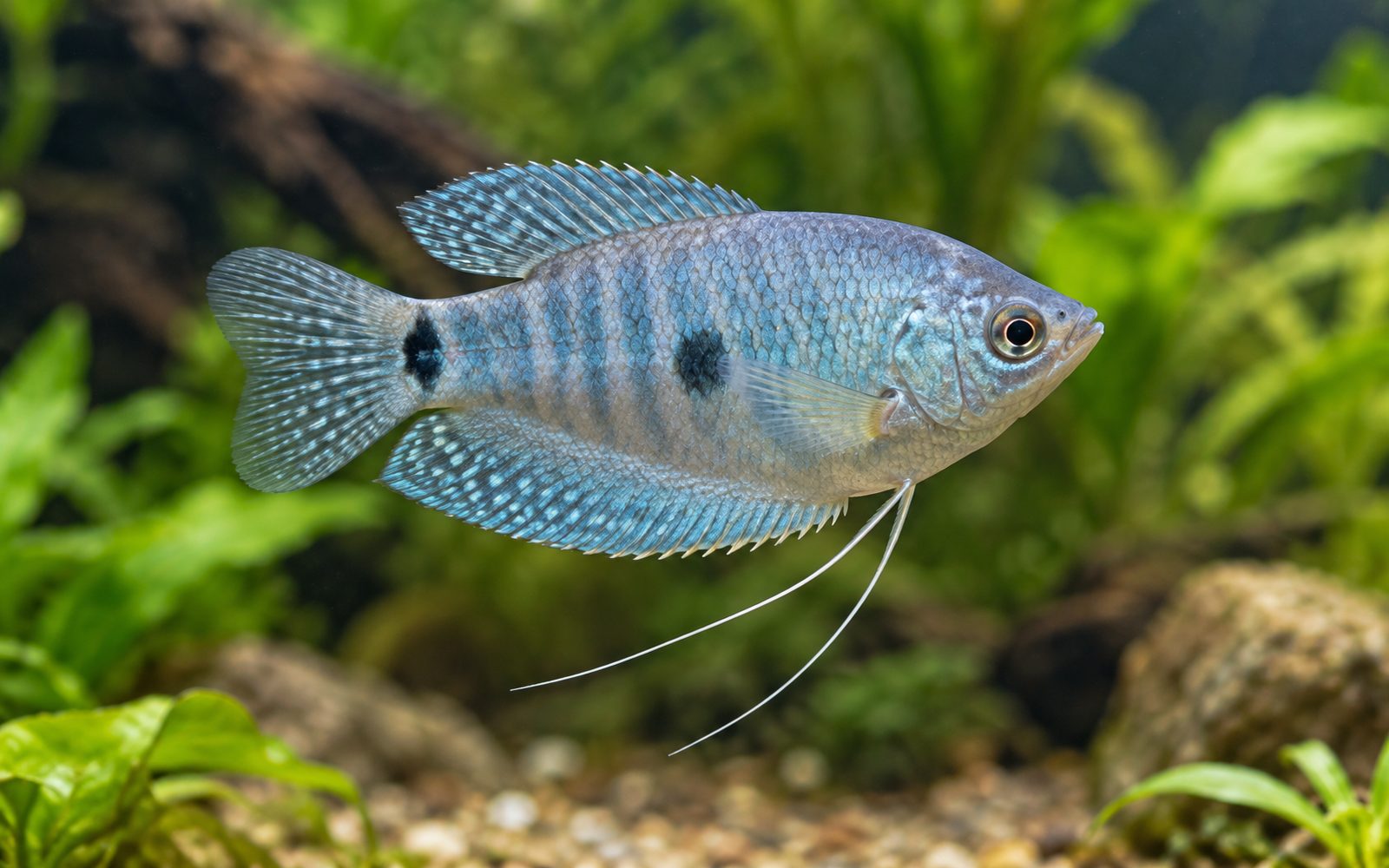
The blue gourami has two dark spots on its sides, one in the middle of the body and the other on the caudal peduncle; since the eye counts as the third spot, it is also called the "three spot gourami." There are gold, opaline (marbled) and platinum forms. It is a relative of the betta and takes oxygen from the air with its labyrinth organ.
It is hardy and has a good appetite, but it reaches 12–15 cm and its temperament varies from individual to individual.
Natural Habitat
It lives in lakes, swamps, canals and rice paddies of Southeast Asia, in plant-rich, still and warm water.
Tank Setup
- Volume: at least 120 liters for a single male or a small group.
- Surface: floating plants and plants reaching the surface; because it breathes air from the surface, warm air should remain between the lid and the water.
- Water: 24–27°C; adapts to a wide range of values.
Diet
Omnivorous. Flakes and granules, spirulina, frozen bloodworms and brine shrimp. It is known for eating hydra and planaria, which is why some hobbyists use it as a "hydra cleaner."
Behavior and Compatibility
Peaceful when young; mature males become aggressive toward their own species and similar gouramis. Some individuals hunt small fish and shrimp.
Good companions: medium to large peaceful fish: large tetras, barbs (non-nipping ones), corydoras, bristlenose pleco, mollies, platies.
Avoid: other male gouramis, bettas, dwarf gouramis, shrimp, very small fish.
Group and Colony Structure
A single male is the safest setup. If females are kept with a male, there should be 2–3 females per male; a single female is worn out by the male's attention. Two males can only be tried in an aquarium of 200 liters or more with the surface divided by plants.
Breeding
The male builds a bubble nest at the surface and draws the female beneath it; hundreds of eggs are placed in the nest. The female should be removed after spawning. The male guards the nest until the fry become free-swimming, then he is removed too. The fry are fed infusoria.
Health and Common Problems
Hardy. In poor water, bacterial infections and fin rot can occur; breathing cold air can lead to respiratory problems.
Sexing
The male's dorsal fin is long and pointed, the female's short and rounded. In the breeding season the male darkens and the female becomes plump with eggs.
Tank mates
This list is calculated automatically from the species profile and grows as new species are added to the catalog. Try it in the planner for a definite answer.
Usually compatible
 Yellow Regal Peacock
Glass Tetra
Yellow Regal Peacock
Glass Tetra
 Emerald Betta
 Firemouth Cichlid
 Cupid Cichlid
 Buffalohead Cichlid
 Chocolate Cichlid
 Festivum
 Geophagus altifrons
 Geophagus surinamensis
Should not be kept together




Hobbyist notes
Things you won't find in books, learned by trial and error. The most helpful ones are on top.
Change history and contributors
- Page created · October 16, 2026