
Water parameters
Overview
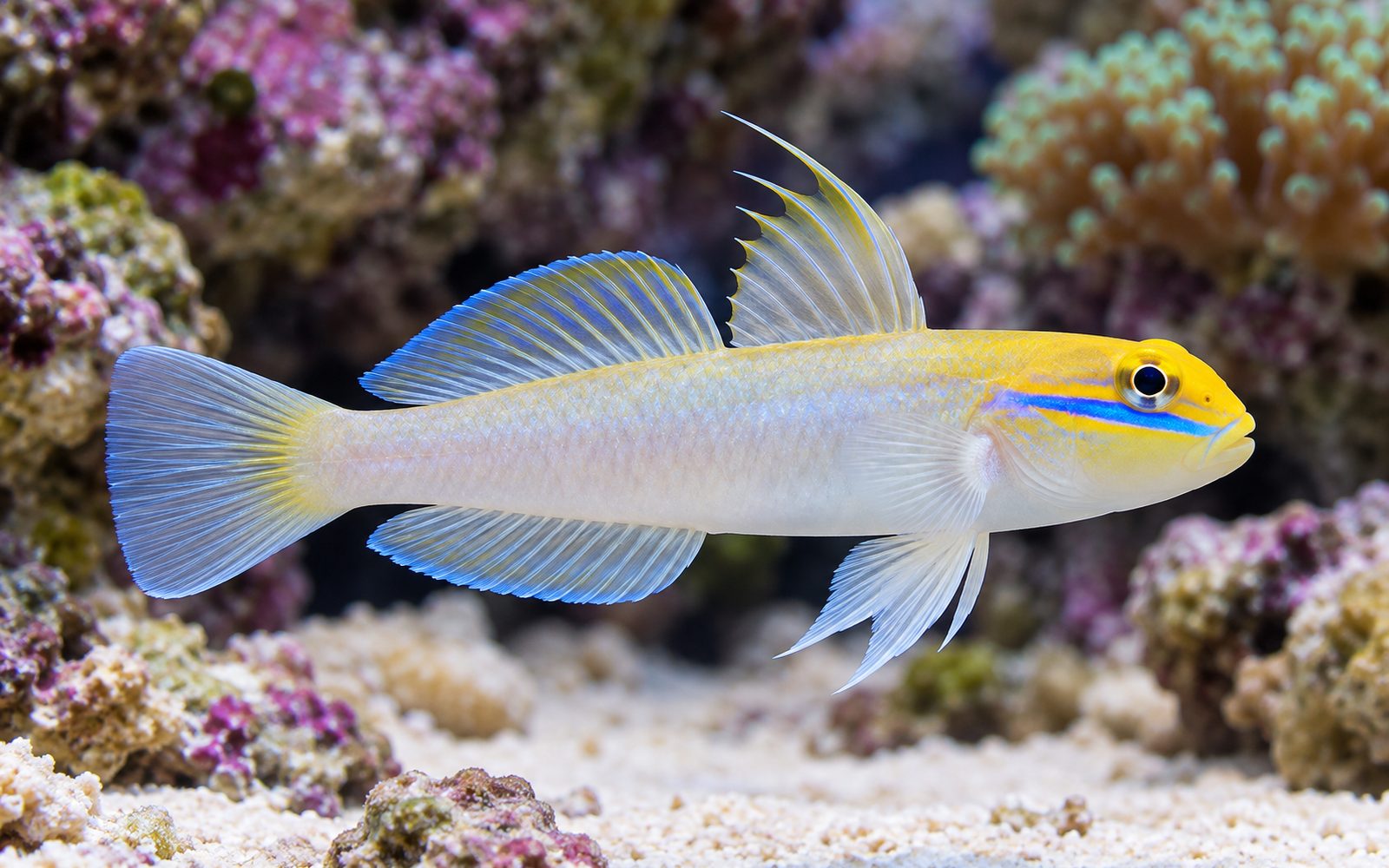
The goldhead sleeper goby is recognized by its long whitish body, yellow head and the bright blue line on its cheek. It takes sand into its mouth, sifts it through its gills and eats the small organisms inside; in doing so it constantly stirs the sand bed and keeps its surface clean.
The same trait makes it challenging: in a small or newly set-up aquarium it quickly exhausts the organisms in the sand, and if it is not fed enough it wastes away and dies. It reaches 15 cm and is prone to jumping. It is suitable for a mature, large aquarium.
Natural Habitat
It lives in Indo-Pacific lagoons and on reef slopes, on sand and rubble flats. Pairs dig a burrow under rocks and sift sand together around their burrow all day long.
Tank Setup
- Volume: at least 200 liters; a large sand surface matters even more than volume.
- Water: salinity 1.023–1.026 specific gravity, pH 8.1–8.4, temperature 24–27°C.
- Maturity: it should be added to an aquarium that is at least a few months old, with plenty of life in its sand and rocks.
- Substrate: fine to medium sand 5–8 cm deep. Set rocks directly on the glass; the goby may dig underneath them.
- Reef compatibility: reef safe; it does not touch corals or shrimp. However, it scatters the sand it sifts in all directions; corals placed near the bottom may get covered with sand.
- Lid: a tight-fitting lid is essential.
Diet
Carnivorous. In addition to the organisms in the sand, offer sinking foods 2–3 times a day: frozen mysis, brine shrimp, copepods and small granules. Make sure the food reaches the bottom. A sunken belly is the first sign of starvation.
Behavior and Compatibility
Peaceful toward other fish. It is territorial toward unfamiliar members of its own species and other sand-sifting gobies. It spends a lot of time with its mate.
Good companions: clownfish, cardinalfish, chromis, tangs, blennies, cleaner shrimp.
Avoid: other Valenciennea species (in a small tank), other sand-sifting gobies, aggressive damsels, large predators.
Group and Colony Structure
Kept singly or as a mated pair. In the wild it lives in monogamous pairs; buying a mated pair is best. Two unpaired adults together will fight. Because two individuals exhaust the food in the sand faster, a larger aquarium is needed if a pair is kept.
Breeding
The pair lays its eggs in its burrow under a rock; the eggs are guarded inside the burrow. Spawning can be seen in the aquarium, but raising the planktonic larvae is very difficult.
Health and Common Problems
- Starvation: the most common cause of death; watch how full the belly is during the first weeks. A weakened individual struggles to recover, so intervene early.
- Jumping: a major risk in an uncovered aquarium.
- Marine ich and velvet: quarantine new arrivals.
Sexing
There is no reliable external difference.
Tank mates
This list is calculated automatically from the species profile and grows as new species are added to the catalog. Try it in the planner for a definite answer.
Should not be kept together





Hobbyist notes
Things you won't find in books, learned by trial and error. The most helpful ones are on top.
Change history and contributors
- Page created · October 16, 2026