
Water parameters
Overview
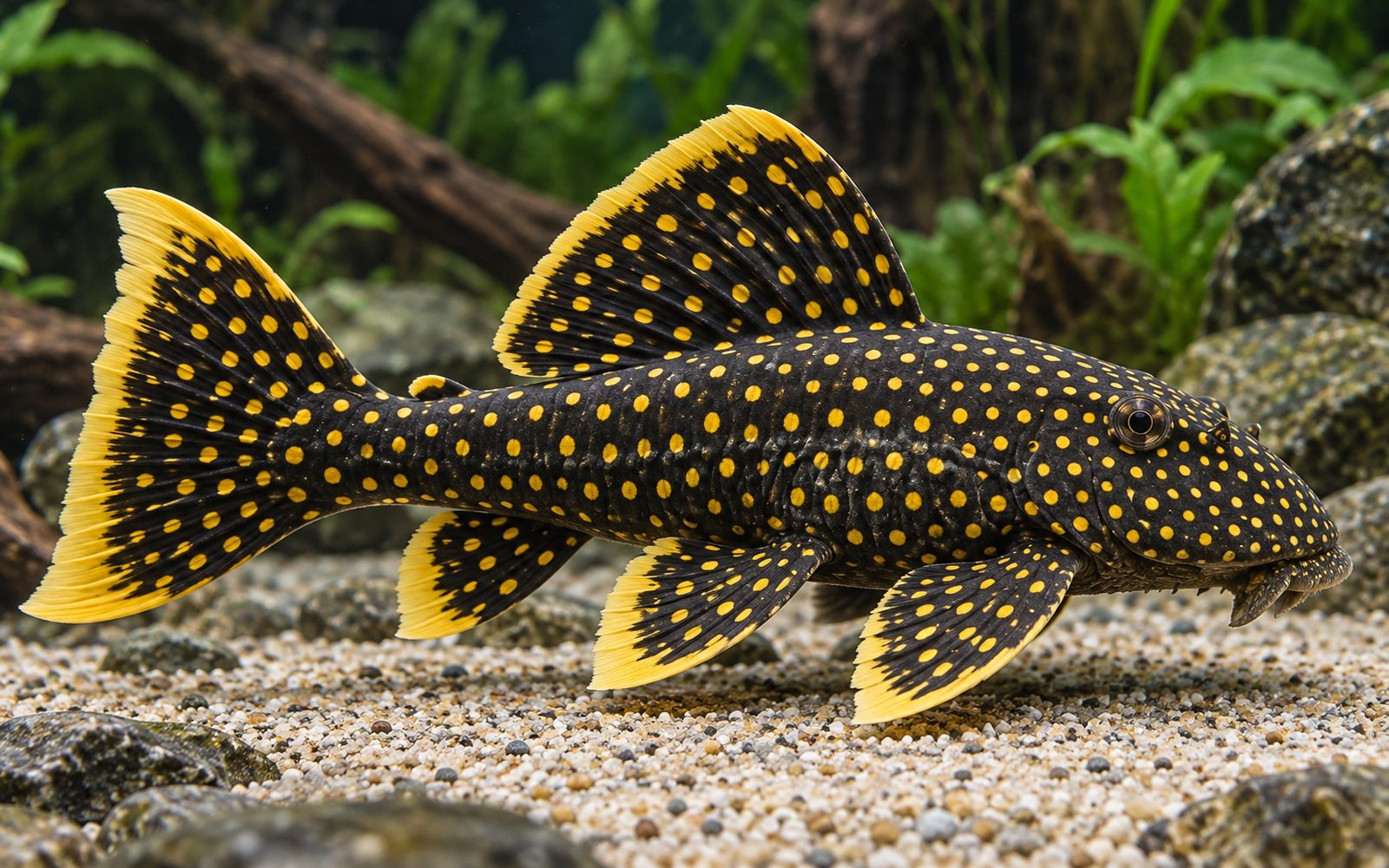
The sunshine pleco is one of the showiest large plecos, with yellow spots on its dark body and broad yellow edges on its fins. As a juvenile it resembles the gold nugget pleco, but it grows larger: adults reach 30–35 cm.
The teeth of the genus Scobinancistrus are suited to cracking the shells of snails and crustaceans. For this reason it feeds mainly on meaty foods; it should not be bought as an algae cleaner.
It grows slowly and lives for many years; a 6–8 cm juvenile becomes the largest fish in the aquarium within a few years. Therefore an aquarium suited to its adult size should be planned before buying. Since most individuals on sale are wild-caught, it is important to feed them well in a calm quarantine tank during the first weeks.
Natural Habitat
It lives in the fast-flowing, rocky stretches of the Xingu River. It hides in large hollows among piles of stones and eats snails and small invertebrates on the rocks.
Tank Setup
- Volume: At least 500 liters and 150 cm in length for one adult.
- Flow and oxygen: A powerful filter, a circulation pump and aeration.
- Cave: A large cave or rock hollow suited to its body.
- Water: 27–29°C, with a 30–40% water change every week. A meaty diet fouls the water quickly.
- Substrate: Sand and rounded gravel; take care that meaty foods do not get trapped between the rocks and rot.
Diet
Carnivorous. Mussel, shrimp and fish pieces, krill, bloodworms, mysis and protein-rich sinking wafers should be the staple. It loves live snails; it will wipe out the aquarium's snail population in a short time. It may accept small amounts of vegetables, but these should not be the staple. Siphon out leftover food within a few hours.
Behavior and Compatibility
It is generally calm toward other fish, but territorial toward its own kind and plecos of similar size. It is active at night. It eats shrimp and snails.
Good companions: Medium to large fish that like warm water: large tetras, Geophagus species, medium-sized American cichlids.
Avoid: Shrimp, snails, other large plecos (in a confined space), small aquariums.
Group and Colony Structure
In a home aquarium a single individual is kept.
Breeding
In the wild it breeds in rock hollows. Breeding in the aquarium is very rare; most individuals on sale are wild-caught. Breeding in the aquarium requires a very large footprint, strong flow and caves sized to its body.
Health and Common Problems
Hardy, but because a meaty diet fouls the water quickly, watch out for rising nitrate. It loses its appetite when oxygen is low. It is sensitive to copper.
Sexing
Difficult to tell apart externally. Mature males have a wider head and longer odontodes on the pectoral fin spines.
Tank mates
This list is calculated automatically from the species profile and grows as new species are added to the catalog. Try it in the planner for a definite answer.
Usually compatible
 Emerald Betta
 Emerald Cory
 Altum Angelfish
 Keyhole Cichlid
 Firemouth Cichlid
 Cupid Cichlid
 Buffalohead Cichlid
 Chocolate Cichlid
 Discus
Should not be kept together



Hobbyist notes
Things you won't find in books, learned by trial and error. The most helpful ones are on top.
Change history and contributors
- Page created · October 16, 2026