
Water parameters
Overview
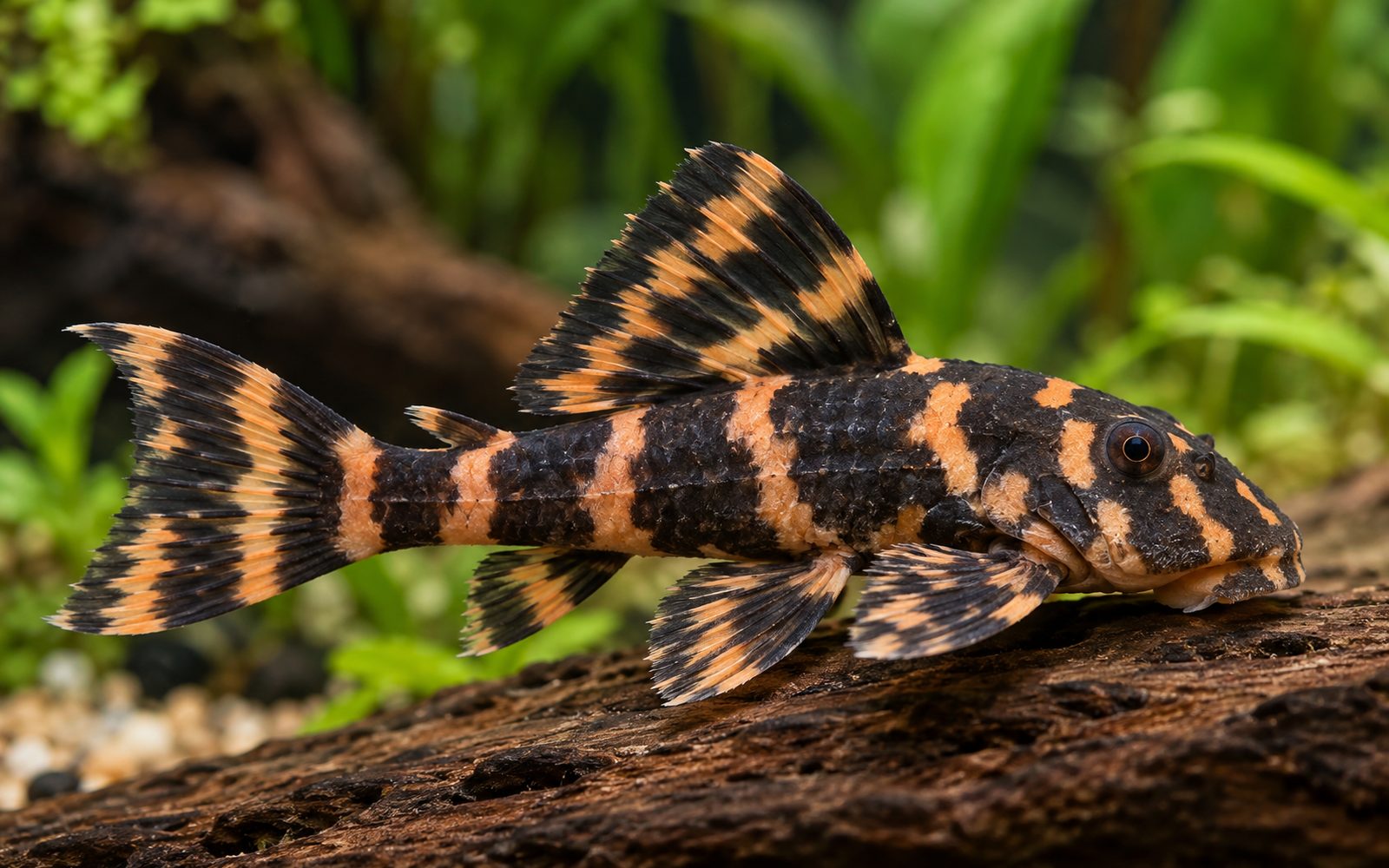
The clown pleco is one of the most suitable plecos for home aquariums thanks to its small size, hardiness and colorful bands. Adults rarely exceed 8–9 cm. The color of the bands ranges from orange to light cream depending on the individual and its origin; some individuals can be almost entirely dark.
As a member of the genus Panaqolus, it is a wood-eating species: it rasps on and swallows driftwood. This means there must always be wood in the aquarium. In older sources it may appear in the genus Peckoltia or Panaque. It can be confused with the similar L448, which grows larger.
Natural Habitat
It lives among sunken tree trunks, branches and root tangles in the rivers and streams of the Orinoco basin. In this environment it both hides and feeds on decaying wood and the biofilm on it.
Tank Setup
- Volume: 80 liters for one or two individuals.
- Wood is essential: Several pieces of wood (hard and soft woods such as mangrove and mopani); the fish rasps on them constantly.
- Hiding: Spaces under roots, caves, pieces of pipe.
- Filter: Because it rasps on wood, it produces a lot of fine (sawdust-like) waste; powerful mechanical filtration and regular cleaning of the bottom are needed.
Diet
Wood fiber is part of its diet, but not enough on its own. Blanched zucchini, cucumber, peas and spinach and vegetable-based sinking wafers should be the staple. Protein-rich food such as bloodworms or shrimp can be given once a week. Too much protein and too little fiber lead to digestive problems.
Behavior and Compatibility
It is peaceful and leaves other fish alone. It hides under roots during the day and becomes active in the evening. It generally does not damage plants; it may occasionally rasp on soft leaves.
Good companions: Tetras, rasboras, corydoras, dwarf cichlids, gouramis, shrimp.
Avoid: Large cichlids that claim the bottom, much larger territorial plecos.
Group and Colony Structure
It lives happily on its own. More than one individual can be kept; males occasionally jostle over wood and caves, but serious fights are rare. There should be a separate hiding place for each individual.
Breeding
It has been bred in the aquarium, but it cannot be said to breed as easily as the common bristlenose. The male claims a cave or a hollow in a root; the female lays her eggs there and the male guards them until the fry hatch. The fry also start rasping on wood and vegetables right away.
Health and Common Problems
Hardy. The real problems are a lack of fiber and dirty water: digestive disorders are seen in individuals kept in an aquarium without wood. The accumulated sawdust-like waste should be siphoned regularly. It is sensitive to medications, especially copper.
Sexing
Mature males have prominent odontodes on the rear half of the body, toward the caudal peduncle, and thicker pectoral fin spines. Females look plumper and smoother.
Tank mates
This list is calculated automatically from the species profile and grows as new species are added to the catalog. Try it in the planner for a definite answer.
Usually compatible
 Flame Tetra
 Blackfin Corydoras
 Polystictus Corydoras
 Emerald Betta
 Emerald Cory
 Porthole Catfish
 Keyhole Cichlid
 Cupid Cichlid
 Geophagus altifrons
 Geophagus surinamensis
Should not be kept together






Hobbyist notes
Things you won't find in books, learned by trial and error. The most helpful ones are on top.
Change history and contributors
- Page created · October 16, 2026