
Water parameters
Overview
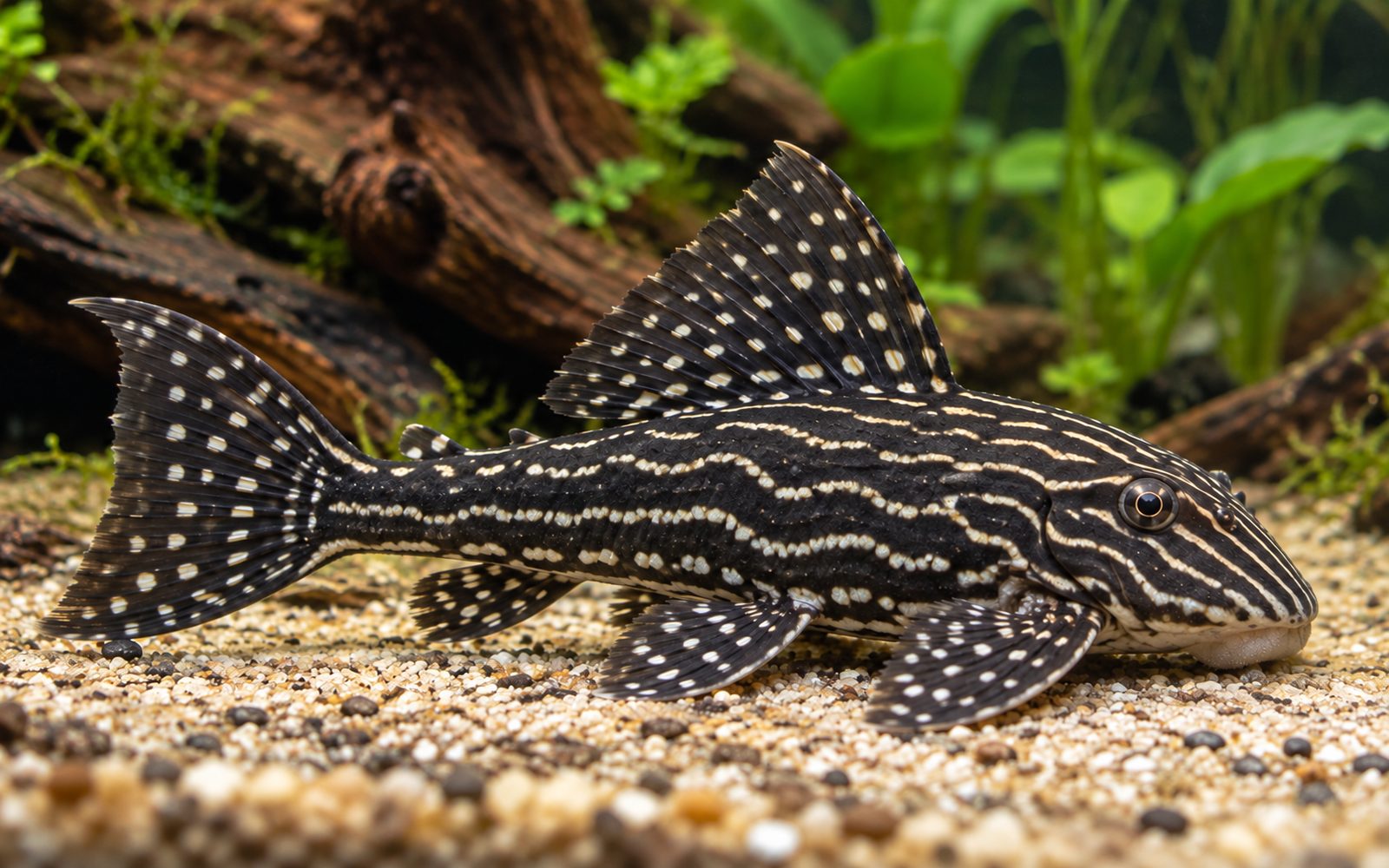
The flash pleco is one of the most admired members of the genus Panaqolus. Juveniles carry thin white lines on a black background; as they mature these lines become finer and break up into spots. Spotted adults are sometimes separated in the trade under the name "L204a". It was sold for a long time only under the number L204 and was described in 2013 as Panaqolus albivermis.
Like the clown pleco it is a wood-eating species, and the aquarium must contain driftwood. Adults reach 12–14 cm, so it needs a larger tank than the clown pleco.
Natural Habitat
In Peru it lives in fast-flowing stretches of the Ucayali basin, among fallen trees and piles of roots. The water is rich in oxygen, and there is plenty of decaying wood in the environment.
Tank Setup
- Volume: at least 120 liters for one or two fish.
- Wood is a must: several pieces of driftwood; the fish gnaws on them constantly.
- Filter: because there are plenty of wood shavings and waste, strong mechanical filtration and frequent gravel vacuuming are needed.
- Oxygen: heavy aeration and flow; soft water makes breeding easier.
- Water: 25–27°C, a 30% water change every week.
Diet
Wood fiber is the basis of its diet, but it is not enough on its own. Blanched zucchini, cucumber, spinach, peas and vegetable sinking tablets should be given regularly. Protein-rich food such as bloodworms or shrimp can be added once a week. Too much protein leads to digestive problems.
Behavior and Compatibility
Peaceful toward other species. Males of its own kind chase each other over caves and wood; with a large footprint these fights stay mild. It usually does not harm plants.
Good companions: Tetras, rasboras, corydoras, dwarf cichlids, gouramis.
Avoid: Large cichlids that claim the bottom, large territorial plecos, other Panaqolus species (in limited space).
Group and Colony Structure
It can be kept singly. More than one fish requires a separate cave and wood territory for each. For breeding, 1 male and 1–2 females are enough.
Breeding
It has been bred in the aquarium in soft water. The male claims a hollow in the wood or a cave, the female lays her eggs there, and the male guards the eggs and fry. The fry start rasping on wood and vegetables at an early age.
Health and Common Problems
Hardy, but low oxygen and dirty water cause problems. Digestive disorders can occur in an aquarium without driftwood. Sensitive to copper. The color of new arrivals may be pale due to shipping stress; with clean water and plenty of wood they usually recover within a few days.
Sexing
Mature males have prominent odontodes on the rear part of the body and on the caudal peduncle; their pectoral fin spines are thicker. Females are plumper and smoother.
Tank mates
This list is calculated automatically from the species profile and grows as new species are added to the catalog. Try it in the planner for a definite answer.
Usually compatible
 Flame Tetra
Glass Tetra
Flame Tetra
Glass Tetra
 Blackfin Corydoras
 Polystictus Corydoras
 Emerald Betta
 Emerald Cory
 Porthole Catfish
 Keyhole Cichlid
 Cupid Cichlid
 Buffalohead Cichlid
Should not be kept together






Hobbyist notes
Things you won't find in books, learned by trial and error. The most helpful ones are on top.
Change history and contributors
- Page created · October 16, 2026