
Water parameters
Overview
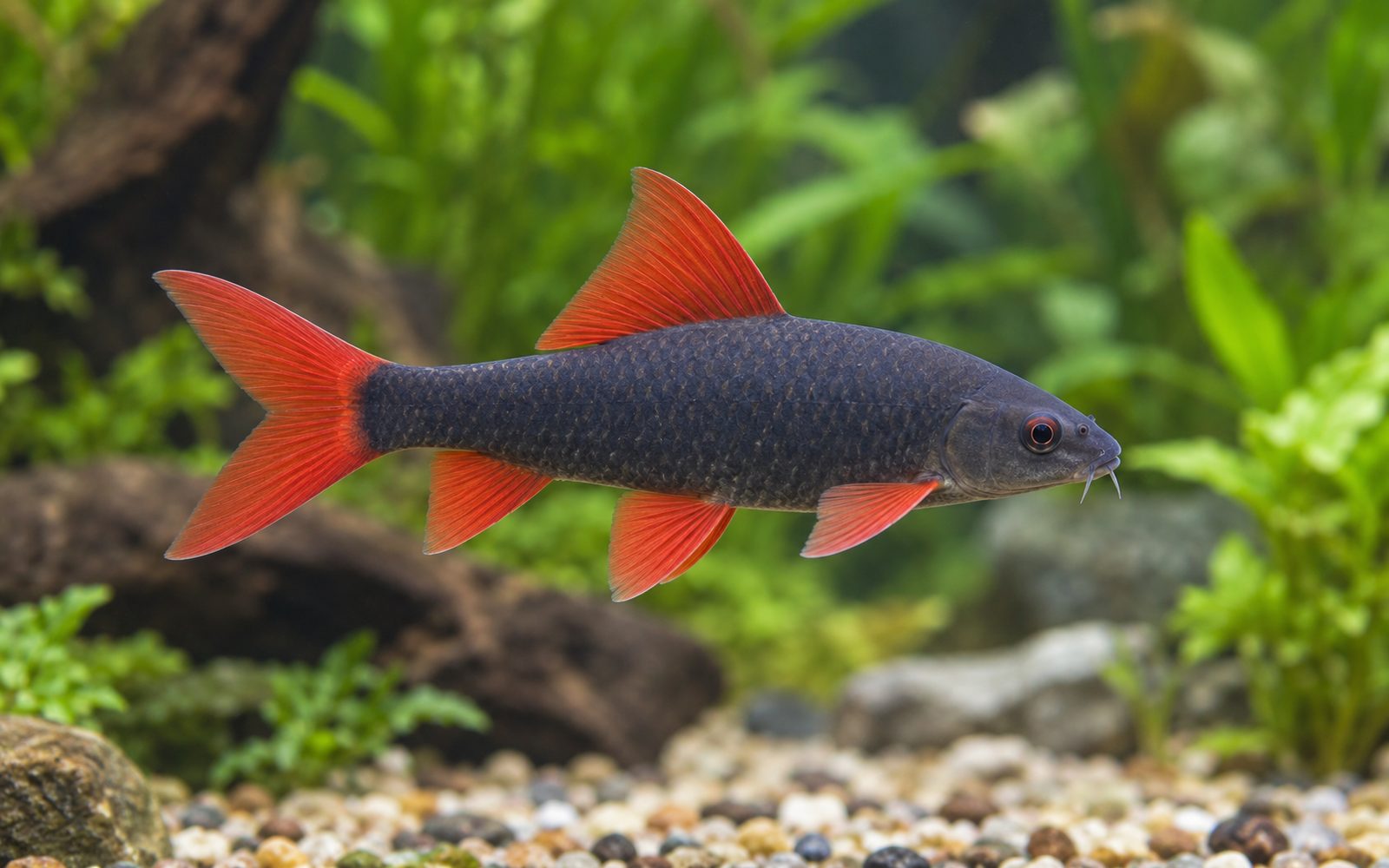
The rainbow shark is a cyprinid closely related to the red-tailed black shark. On its gray–blue body all of its fins (not only the tail) are bright red–orange; this sets it apart from its relative. An albino form with a pinkish-white body and red fins is also very common in the trade.
It looks docile when young; as it matures it claims a territory on the bottom and defends it fiercely against its own kind and similar-looking fish.
Color and Fin Varieties
- Albino: pinkish-white body, red fins and red eyes; its behavior is the same as the wild form.
Natural Habitat
It lives in rivers and streams of the Mekong, Chao Phraya and Mae Klong basins, over sandy and rocky bottoms. It is known to move into flooded areas in the rainy season.
Tank Setup
- Volume: at least 200 liters and 120 cm of length; a large footprint is important.
- Water: 24–26°C; clean, oxygen-rich water and gentle flow.
- Decor: a bottom divided with roots, caves and rocks; a hiding place where it can set up a territory and obstacles that break lines of sight.
- Lid: it jumps; a tight lid is essential.
Diet
Omnivorous; it grazes algae and biofilm on surfaces. Sinking granules and tablets, spirulina, blanched vegetables (zucchini, cucumber), frozen bloodworms and brine shrimp. Algae alone is not enough; feed regularly.
Behavior and Compatibility
It sets up a territory in the bottom and middle layers and chases fish that enter it. It reacts most harshly to its own kind, the red-tailed black shark, the flying fox and bottom dwellers of similar body shape. It usually causes no problems with fast fish swimming in the middle and upper layers.
Good companions: fast midwater schooling fish (barbs, danios, large rasboras, rainbowfish), gouramis, Ancistrus in a large aquarium.
Avoid: a second rainbow or red-tailed black shark, similar species such as the flying fox and Siamese algae eater, corydoras and other peaceful bottom dwellers, very shy species.
Group and Colony Structure
The rainbow shark is kept alone. Two individuals fight constantly in a normal-sized aquarium; the weaker one gets injured or falls ill from stress. Several individuals can be tried in very large aquariums divided by decor, but this is not recommended for the hobby.
Breeding
It almost never breeds in the home aquarium. Commercial breeding is done on farms in Southeast Asia with hormone support.
Health and Common Problems
Hardy. With stress and poor water, the red of the fins fades; this is a sign to check the water values and conflicts in the aquarium. White spot can appear. If there is a fish it constantly chases, or if it is the one being chased, rearranging the decor to change the territories often reduces the tension.
Sexing
Hard to tell apart externally. Mature females have a plumper belly; males are slimmer and their colors slightly more intense.
Tank mates
This list is calculated automatically from the species profile and grows as new species are added to the catalog. Try it in the planner for a definite answer.
Usually compatible
 Emerald Betta
 Firemouth Cichlid
 Buffalohead Cichlid
 Chocolate Cichlid
 Festivum
 Geophagus surinamensis
 Rainbow Cichlid
 Gymnogeophagus balzanii
 Pearl Cichlid
Should not be kept together


Hobbyist notes
Things you won't find in books, learned by trial and error. The most helpful ones are on top.
Change history and contributors
- Page created · October 16, 2026