
Water parameters
Overview
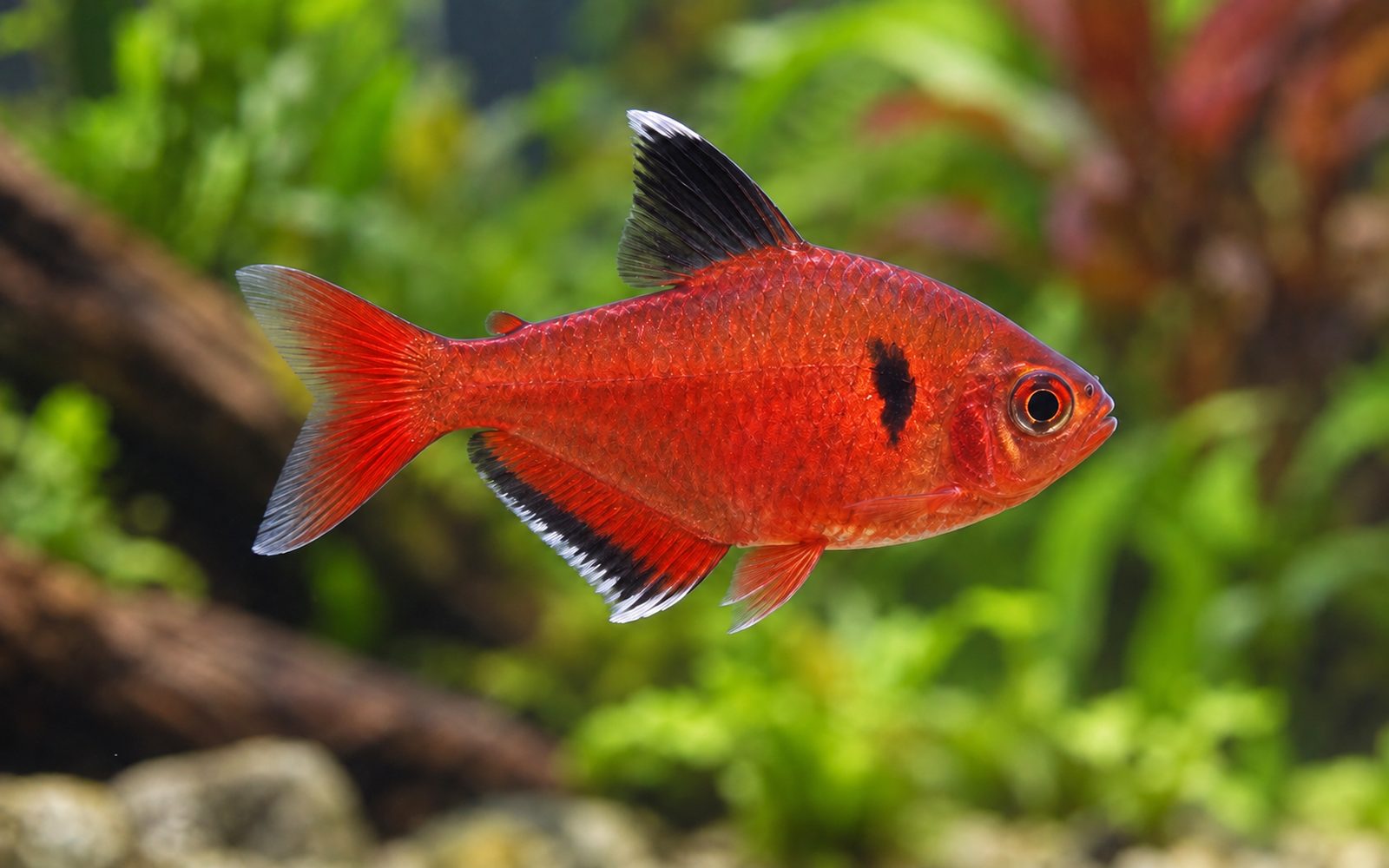
The serpae tetra is recognized by the deep red or orange-red color covering its whole body. Right behind the gill cover there is a small, comma-like black spot; the dorsal fin is black with a white tip, and the edge of the anal fin has black-and-white lines. It has been in the trade for decades, and most of the forms sold under different names are the same species. There is also a long-finned cultivated form.
It is hardy and adapts to a wide range of water values; however, it is one of the most notorious tetras for fin nipping. When kept with the right tankmates and in a large school, this habit largely stays within the school itself.
Natural Habitat
It lives along slow-flowing, planted shores and in floodplain lakes of the southern tributaries of the Amazon and the Guaporé and Paraguay river systems. These waters are usually soft and slightly acidic, with bottoms covered in leaf and root litter.
Tank Setup
- Volume: at least 60 liters for a school of 8–12; a length of 60 cm or more.
- Water: 23–26°C is ideal. pH 6–7.5; soft to moderately hard water. Farm-bred fish also adapt to harder water.
- Decor: densely planted edges, roots and floating plants. Obstacles that break lines of sight spread out the chasing within the school.
- Maintenance: a 25% water change every week; moderate flow is enough.
Diet
Omnivorous with a big appetite. Make quality flakes or small granules the staple and vary it with frozen brine shrimp, bloodworms and daphnia. Foods containing carotenoids (brine shrimp, color-enhancing foods) help keep the red vivid. Feed 1–2 meals a day, only as much as is eaten quickly.
Behavior and Compatibility
An active species whose members constantly chase each other within the school. In small groups this energy turns toward other fish; it nips the fins of slow-swimming and long-finned species in particular. It mostly leaves adult dwarf shrimp alone but eats their young.
Good companions: fast, robust species: other medium-sized tetras, zebra danios, corydoras, Ancistrus, small cichlids such as kribensis.
Avoid: bettas, angelfish, fancy guppies and other long-finned forms, dwarf gouramis, slow-swimming species.
Group and Colony Structure
It is a schooling fish, and at least 8, ideally 12 or more individuals are recommended. In a large school the fish establish a pecking order among themselves and the aggression is spread out within the group; a group of 4–5 is both shy and harasses its tankmates. The sex ratio does not matter.
Breeding
It is an egg-scattering species and can be bred in the aquarium. A separate tank is prepared with soft, slightly acidic water (pH 6–6.5), a temperature of 26–27°C, dim light and fine-leaved plants or a spawning mop. The female releases a large number of eggs among the plants; the parents must be removed right away because they eat the eggs. The fry become free-swimming within a few days; in the first days they are given infusoria, then newly hatched brine shrimp.
Health and Common Problems
- Fin wounds: small wounds may occur from chasing within the school; clean water usually heals them on its own.
- White spot (ich): appears after sudden temperature changes; the temperature should be raised slowly and the fish treated with a suitable medication.
- Color fading: a sign of stress, a small group and a monotonous diet.
Sexing
Males are slimmer and a more intense red; their dorsal fins look deep black. Females have plumper bodies, and the black on their dorsal fin may be paler. Females carrying eggs look distinctly round when viewed from the side.
Tank mates
This list is calculated automatically from the species profile and grows as new species are added to the catalog. Try it in the planner for a definite answer.
Usually compatible
 Blackfin Corydoras
 Polystictus Corydoras
 Emerald Betta
 Emerald Cory
 Porthole Catfish
 Keyhole Cichlid
 Cupid Cichlid
 Buffalohead Cichlid
 Geophagus surinamensis
Should not be kept together






Hobbyist notes
Things you won't find in books, learned by trial and error. The most helpful ones are on top.
Change history and contributors
- Page created · October 16, 2026