
Water parameters
Overview
Nothobranchius furzeri is an annual killifish whose life in the wild fits into a few months. Some lab strains have an average lifespan of only a few months; strains from the wild usually live 6–12 months. Growing and aging in such a short time has made it a favorite model organism for research on aging and embryonic dormancy (diapause).
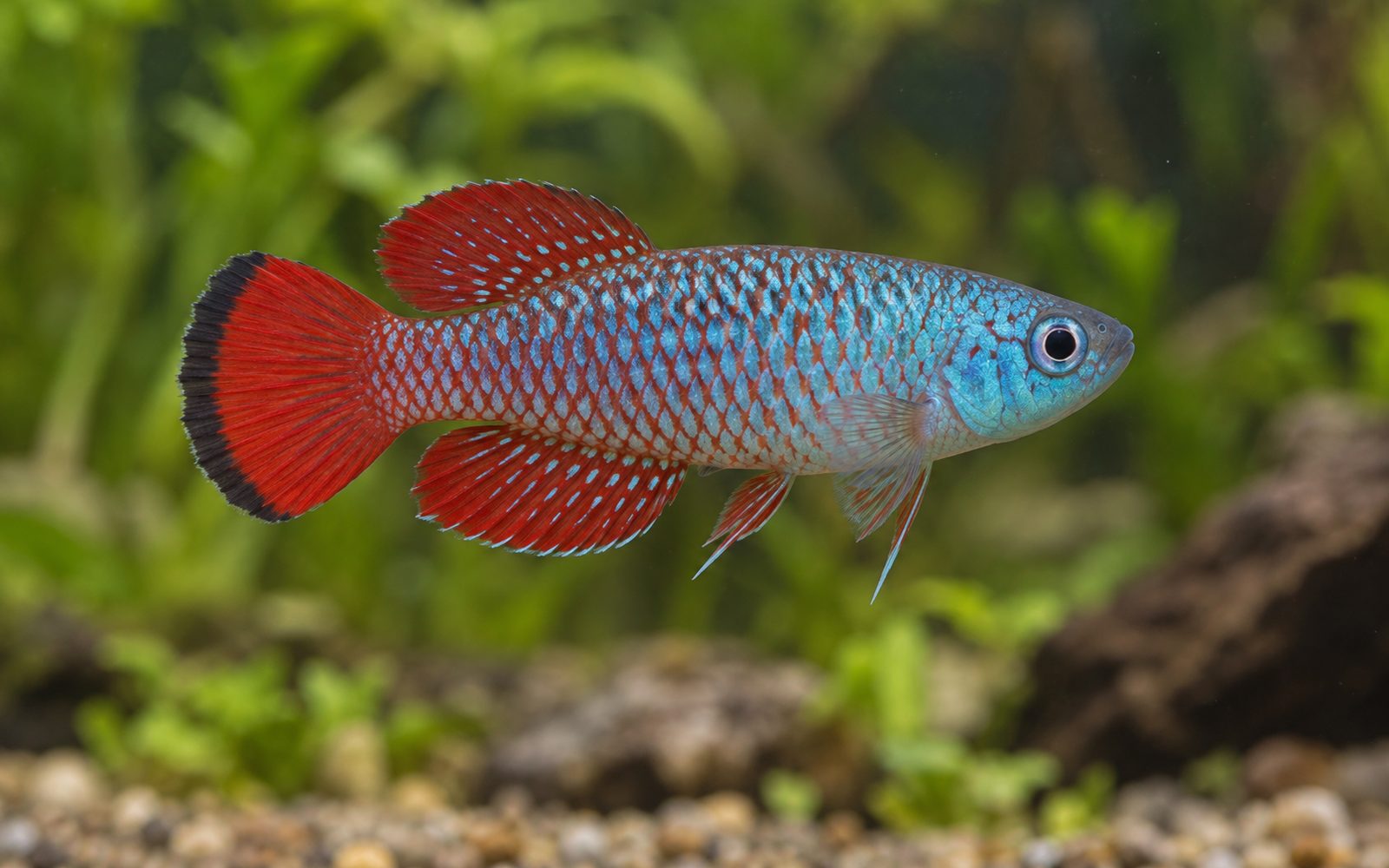
Males occur in two color forms: red-tailed and yellow-tailed. In both, the head and front of the body are turquoise-blue and the scales have dark red edges. Females are plain gray-brown.
Care in the aquarium is similar to other annual species: a short but intense life, plenty of live food and storing the eggs in damp peat.
Natural Habitat
It lives in depressions and pools on semi-arid savannas that hold water for only a few weeks or a few months during the rainy season. The water is shallow and murky, and its temperature varies greatly during the day. When the pool dries out the adults die; the eggs wait in the mud for the next rains.
Tank Setup
- Volume: 40 liters for one male and two to three females; a species tank is recommended.
- Substrate: Bare bottom; a container filled with boiled peat or fine sand for spawning.
- Water: 22–26°C; neutral to slightly alkaline, moderately hard water. An air-driven sponge filter is enough.
- Lid: A tight lid is essential.
- Maintenance: 30–50% water change weekly; it eats a lot and fouls the water quickly.
Diet
Carnivorous, with a very high growth rate. It should be fed two to three times a day with live or frozen foods such as bloodworms, daphnia, mosquito larvae and brine shrimp. Underfeeding juveniles delays both growth and breeding.
Behavior and Compatibility
Males are active and showy; they fight each other and chase females intensely. Because of its short life and special care routine, it should be kept in a species tank, not with other fish.
Good companions: females of its own species.
Avoid: other Nothobranchius species (hybridization), community fish of any kind, large and active species.
Group and Colony Structure
Two to three females per male is ideal. In a small aquarium two males wear each other down. Because of the short lifespan, keepers usually refresh the colony by wetting a new batch of eggs every few months.
Breeding
It reaches maturity very quickly: well-fed individuals can start spawning at 3–5 weeks. The pair dives into the peat or sand and buries its eggs.
- Collecting: The peat is removed every 1–2 weeks, drained and squeezed until it has the consistency of damp soil.
- Storage: It is kept in a labeled zip-lock bag at 22–26°C in the dark. Because the eggs can pause (diapause) at different stages, they do not all mature at the same time.
- Duration: about 1.5–4 months depending on temperature. Eggs with visible dark eyes are ready for wetting.
- Wetting: The peat is placed in cool, soft, shallow water; the fry hatch within hours. Eggs that do not hatch are dried again.
The fry are fed brine shrimp on the first day. A low water level in the first days reduces the number of fry that fail to fill their swim bladder.
Health and Common Problems
- Aging: Within a few months, fading color, weight loss, a hunched back and slowing down appear; this is not a disease but the natural lifespan of the species.
- Velvet (Oodinium): common; light salting in a species tank is a widespread precaution.
- Dirty water and leftover food quickly lead to losses.
Sexing
Males are turquoise and red or turquoise and yellow, with broad, colorful fins. Females are smaller, gray-brown and have transparent fins; sexing is easy from a young age.
Tank mates
This list is calculated automatically from the species profile and grows as new species are added to the catalog. Try it in the planner for a definite answer.
Usually compatible
 Yellow Regal Peacock
Glass Tetra
Yellow Regal Peacock
Glass Tetra
 Emerald Betta
 Emerald Cory
 Porthole Catfish
 Keyhole Cichlid
 Buffalohead Cichlid
 Geophagus surinamensis
 Rainbow Cichlid
 Gymnogeophagus balzanii
Should not be kept together






Hobbyist notes
Things you won't find in books, learned by trial and error. The most helpful ones are on top.
Change history and contributors
- Page created · October 16, 2026