
Water parameters
Overview
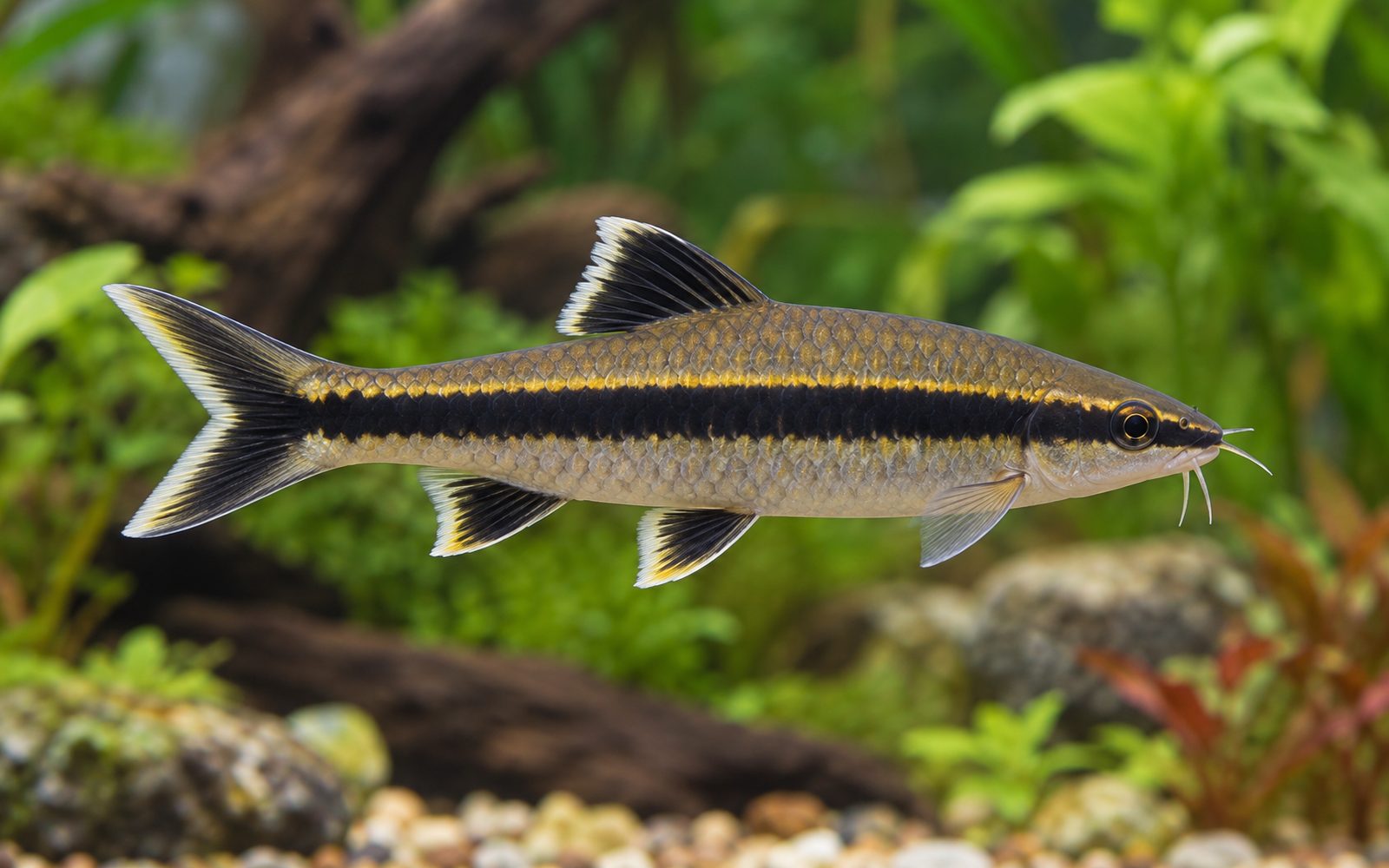
The flying fox is a bottom-dwelling cyprinid endemic to Sumatra and Borneo. Above the smooth-edged black band that runs from its snout to the base of its tail is a thin gold line; the dorsal, pelvic and anal fins are black with light-colored edges. It grazes algae and biofilm from surfaces.
In the trade it is often confused with the Siamese algae eater. The differences between the two matter, because the flying fox is more territorial and its interest in eating algae declines with age. In the flying fox the black band runs to the base of the tail and has smooth edges, there is a gold line above it, the fins are patterned black and white, and there are two pairs of barbels. In the Siamese algae eater the band continues into the tail fin, its upper edge is jagged, the fins are clear and there is a single pair of barbels.
Natural Habitat
It lives in clear, fast-flowing streams on Sumatra and Borneo, over rocky, root-filled bottoms. The water is oxygen-rich and moderately soft.
Tank Setup
- Volume: at least 200 liters and 120 cm in length.
- Water: 23–26°C; clean, oxygenated water and gentle to moderate flow.
- Decor: a bottom divided up by flat stones, roots and plants; broad leaves and rock surfaces for resting.
- Lid: it jumps; a tight lid is needed.
Diet
Omnivorous. It grazes algae and biofilm but is not satisfied with these; provide sinking tablets and granules, spirulina, blanched vegetables and frozen foods (bloodworms, brine shrimp). It is not a reliable solution for black beard algae.
Behavior and Compatibility
Peaceful when young; as it matures it becomes territorial toward its own kind and similar-looking bottom fish. It usually leaves fish swimming in the middle and upper levels alone. It rests propped on its fins on broad leaves or rocks.
Good companions: barbs, danios, rasboras, tetras, gouramis, rainbowfish; bristlenose plecos in a large tank.
Avoid: a second flying fox, similar species such as the red-tailed black shark, rainbow shark and Siamese algae eater; very shy bottom fish.
Group and Colony Structure
In a normal-sized tank it is kept alone. In very large tanks well divided by decor, a group of 5 or more can spread out aggression; but 2–3 individuals fight constantly.
Breeding
Breeding in home aquariums is unknown. The fish sold are wild-caught or farm-bred.
Health and Common Problems
Hardy. Its colors fade in poor water and under stress; white spot may occur. Quarantine new arrivals and, during this time, do not rely on algae alone but feed tablets and vegetables. Fish kept for long periods in low-oxygen, still water become lethargic and stay motionless on the bottom.
Sexing
They cannot be reliably sexed externally. Mature females are generally considered to be plumper.
Tank mates
This list is calculated automatically from the species profile and grows as new species are added to the catalog. Try it in the planner for a definite answer.
Usually compatible
 Emerald Betta
 Festivum
 Firemouth Cichlid
 Buffalohead Cichlid
 Geophagus surinamensis
 Rainbow Cichlid
 Gymnogeophagus balzanii
 Pearl Cichlid
 Blood Parrot
Should not be kept together


Hobbyist notes
Things you won't find in books, learned by trial and error. The most helpful ones are on top.
Change history and contributors
- Page created · October 16, 2026