
Water parameters
Overview
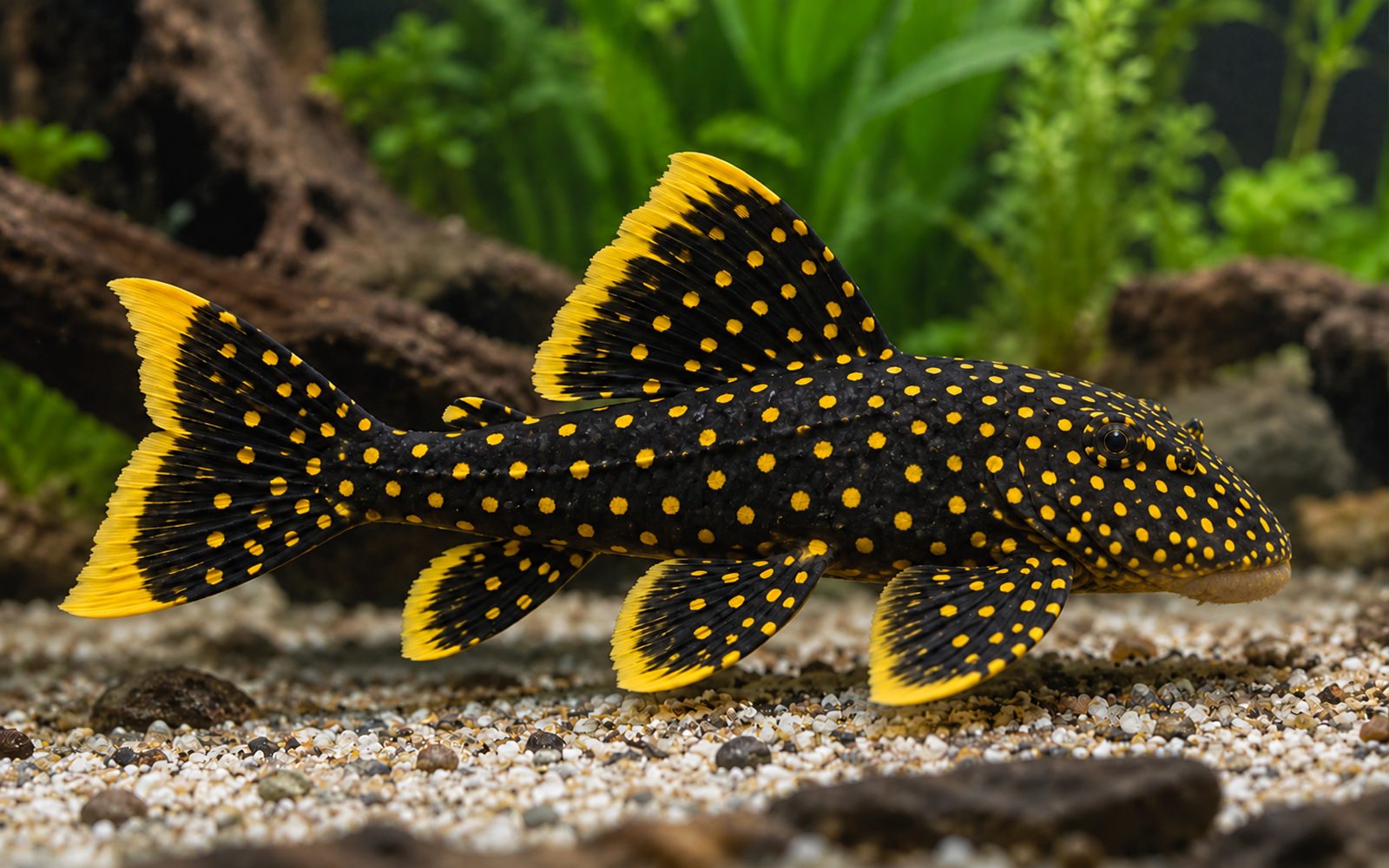
The gold nugget pleco is one of the most sought-after L-number plecos, with bright yellow spots on a black background and yellow edges on its fins. It was sold for a long time under the numbers L018, L085 and L177, and was scientifically described in 2011 as Baryancistrus xanthellus. The similar-looking L081, with smaller spots, is regarded as a separate form.
Juveniles are sold as small 5–6 cm fish; however, it reaches 20–25 cm and becomes territorial. For this reason it is not suitable for small community aquariums.
Natural Habitat
It lives in shallow, fast-flowing, rocky stretches of the main channel in the Volta Grande section of the Xingu; the L177 form comes from the Iriri River. It feeds on algae and biofilm on sunlit rocks; the water is warm and extremely oxygen-rich.
Tank Setup
- Volume: A footprint of 120 × 45 cm (about 300 liters) for one adult.
- Flow and oxygen: A powerful circulation pump and aeration are essential.
- Decor: Flat stones, rock piles and spacious caves; letting light reach the rocks encourages biofilm growth on them.
- Water: 27–29°C, with a 30–40% water change every week.
Diet
Mainly herbivorous; in the wild it grazes algae on rocks and the tiny organisms living in it. In the aquarium, spirulina- and algae-based sinking wafers and granules should be the staple; blanched zucchini and spinach can be added. Protein-rich food such as mysis or bloodworms can be given 1–2 times a week. It does not eat wood.
Behavior and Compatibility
It is generally calm toward other species, but markedly territorial toward its own kind and other plecos sharing a similar habitat. During feeding it may push small bottom dwellers away.
Good companions: Calm, medium-sized fish that like warm water with flow: large tetras, Geophagus species, discus (in a very large aquarium).
Avoid: A second Baryancistrus (in a small aquarium), plecos of similar size, slow and small bottom dwellers.
Group and Colony Structure
In a normal aquarium a single individual should be kept. More than one individual can only be attempted in a very large footprint, with plenty of caves and visual barriers.
Breeding
In the wild it breeds in rock hollows. Breeding in the aquarium has been achieved only very rarely; most individuals on sale are wild-caught.
Health and Common Problems
It is sensitive to low oxygen and dirty water. Bacterial infections and starvation may occur after shipping; watch the belly line of a new individual. Fading of the yellow colors is usually a sign of stress or unsuitable water parameters.
Sexing
Difficult to tell apart externally. Mature males have a wider head and more prominent odontodes on the pectoral fin spines. Females look slightly plumper in the belly when viewed from above; a reliable distinction can only be made in large, mature individuals.
Tank mates
This list is calculated automatically from the species profile and grows as new species are added to the catalog. Try it in the planner for a definite answer.
Usually compatible
 Emerald Betta
 Emerald Cory
 Altum Angelfish
 Keyhole Cichlid
 Firemouth Cichlid
 Cupid Cichlid
 Buffalohead Cichlid
 Chocolate Cichlid
 Discus
Should not be kept together


Hobbyist notes
Things you won't find in books, learned by trial and error. The most helpful ones are on top.
Change history and contributors
- Page created · October 16, 2026