
Water parameters
Overview
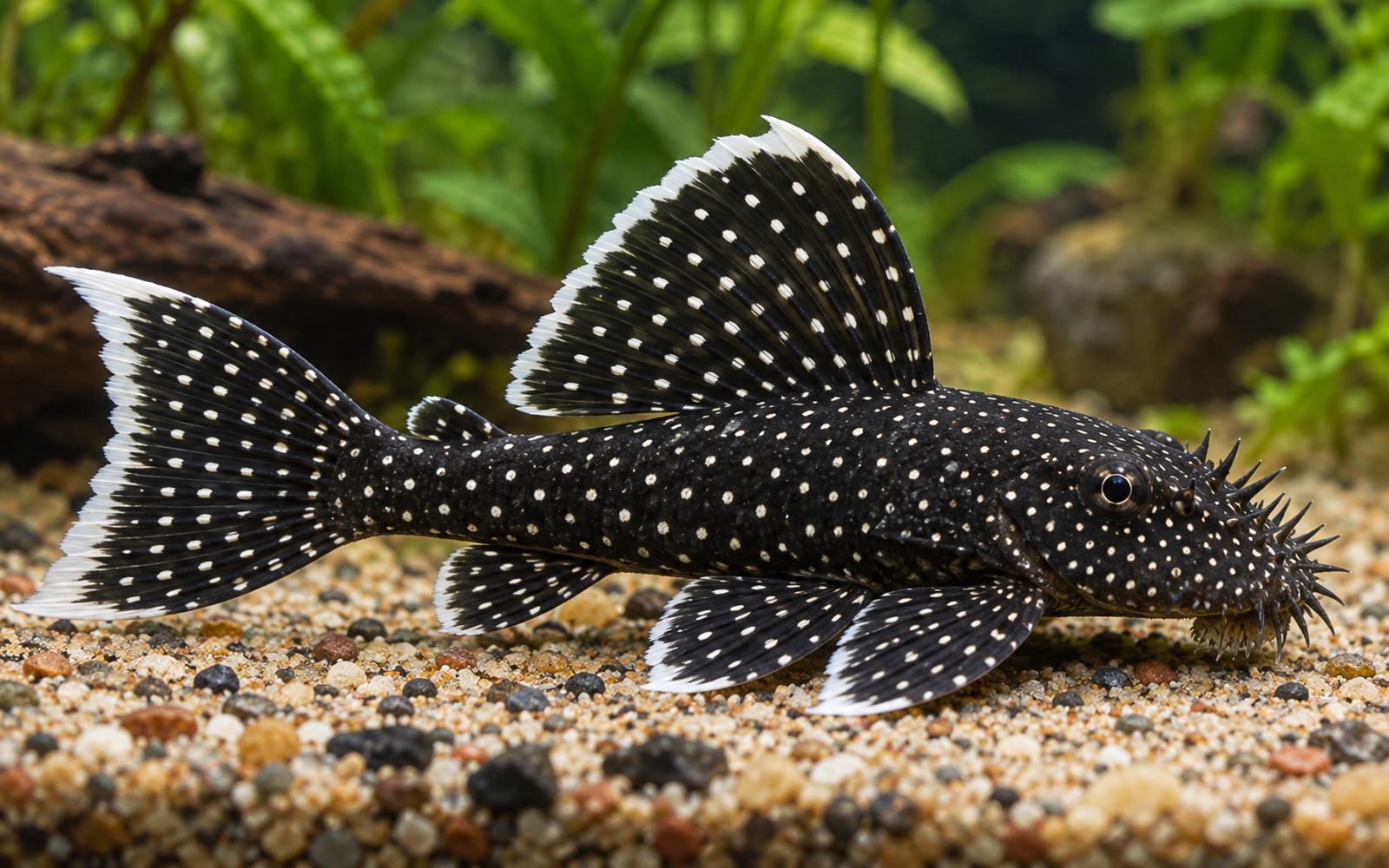
The starlight bristlenose is related to the ordinary bristlenose pleco (common bristlenose) found in stores, but is far more ornate. Its jet-black body is covered in white spots like a night sky; the white margins on the dorsal and tail fins are especially prominent in young fish.
In older books and on store labels the common bristlenose has also been mistakenly called Ancistrus dolichopterus. The true A. dolichopterus comes from the blackwaters of the Rio Negro and needs soft, acidic water; in this respect it is more demanding than the common bristlenose.
Natural Habitat
It lives in the tea-colored, soft and acidic blackwaters of the Rio Negro basin, among fallen trees, roots and rocks. The water is warm and very poor in minerals. The hardness of these waters is very low, and the pH is usually below 6.
Tank Setup
- Volume: 80 liters for one fish; a larger footprint for more than one male.
- Water: Soft, slightly acidic water (below pH 6.5) noticeably improves color and appetite. Dried leaves and roots soften the water naturally.
- Decor: Roots and caves are essential; males claim a cave of their own.
- Flow: Moderate flow, good aeration.
Diet
Mainly herbivorous. Make spirulina and vegetable sinking tablets, blanched zucchini, cucumber, spinach and peas the staple. Bloodworms or mysis can be added once a week. Rasping on roots aids its digestion.
Behavior and Compatibility
Peaceful; it leaves other fish and shrimp alone. It is nocturnal but is also seen during the day once settled. Males chase each other over caves.
Good companions: Blackwater species: cardinal tetras, rummy-nose tetras, apistogramma, discus, corydoras, shrimp.
Avoid: Species that need hard, alkaline water, and large cichlids that claim the bottom.
Group and Colony Structure
It can be kept singly. More than one male should only be kept in a large aquarium with a separate cave for each. For breeding, 1–2 females per male is enough. Females usually do not cause problems among themselves; several females live comfortably in the same tank.
Breeding
Like the common bristlenose it breeds in caves, but it is hard to breed without soft water. The female lays her eggs in the male's cave; the male guards the eggs and fry.
Health and Common Problems
If kept in hard, alkaline water for a long time, its color fades, its appetite drops and it becomes prone to disease. Avoid nitrate buildup and copper-based medications.
Sexing
Mature males have soft, branching tentacles on the snout and around the head, as in the common bristlenose. Females lack these tentacles or have only short ones along the edge of the mouth. Males are also slightly larger with broader heads.
Tank mates
This list is calculated automatically from the species profile and grows as new species are added to the catalog. Try it in the planner for a definite answer.
Usually compatible
 Polystictus Corydoras
 Emerald Betta
 Emerald Cory
 Porthole Catfish
 Keyhole Cichlid
 Cupid Cichlid
 Buffalohead Cichlid
 Geophagus altifrons
 Geophagus surinamensis
Should not be kept together






Hobbyist notes
Things you won't find in books, learned by trial and error. The most helpful ones are on top.
Change history and contributors
- Page created · October 16, 2026