
Water parameters
Overview
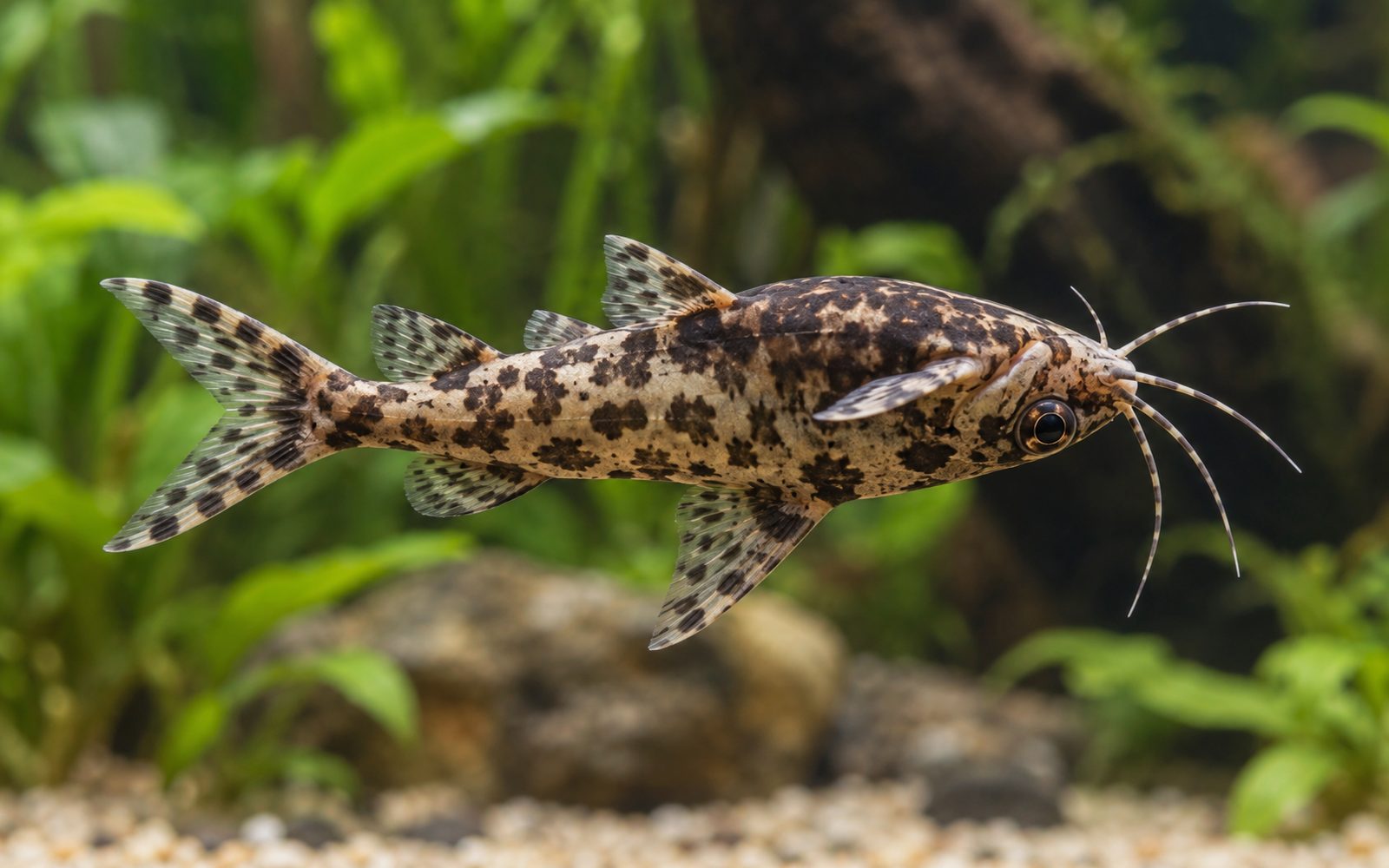
This small Synodontis is known for its habit of swimming upside down: it moves along the undersides of roots, leaves and cave ceilings while inverted, and even picks up food at the surface upside down. Most fish have a pale belly; in this species, however, the belly is darker than the back. Its scientific name means "black belly". This reversed color pattern hides the fish from predators looking both from above and from below while it swims upside down.
It is a charming species with dark brown blotches on a beige background and large eyes. It stays at 8–10 cm and, thanks to its peaceful nature, is one of the few Synodontis suited to community aquariums.
Natural Habitat
It lives in the central Congo River basin, in slow-flowing shoreline waters full of plants and roots. The water in this region is generally soft, slightly acidic and dim because of the forest canopy. The fish spend the day in groups under sunken branches and overhanging plants.
Tank Setup
- Volume: at least 100 liters and 80 cm of length for a group of 4–6.
- Decor: roots it can turn over and rest beneath, broad-leaved plants (Anubias, Echinodorus), caves and hollows.
- Lighting: it likes a dim environment; floating plants increase how often it is seen during the day.
- Water: 23–26°C, pH 6.0–7.5, soft to moderately hard water; clean and well oxygenated.
Diet
Omnivorous. It eats both from the surface and from the bottom: sinking tablets, small granules, flakes, frozen bloodworms, brine shrimp and daphnia. Feeding in the evening, just before or after the lights go out, is most effective. If it lives with fast-eating tankmates, leave part of the food for the night.
Behavior and Compatibility
Extremely peaceful. It hides during the day and becomes active at dusk. When it lives in a group, it can be seen hanging together under roots during the day as well. It can also swim in the normal position and rights itself when taking food from the bottom. It leaves adult fish alone; only newly hatched fry are at risk.
Good companions: tetras, rasboras, peaceful barbs, dwarf cichlids, corydoras, gouramis, Congo tetras.
Avoid: large predators whose mouths it would fit into and aggressive cichlids; species that need very hard, alkaline water.
Group and Colony Structure
It lives in a loose group: at least 4, ideally 6 individuals. Kept alone, it becomes very shy and is rarely seen. The sex ratio does not matter; enough hiding places should be provided for every individual. The group often rests side by side under the same root.
Breeding
It rarely breeds in the aquarium. In reported spawnings the eggs were laid in caves or hollows. An interesting detail: in their first weeks the fry swim normally like other fish; they start swimming upside down when they are a few weeks old. Most of the fish in stores are bred commercially with hormone treatment.
Health and Common Problems
- It is hardy in clean water; nitrate buildup and sharp substrate lead to barbel damage.
- Because of its scaleless skin it is sensitive to copper and strong medications.
- Its pectoral spines can get caught in nets; catch it with a container.
Sexing
Females are larger and plumper. Males have a pointed, prominent genital papilla behind the vent, while in females it is rounded. Males are usually more slender.
Tank mates
This list is calculated automatically from the species profile and grows as new species are added to the catalog. Try it in the planner for a definite answer.
Usually compatible
 Flame Tetra
 Blackfin Corydoras
 Polystictus Corydoras
 Emerald Betta
 Emerald Cory
 Emerald Dwarf Rasbora
 Porthole Catfish
 Keyhole Cichlid
 Geophagus surinamensis
 Cryptocoryne Parva
Should not be kept together






Hobbyist notes
Things you won't find in books, learned by trial and error. The most helpful ones are on top.
Change history and contributors
- Page created · October 16, 2026