
Water parameters
Overview
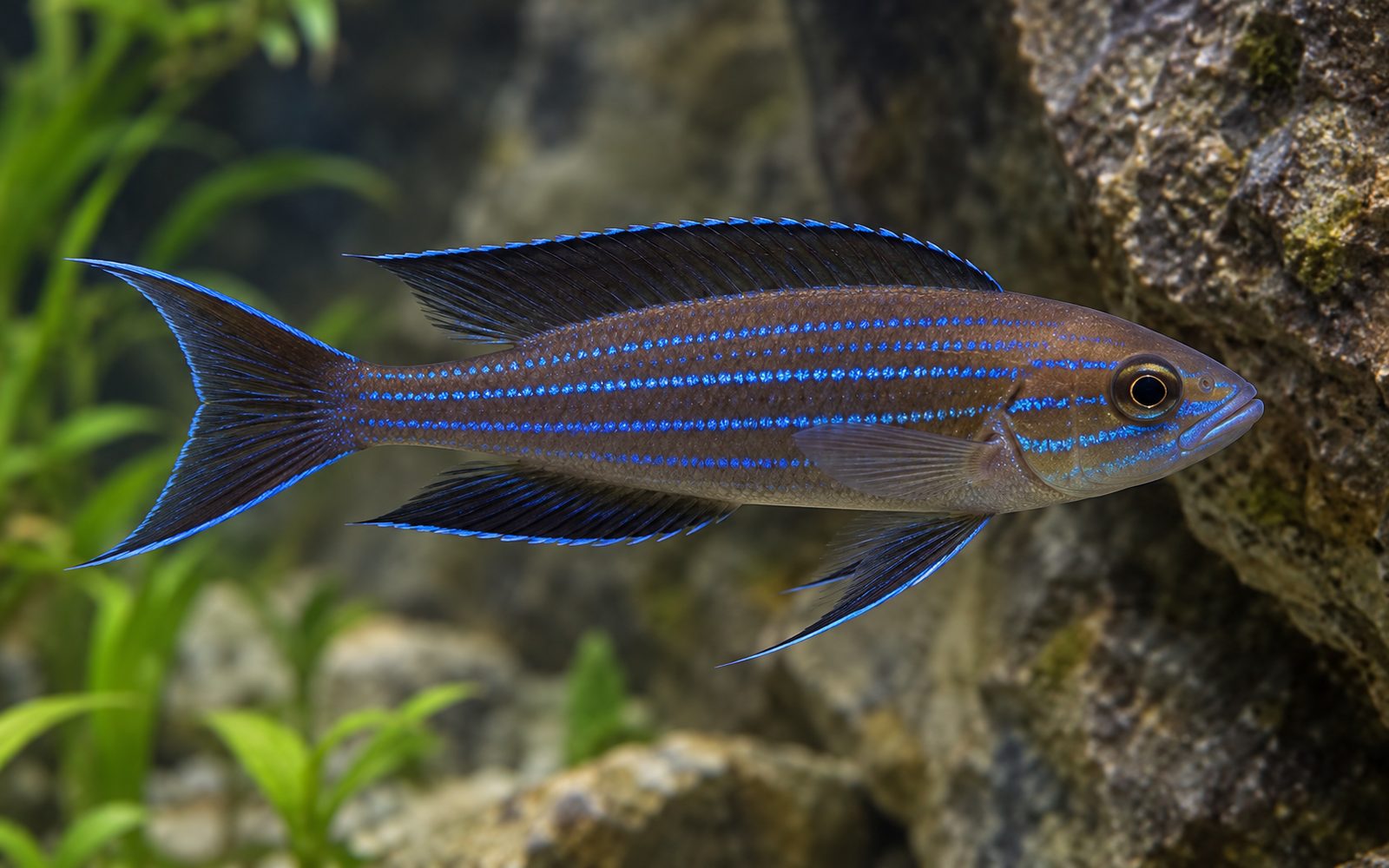
Paracyprichromis nigripinnis is a slender, elongated Tanganyika cichlid resembling Cyprichromis; however, instead of forming large schools in open water, it lives in small groups close to rock walls and cave entrances. Its dark brown–gray body has thin, bright neon-blue horizontal lines; its fins are dark with blue edges. These lines are more pronounced in males.
It is a calm, elegant and somewhat shy fish. Its posture, oriented toward the rocks and sometimes tilted on its side or head-down, sets it apart from ordinary schooling fish.
Natural Habitat
It lives along the lake's rocky shores, right in front of caves formed by large rock blocks and steep rock faces. It holds its body parallel to the rock surface and picks up zooplankton carried by the water. Its natural environment consists of calm areas where the light fades.
Tank Setup
- Volume: at least 150 liters and a length of 100–120 cm for a group of 8–10.
- Layout: tall rock walls, overhangs and cave entrances; open water at the front.
- Lighting: dim or moderate light; it hides under bright light.
- Water: pH 8–9, hard and stable; a 25% water change every week.
- Lid: a lid is recommended, as it may jump when startled.
Diet
A plankton eater. Fine-grained, slow-sinking granules and flake food, plus frozen cyclops, brine shrimp, mysis and daphnia, are suitable. Food should be given in small pieces and small amounts, twice a day.
Behavior and Compatibility
Extremely peaceful. Males display their colors in their own small areas, but serious fights are not seen. In busy, crowded aquariums it withdraws and may miss its food.
Good companions: shell-dwelling cichlids, Julidochromis species, calm sand-dwelling species such as Xenotilapia, Cyprichromis.
Avoid: large fish-eating species, active and aggressive fish such as Tropheus and mbuna, aggressive Neolamprologus species that claim the rocks.
Group and Colony Structure
- Kept in groups of 6–10 individuals.
- The male-to-female ratio should be 1 : 2–3; males set up small territories close to each other in front of the rocks.
- Juveniles can be bought and grown up together; the ratio is adjusted as the males become apparent.
Breeding
The female is a mouthbrooder. Spawning takes place in midwater near the rock wall; the female collects the eggs into her mouth. Only a few eggs are laid and incubation lasts about 3 weeks. The fry are released ready to swim, hide among the rocks and are fed newly hatched brine shrimp.
Health and Common Problems
- Stress: loss of color and food refusal are seen in a crowded, bright or noisy environment.
- Water quality: sensitive to high nitrate and sudden changes.
- Bloat: can occur with coarse food and overfeeding.
Sexing
In males the blue lines are brighter and the fins longer and darker. Females are paler; telling them apart becomes easier when they are seen side by side.
Tank mates
This list is calculated automatically from the species profile and grows as new species are added to the catalog. Try it in the planner for a definite answer.
Usually compatible
 Egyptian Mouthbrooder
Amazon Molly
Egyptian Mouthbrooder
Amazon Molly
 Butterfly Goodeid
Anatolian Killifish
Swamp Guppy
Butterfly Goodeid
Anatolian Killifish
Swamp Guppy
 Horned Nerite Snail
Burdur Killifish
Horned Nerite Snail
Burdur Killifish
 Cyprichromis leptosoma
 Daffodil Cichlid
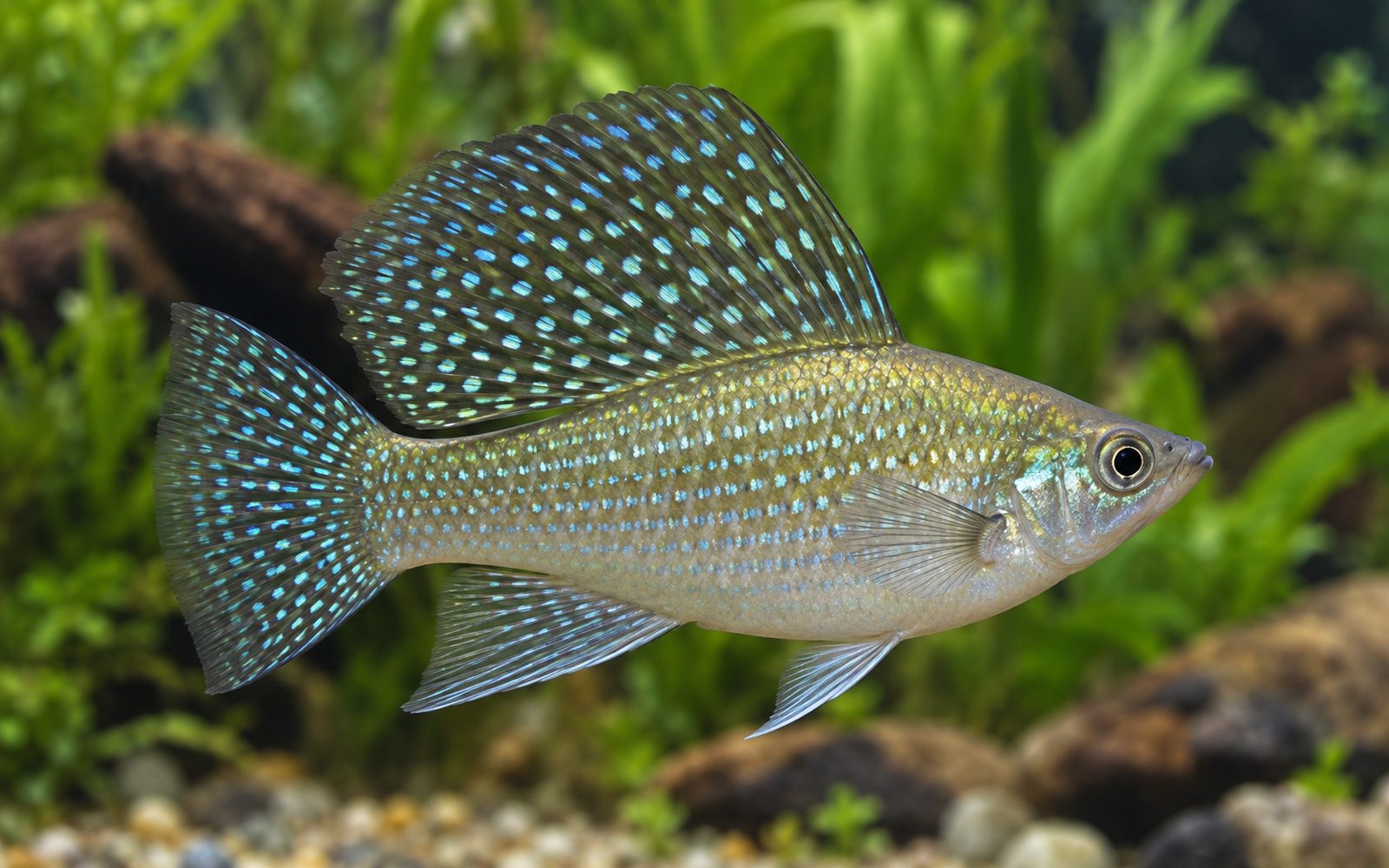 Giant Sailfin Molly
Should not be kept together






Hobbyist notes
Things you won't find in books, learned by trial and error. The most helpful ones are on top.
Change history and contributors
- Page created · October 16, 2026